
Building Small by Design: How to Turn Enterprise Skill into Niche Authority - Stephen Slater

Subscribe to the podcast


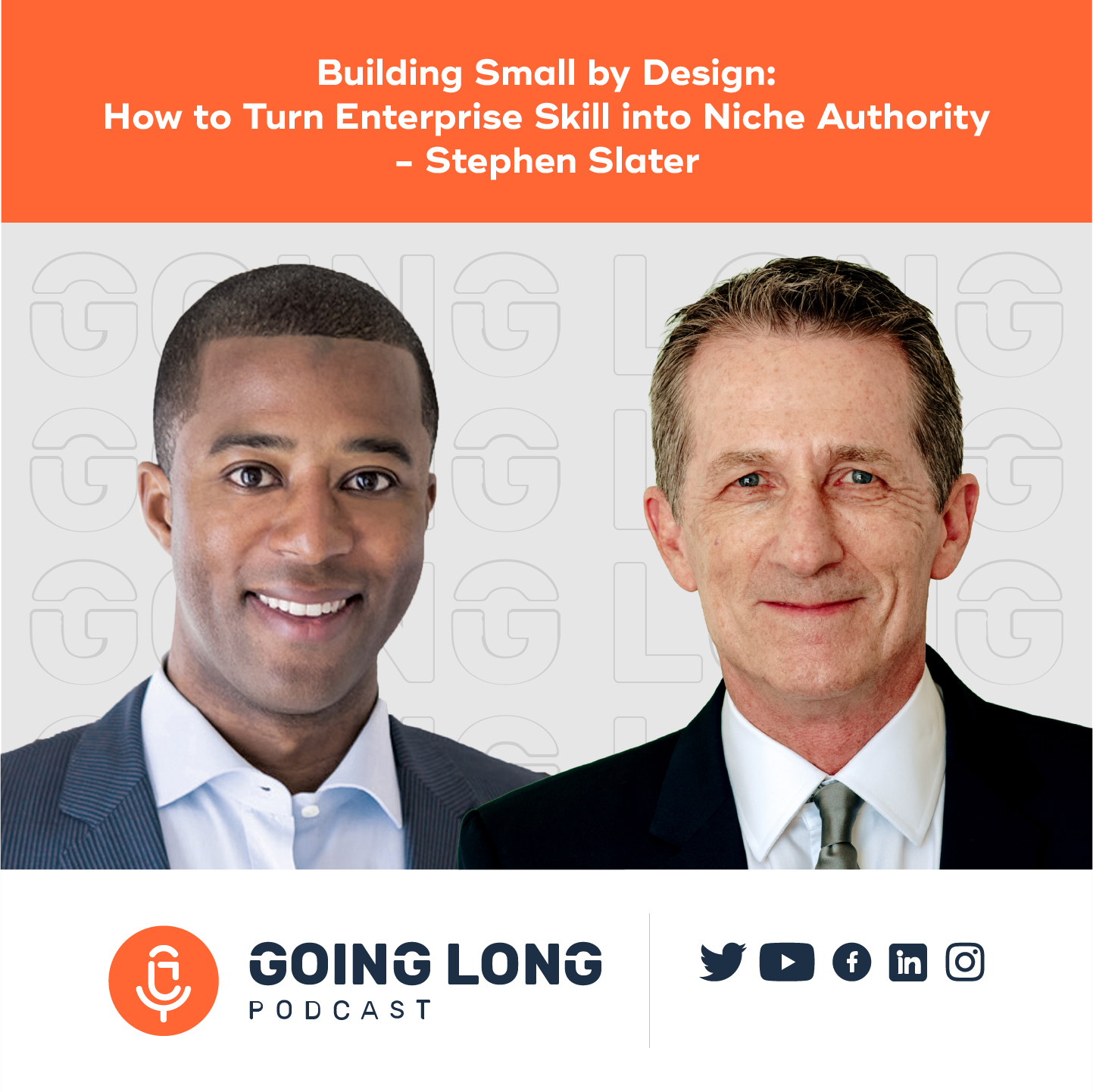
Building Small by Design: How to Turn Enterprise Skill into Niche Authority - Stephen Slater

Are you an overachieving director, VP, or enterprise leader sitting on specialized market knowledge, wondering how to transition your corporate reps into a lifestyle-focused firm that serves you and your family first?
In this transparent guest conversation, host Billy Keels sits down with Stephen Slater—former city planner, Verizon corporate real estate manager, and founder of Blue Croix. Stephen shares his unique trajectory of walking away from a fast-track corporate career right after receiving an employer-funded MBA, relying on raw intuition, naivety, and a clear understanding of his own risk tolerance. Discover how Stephen built a high-margin, low-volume consulting firm by creating specialized cash-flow solutions for major telecommunications giants, why "it's not what you make, it's what you keep," and how to structure a business designed specifically to support your life choices rather than relentless, unnecessary headcount scale.
🚀 Want to make your corporate role optional? Grab your FREE copy of Billy's 3-Step Process eBook here: https://www.makeitoptional.com/?utm_source=youtube&utm_medium=social&utm_campaign=p2olm
📌 Questions Answered in This Episode:
- How do you evaluate your personal propensity for risk before stepping off the corporate fast track?
- What does it look like to build a high-margin, niche consulting business that services enterprise telco giants on your own terms?
- Why is "it's not what you make, it's what you keep" the ultimate financial mantra for independent enterprise consultants?
- How do you leverage your corporate network while maintaining genuine, long-term professional relationships?
- What is the "Protean Corporation" structure, and how does it allow you to scale fluid teams up and down per project?
⏱️ Episode Chapters:
- 00:00 - Broadcast Recording Setup: Thursday, July 30, 2026, with Stephen Slater
- 00:30 - Public to Private Sector: Managing $7 Billion Real Estate Operations
- 02:45 - Walking Off the Fast Track: Risk Tolerance, Intuition, and Partner Support
- 07:15 - Testing the Water: Creating a Cash Flow Model on Vacation Days
- 11:20 - Unfiltered Networking Truths: What Happens to Corporate Relationships When the Title Changes
- 14:05 - Designing a Niche Business: Choosing High Margins over Mass Scale
- 18:10 - Lifestyle Architecture: Building a Business That Serves Your Family and Time
- 22:15 - Recovering Hidden Assets: How Blue Croix Solves Complex Zoning and Permitting
- 26:40 - Corporate Skill Transferability: What You Learn vs. What You Keep
- 30:10 - Fluid Team Building: Leveraging Trusted Vendor Networks Across Decades
- 33:20 - Working Remotely for 25 Years: Selective Project Execution
- 37:15 - The Power of Now: Focusing on What You Have in the Trough
- 40:30 - Connecting with Stephen Slater and Blue Croix
📘 About Billy Keels & Corporate Optionality
If you're a corporate executive who wants to make your role optional, learn how to achieve true control over your career and turn your corporate skills into personal assets.
With 26 years of experience in corporate sales leadership, Billy Keels achieved true optionality through multiple income streams. Today, he has helped dozens of executives build a predictable path to take control of their time and start living their ideal day.
This free ebook gives you everything you need to identify, plan, and take control of your career while building financial optionality, leveraging your skills, and starting to live your IDEAL day - today!
- Get the Free eBook: https://www.makeitoptional.com/?utm_source=youtube&utm_medium=social&utm_campaign=p2olm
- How to Leave a Review for The Going Long Podcast: https://youtu.be/qfRqLVcf8UI
Be sure to connect with Billy:
- Website: https://www.billykeels.com
- YouTube: https://www.youtube.com/@billykeels
- LinkedIn: https://www.linkedin.com/in/billykeels
- Instagram: https://www.instagram.com/billykeels
- Facebook: https://www.facebook.com/BillyKeelsFanPage
- Twitter/X: https://www.twitter.com/billykeels
Episode Transcript
Billy Keels 0:00
The corporate reps and deal making skills you're mastering today are your greatest personal asset. In this episode, former telco executive who was responsible for a $7 billion subsidiary, Stephen Slater, breaks down how he leveraged his corporate enterprise experience to design a high margin niche consulting firm that serves his life and his schedule first. Let's dive in. Let's get you to optionality. Today's episode is sponsored by Billy Keels Advisory Services. If you want to learn more about how to make your 99 optional, just go to makeitoptional.com. Once again, that's make itoptional.com.
Speaker 1 0:39
Helping you build freedom without losing your edge. This is the Going Long podcast with Billy Keels.
Billy Keels 0:51
Your unique skill set and set of corporate experiences are exactly what allow you to carve out your niche in the world and create the life you want. Today's guest exemplifies this statement perfectly. You know, he started his career as a city planner in Santa Ana and Long Beach, where he oversaw zoning projects, redevelopment, and probably one or two other things that he'll tell us about. But eventually, he was appointed by the mayor to the strategic planning task force. Went on for a while, but then he decided, hang on, I'm going to go from public sector to the private sector, and where he was working for a company which today is known as Verizon. I'm sure he'll give us more background on that. But where he was responsible for all leasing purchases as well as sales for this 7 billion-yes, I did say with a B- billion subsidiary. Since then, he's founded Blue Qua, which offers niche consulting services for telcos and organizations needing help navigating the complexities of the permitting and entitlement process. Some of his clients include, you know, companies you may have heard of like AT&T, Chevron, Broadcom, 20th Century Fox, and Cushman and Wakefield. He probably names one or two others, and you know what? He is also a graduate of Miami University. Gives me great pleasure to welcome to today's conversation the founder of Blue Qua, none other than mr. Stephen Slater. Stephen, welcome to the show.
Speaker 2 2:15
Hello, Billy. It's always a pleasure to talk to you.
Billy Keels 2:19
You know what? This is such a long time coming. It makes me happy just to to see your face. So everybody, if you're not watching the video version already, I'm gonna say go jump over to the video version and check out this conversation, as well as you know if you're listening or running on the treadmill, that's cool as well. So, Stephen, I want to get straight to it, man. Are you are you ready for question number one?
Speaker 2 2:41
I am ready for question number one, whatever it may
Billy Keels 2:44
be. Yeah, I kind of think you were born ready, knowing what I know of you. I think you were born ready. So here's the thing: I just want to start from the very beginning, because as you know, there are many people who are in corporate roles. They are senior leaders in in large organizations, and you've worked with one or two and continue to work with them, but I have this thought that there is a reality that every corporate relationship ends right, and everyone has a story. I would love for you to share what was the end of your corporate story, and also I don't want to just leave it there, but also help us understand what what new world did that open for you.
Speaker 2 3:21
My end of the corporate world came in a very unique way-one that I probably wouldn't encourage everyone to consider. I've always been very confident in terms of the audience, in terms of leaving the corporate world. I think there's things you need to know about yourself before you do that. The number one that comes to me is your propensity for risk, so your ability to go out and the other things that are important is your partner, and always don't follow the rules. And when I was in the corporate world, I was younger than much of your audience, I think, and I was on that fast track, and I had got my MBA. The corporation paid for it, and I was the youngest manager in the in the Western region, and I had a department, and I was just a hair under 30, and so I was I was going places, and I'm a big believer in intuition. I started. We can talk more about it, but I started to dabble a little bit and doing some entrepreneurial things on the side that boosted my confidence any even more. And you know, I was at the time. I think I've always been a little naive, and there's beauty in naivety because sometimes you do things that you wouldn't do otherwise. And essentially, and I like I said, I wouldn't recommend this for everybody, but I just walked out the door. I just quit, and worst timing ever. My father, a CPA, almost fell off his chair when I told him because I was on his fast track. You know, and the corporation said, "Yeah, you know, you're going to have to go to other states and move." And we're surfers, we're skiers, we're California people. I don't know if I want to do that, you know. So all of this kind of came to a culmination. And one day, talking with my wife, it just became clear that it was time to do something else. And she said to me, "You know, what do you want to do? And I said, "Well, I've been in government. I've worked for one of the biggest corporations in the world. I got in my MBA. I should be an entrepreneur, and she said, "Well, if you don't go back and quit right now, I'll be disappointed. So that's where your partner comes in. That's where it's important to have a partner if you take a bold step like that. And so I walked out the door when we had just had our first child. We had just bought our first home. We had a California mortgage. My wife at the time was in grad school, so we only had one income, and I didn't have. I wasn't capitalized. I ignored everything I learned in my MBA program. You know, take that for what it's worth, and just walked out the door. And the greatest memory I have of it is my secretary came to me and said, "I know you're going to do well, so I want to make investment in you. And she loaned me money, and that was my first source of capital. Of which, throughout my my life, going out like that, I've been undercapitalized frequently, and I've had to borrow from people, and those are all things you learn with your business skills, and that's how it all started.
Billy Keels 6:29
Well, I love the the way that you help us understand how things got started, and I think it's amazing that your your secretary is one of your very first investors investing in you. But there, I want to make sure that everyone heard what I believe I heard. You mentioned that you had the intuition while you were on the corporate fast track, while you were doing the things that were not even expected of you because you were overachieving, which made you like the the person of the of the year, and people were focusing on. But you said that you had this intuition to try to do something on the side, and then afterwards you said it gave you confidence. Can you go into what you meant by that? I hope it because I did hear you correctly.
Speaker 2 7:12
Yes, yeah. I um, you know, I was in the public sector. I went into the private sector. I got my MBA. I did a lot of financial analysis. I taught myself how to do cash flow modeling, NPVs, IRR modeling on lease deals, and I began to think back to my public sector days. And I'll never forget one of my. I went to one of my bosses at the time, and I said, "These developers, they come in and they tell me that if they don't get more density on this project, it won't pencil out. Well, how do I know if they're telling me the truth? How do I know what pencils out and what doesn't? And he didn't really have a good answer, so I built a cash flow model that looked at an apartment complex, and you could do sensitivity analysis with it and look at different returns based on the density, and I created this, and then I thought I got to share this with planning departments. So, and this was while I was working in the corporate environment. You talk about your optionality and building something on the side. I did it briefly, and I just got started on it, and I thought this is a winner, you know, because we we put out a back in those days, we put out a just a little flyer. We mailed it out to all the planning departments, and we held this seminar finance for planners. 120 people showed up for it and paid a fee, and so I then I started doing these workshops on my days off, going into planning departments and doing two a day on my vacation days, and I thought this is kind of nice, you know. When that check shows up in the mailbox, it's mine, you know, 100% mine. I got to pay tax on it, but you know, it's mine. Yeah, and so that gave me a little bit of of instilled a little confidence in me to to make the move as boldly, perhaps as I did, I don't know if I would do it the same way as you get older, because you're more vested. You know your retirement plan, your whatever, your stock options, all of those things. On the other hand, you know I'm a big believer in avoiding paralysis through analysis, and sometimes when you make a jump, like the Stoics say, you know the obstacle is the path. And sometimes you'll do things when you're back to. I'm I'm always at my best when I'm in a corner. So there, you know, success was the only option. Failure was not an option because I had to pay a mortgage. I had to do you know all these things. So you had to make it work. And I'll tell you, when you walk out the door, it's very easy to get up in the morning. Most of your audience are achievers, so they get up and get to it anyway. But when your back is against the wall like that, you're you're ready to go. The other thing that worked well for me was networking. I was young. I was in that. I was at the corporate headquarters. I was wearing a suit every day. I was drinking the corporate Kool-Aid, but I looked at that building like a library, and I had friends in every single department. I would go to lunch with somebody in strategic planning, somebody in finance, somebody in accounting. I knew people in all the different departments, so I learned as much as I could, and I built my network base big before I left, and that that proved to be very valuable over time.
Billy Keels 10:29
Would you say that that's something that was in terms of? So you really talked about two things: one, being able to do identify a problem, wanting to solve it in your way, or were you wanting to solve a problem where you say that you weren't necessarily trusting what you were hearing, and so you wanted to come up with a solution around the density part? Just before I asked the next question, was it?
Speaker 2 10:50
I just came up with a way to to answer a question that I knew a lot of other people had, and a way to make money, and I saw that I could do that. I didn't leave with that being my business idea. I just kind of, again, being young and naive at the time, I just said, "I'll figure it out. You know, if this is working, I can figure out something else if I need to, and I'm just going to go for it.
Billy Keels 11:13
Yeah, it's it's interesting. I love that. I was talking to a client the other day, and we were talking about his naivete, and I said, "Well, you know, well, that's one of the things that is actually it's a gift. So because you don't know what you don't know, and if you want to curiously explore what that is, then you know go out go out and explore it, which I think is great. But in the second part, you talked about networking. Was that something that you were that you were very intentional about, or was it just because that's a part of your DNA, just to go out and meet people and do different things.
Speaker 2 11:42
It's it's both. It's probably 70% part of my DNA, but I knew there was value to it. And in networking, I'm a big believer in you know when when you leave the corporate world, depending on your role, if you're in sales, it's a little different. But if like I, I was engaging a lot of service providers, and so you have a whole host of people that you have this relationship with, and once you leave the corporate world, that relationship may not be so strong because you're not engaging them anymore. Whoa, whoa, whoa,
Billy Keels 12:11
whoa, whoa! Hang on a second, hang on a second. I don't know if people are running, swimming, whatever. This is something that comes up all the time, Stephen. So I want to make sure whatever you're doing right now, watching, listening, please take out a little pin. Stephen's getting ready to drop platinum on you. So, Stephen, can you please repeat what you just said?
Speaker 2 12:30
Well, and and I gave this counseling to others who left like I did afterwards, and I said, just be prepared. There's a whole lot of people there that maybe you feel like they're a close friend, but the minute that you're not engaging them, you might have a little difficulty finding them. So that's a soft way to to put it, but but that's very real. But my networking, for instance, when I when I networked with at the time the other telephone company, the Pacific Bell AT and T, nobody did that in those days. They were the enemy. You couldn't. But I had lunch every month with my counterpart there, and we exchanged ideas. And so the minute I left, my corporation that I left hired me back to do projects. I went right over to the competitor, and they hired me right away, so I started the business in 1989. Unfortunately, there's only been one month of zero revenue, and that was the first month.
Billy Keels 13:31
Yeah, no, I think that's that's phenomenal. So, in in recognizing that that's part of your DNA, also there was the intentionality of being able to build relationships, focusing on the fact that yes, when you no longer wear the badge of the company that you're working for, there is a high probability-not possibility, but probability-that though many of those relationships, if you're not really working to build them truly, that there's less utility once you are once you're gone. So you talked about just, and I and I love this because you're very intentional about the way you did things, and and being able to share with others who are on this path now. They have that similar curiosity, or that that that intentionality, or maybe their tuition is also saying something similar to yours. But what was so you made the decision? You walked out. The secretary invests in you, but then then what do you do? How do you figure out what exactly it is that you want to be able to solve? What your business is going to be able to solve? You've given us some really high level, but maybe if you could help us understand how you came to the realization of what Blue Qua would actually be doing and who they would, who would you be serving as clients?
Speaker 2 14:40
Yeah, it all it all kind of built off of those first contracts that I got, and those were doing traditional what we call land use entitlements, getting approvals, not not just building permits or those things, but very complex conditional use permits where there's controversy and public opposition and. You have to go in and and do consensus building with the community. So very complex, and so we were billy by hourly, like attorneys, and that's our business model. It always has been, and as we build the projects, some of these projects take years to get completed, and so we started with those basic projects, and then we began to continue to develop really deep niche specialized services as a small business. From our perspective, that's the only way to survive. We never tried to compete with the big guys. We always stayed in our little niche, and that niche began became deeper and deeper with time, and narrower and narrower, and so we created a lot of specialized services that deliver value to the property owner far, far in excess of what our fees are, and that just captured and resonated with our corporate base. And then you know, as you go out. I think an important thing is to have a business plan, a business idea, but that gives you momentum. That takes you direction, which is great. But you got to be ready to turn left and turn right and reinvent yourself. You know, one of the things that I did was I became fascinated by Mexico when when Mexico opened up its markets, and I immersed myself, and I went down into Mexico on my own, on my own nickel. I went to Monterrey, Mexico City, and Guadalajara, and I spent days in each city, and I mapped the cities, and I had had 1200 photographs, and I had meetings, and I did all this on my own. And so, after I did that, you know, I one of my dear, dear friends was the corporate real estate director, vice president of real estate at 20th Century Fox, and I got a call from him one day, and he said, you know, I know you've been going down to Mexico a lot. I know you know what's going on down there. We've got an office. It's in Mexico City. I don't know where it is. I don't speak Spanish. I don't know if we're under market, over market. I don't know anything about it. But the lease terminates in three weeks. You know, can you go down there and take care of it for us? And I said, sure. You know, send me the files on it. And they became a great client doing all their Latin American transactions for many, many, many years. And so that was that was a way of inventing, and I've done that kind of like people like to say today pivot times. And again, it just emphasizes the niche service because we're in a service business, and you stay small. We're small by design.
Billy Keels 17:39
Yeah,
Speaker 2 17:39
you can't. You know, from my perspective, we're not a scalable business.
Billy Keels 17:45
Okay,
Speaker 2 17:45
but what we are is a high margin, lower volume business. And I'm jumping ahead a little bit, but no, you're
Billy Keels 17:54
absolutely not. You're not. But I, I will just, I am going to interrupt you just for a second because it's super important that the going along family understands the clarity with which you're operating, because there's this misnomer that when you build a business, you must build the next biggest, largest behemoth, and I just want the the go along family to really recognize the intentionality of Stephen's focus and the and the actions really saying it doesn't need to be the big thing. The the business and and Stephen, I know I cut you off there, but just it sounds like are you more in the line of the business needs to actually serve you your your life and your clients, or you just have to continue to grow as everybody else tells you to do?
Speaker 2 18:39
Yeah, no, that's that's a good point because, you know, you talk about these guys. They all see Jeff Bezos and they see these million, you know, billionaires, and they all want to. I mean, that's like if you love basketball, that's like thinking you're going to be LeBron James. You know, the the numbers are not on your side. What I always did, and and again, big thing for me is for your audience to listen to people, what people have to say, but figure out what's right for you. There's no greater wrong. You got to do what works for you. What, what? In my case, what I did was I left. I needed to make money to pay my bills. Number one, but number two, the focus was always on living life, and then creating a business that complemented living that life. So I wanted to go to my kids' events. I wanted to be there for them. I want everybody that works in our company to be able to go to their kids' events. So we say, you know, you got work to do. You can do it whenever you want. You can do it in Poughkeepsie, New York. You can do it on the moon. You can do it wherever you want. You can do it at night, but just perform, and that's that's what counts. And so, the business was always designed to complement my life and my family, not necessarily to maximize revenue or to do all these numerical things. Because for me, you know, the the the. The intangible things are always important to value, along with the tangible, you know, the numerical things. Yeah, and I
Billy Keels 20:09
appreciate I appreciate you sharing that. And so, and then the other thing is because I know you like to keep it real, like because you did it, you designed your business that way. Does that mean you've done it perfectly every every time, all the time, or have there been moments where you know exceptionally the business actually needed something or needed your intervention as more of the exception, or have you been that was the rule and it was perfect and you've never broken that rule ever?
Speaker 2 20:34
Nothing's perfect. No, there's times when you know the business took priority. You know, if anybody tells you they they go out and they start a business and everything's great all the time, I don't know if I believe them because that's not how life works. You know, for me, it's been pretty good. I mean, I've been able to. Am I a multi multi? No, you know, but I've been able to do what I want to do. Yeah, and I've been able to have a good income, and I've been able to live my life as I would like. I've been able to travel. I've been skied all over the world. I've done a lot of wonderful, wonderful things. I'm a blessed man. I'm a very functional man. But you know, there was times I bought a very expensive home out of country in, and I paid cash for it in 2007. So as everybody knows, 2007 was not an ideal year to make a big investment. 2008 came, and so you know there's always tricky, difficult times, and that's when you find what you're made of. I mean, I had my dream car in 2009, you know, and and boom, right to Carmax. How much money would we give me for it? Because I had to meet pay, you know. So nothing ever works perfect all the time. But that's that's when you find out what you're made of.
Billy Keels 21:53
Yeah, no, I appreciate you sharing that. And then also too, so you've you've mentioned a couple times, right? And as you're talking about really finding the the niche the as you are are with your business and you're and you're there and you're you're going in that space one one of the things I I talk about a lot especially with clients is like there's this whole concept of specificity builds authority and as you talk about more and more the niches that you are going deep in can you maybe talk to us about because you've made a strategic choice and you followed that up with your actions that you are in that niche? How does that actually help you, your company in terms of the clients that you're serving on one hand, and then potentially how does that maybe work against you as well because you can be seen as potentially so niche.
Speaker 2 22:42
Well, there's enough business within the niche to keep us going. There's more than enough, and so we've never been dry. We've never been enough. I'm never say never, but you know, if we have, it's been for weeks or short time periods, which we looked at as an opportunity to go skiing, go on a little trips. But I mean, an example to say when you know it's hard. My business is very specialized, but an example is when the telcos converted from mechanical to digital systems. It opened up a lot of vacant space in their buildings, so we created this way that we could go in and modify zoning, and they could sell their parking lots because they no longer they didn't have employees going into the buildings because they were now digital systems, and a sample building could go from 80 employees down to five, and so they had these huge parking lots for all those employees that they no longer needed, but the zoning code didn't allow them to sell those parking lots. So what we we came up with a way, and this has been going for over 20 years now. We came up for a way to modify the zoning so they could sell those properties and generate additional revenue that went straight to the bottom line of the corporation, so the projects we were doing became profit projects and not coming out of a cost center as an expense item. And all of our fees-this will resonate with your C C F O S and those guys-all of our fees came out of the sale transaction, like a broker's fee. But we're not brokers. We don't, you know, we we're service providers who pay, we charge by the hour. So these kind of properties, you know, the ones that are in Marina del Rey, Santa Monica, you know, New York City, you know, those things are high valued assets, and so we were able to create the system whereby we were generating big revenue numbers. We still are to the telcos, and it took very, very precise. And there's there's a lot to it more than beyond this this podcast. But you know that's really the niche that served us well, among another a number of others. But that's. Big one. We've even condominiumized buildings in high-value areas where the telcos are able to sell certain floors of a building as condominiums and generate significant revenue that goes right to the bottom line for the corporation.
Billy Keels 25:18
Excellent. So then, basically, when you are you know blue coil? As you are working with these large corporations, you're able to help them identify really top line growth opportunities. If if I'm understanding you correctly, right?
Speaker 2 25:31
Yeah, it's really it's really recovering of assets that are no longer required for operations, but in their current condition, they're not conveyable. In their current condition, they cannot be sold, and so we go in and and do all the mechanics associated with all the things we learned as city planners to enable a transaction to happen where one cannot happen today. Yeah, well,
Billy Keels 26:00
so I guess what what I want to what I draw on because I think this is what's important for the going along family. As I'm listening to you and I hear the early days of you in city planning or the special task force that I talked about, and then you're in the the from the public sector to the private sector, you have relationships, you have understanding of a specific industry, you are then curious, and you have this intuition to want to go out and solve some some different problems. So, and and this is also one of the areas where I see people that want to start a business on the side, for instance, to really understand like there's a lot of skill sets that you're currently using in your corporate role, and that you get lots and lots of reps on. So maybe could you talk to us about what your experience has been in terms of being able to leverage skills and just your natural? You're talking about 70% DNA before, so that you can start to recognize that in the corporate environment, and also recognize well if you have that intuition that Stephen's talking about, you can even build something on the side. Can you talk to that a little bit?
Speaker 2 27:04
Yeah, you know, interestingly, I began to say that's all true within that corporate environment. You're developing skill sets that are transferable into the open market. My personal experience was kind of the opposite of that. I was beginning to see, you know, budgeting systems that were specific to the corporation, policies that were specific to that corporation, and I began to think, you know, I'm getting a lot of transferable skills, but I'm also spending a lot of time on skills that may not be transferable, and that accelerated my my movement. But in terms of networking with people in finance, with all of this getting the MBA, all that, you know, when you leave, when you start your own business, it's not what you make; it's what you keep. And so I'm
Billy Keels 27:51
going to say that again because that was like music to my ears. It's not what you make; it's what you keep. This has been one of my life mantras forever, and I love that you said that. Sorry that I interrupted you again, but please continue.
Speaker 2 28:02
Very entrepreneurial accountant, and he set up my book system, and you know the ways you do loans internally and how you do your corporate structure. I mean, the perfect example is everybody today wants to do an LLC. You know, I'm not quite sure why. I mean, but other than it's easy, but there's things like I'm a C corp. There's things that you can do with a C corp. It takes more, you know. You got to keep board minutes. You got to do all those things. So there's more administrative, and also you know everybody says there's double taxation on dividends, but but and there is. But you know there's ways to work with those, and so in terms of skills that I got in the corporate world, those really helped me out. The MBA, as it's because again, as we said, it's not what you make; it's what you what you
Billy Keels 28:50
keep. Yeah, for sure. Hey, by the way, as as the go along family is listening, please know that as Stephen is talking about these kind of tax concepts, he's sharing them simply for an educational purpose, he is not giving anybody any advice to do any of that kind of stuff. Just to keep everything super clear, you know, go talk to your tax professional, and they can give you new ideas as well. So
Speaker 2 29:14
explain, Billy.
Billy Keels 29:15
Yeah, yeah, yeah. I've done this once or twice. The
Speaker 2 29:17
message is just you know do your homework on those things because there's a lot of benefit for you in your legal structure and your accounting approach and all of those things. So yeah,
Billy Keels 29:28
and this is one of the things when you have that intuition and you begin to explore the the businesses on the side and things like that, you you start to realize that there are many options. There are many yeah, there are many options in life to be able to not just generate more, keep more, and do it in a way where you also can own more of your time. You've also mentioned a couple of different things. I want to. I know that also too early on, team sport something that was really important for you as a big part of of your life as well. And I know even through college. Maybe talk to us about how team or collective sport has served you, whether it was in your public or private sector roles, or even nowadays, and as the as as the head of Duquan.
Speaker 2 30:15
I was always one of those guys. You know, I was an entrepreneur from day one. I had a paper route. You know, I was growing up in Cleveland, delivering papers fourth grade at 430 in the morning, seven days a week. You know, I went. I was captain of my high school football team. I was captain of my college rugby team. All of those things were great in terms of team building. So one of the things that Blue Croy does, Blacquard does, is that we have a job and we team up when we finish the job we team down so we're able to put together these fluid teams very quickly with trusted vendors we we you know I have vendors I've worked with for 25 years we do things, you know. Legal doesn't like this, but we do things on an email. You know, I I have a associate in Argentina, Alicia, that's done huge projects for me with Fox and Mattel in Chile and in Argentina, and I met her downtown at City Hall at a plan. We were both standing in line for a plan check meeting, and I met her 25 years ago, and we still do work together, just meeting like that. So that you know that ties into the to the team thing. The other is, and I mentioned this to you. I don't know if you did your homework and Googled it, but Protein Corporation
Billy Keels 31:40
is
Speaker 2 31:41
basically how Blue Croy is structured, and I didn't go out and say protein corporation. That's great. I'm going to structure business that way. I just did it, and then came across the term and found out that's what we do, you know. And and the other thing I find I'm a little older, you know. The other thing I've found out that you know there's this mantra to you know buy, borrow, and die. I don't know if you've heard that.
Billy Keels 32:07
Yeah, yeah, yeah, yeah. Very familiar with it.
Speaker 2 32:09
You know, I've didn't didn't have that as a concept, but I found that I'm doing that. And so, just trust yourself. If you you all of your audience has great skills, you just figure out how to package those skills. Your your question on the team thing-it's always served me well, and I think that's a big part of how I'm able to network and talk to people very easily. I can go in and start a conversation with anybody, and times that's not my family's not real happy with that.
Billy Keels 32:40
You've never met. You've never met a stranger. Yeah, you've never met a stranger. But it is important, right? And and also too, because there's a lot of high achievers, and and a lot of times in corporate, when you're a high achiever, you tend to do things on your own. Your way is the best way, et cetera, et cetera. And you will find those that move highest up the ladder recognize the importance of teamwork, because ultimately teamwork does make the dream work, and whether that's inside the corporation or when you leave the corporation, it is a matter of being being able to recognize those different areas of your life. Whether it's health, whether it is wealth, and it's setting up you know a state, or it is a matter of the business structure. All of these things, you can't know everything, so it's a matter of being able to surround yourself with those people that can help complement and get you to your dream state sooner.
Speaker 2 33:27
It's even beyond that because, and I told my kids always this: that you want to stay close to the people that are good with you, the people that have reciprocity with, the people that want to see you do well. There's a whole nother set of people that you know. Misery loves company, and there's another set of people that sometimes you want to maybe make a little distance between you. Leave that.
Billy Keels 33:52
Yeah. No, I love that. It's it's great. And you know, you mentioned something earlier, and I know this about you. I know this also too. You talk about you know keeping people close to you. You talked earlier about you had this desire to know more, and you'd flown. You flew down to Mexico, and you talked a little bit about Latin America. And I know you were talking about traveling and skiing and all these different things. I've lived in Europe now for 25 years. I've done a lot of travel. Been very fortunate, and traveled to to 91 different countries at this point in life. And because you're talking so much about travel, I'm always curious. Like, how has travel influenced or influenced your life in in the way that you maybe view the world, or the way that you interact with people and things like that?
Speaker 2 34:40
You know, I just got back from Japan and Korea, and if those in your audience that haven't been there, I would highly encourage you to do it because it's a real eye opener, you know. And it and it makes it me it for me personally. I mean, it. I think carefully when I go there and when I come back. Because their ability to live their lives with nature, the cleanliness, the etiquette, the honor, integrity, the technology they have-it's very inspiring. Japan and Korea, in particular, are very, very unique, and I always come away from those countries with, you know, my wife and I. We love history. We read books about the cities. We're urban people, so we like to go stay in Tokyo and Osaka and in Vienna and you know the Berlin, the cities, and just really hang out and check them out. And it's it's inspiring, and it gives you new ways to look at things. It gives you new ideas. You see how things are being done differently. It's it's very healthy.
Billy Keels 35:50
Yeah, I love that. And maybe you you mentioned Berlin. Maybe we can get Barcelona on your on your on your travel schedule at some point in time. We'll we'll talk about that afterward. Yeah, it's
Speaker 2 36:01
happening next year.
Billy Keels 36:03
Awesome, awesome, awesome. Listen, because you you've come back to this thing of, you know, you you did public sector, you did private sector, you were in your corporation, you also sat down with others that people would see maybe as as competitors, and then today, you're you're it feels to me like you're still in this environment, but you're just doing it from a different perspective. Can can you maybe talk about that? Because there's also there's the point of now. I'll just let you talk about if you if there's anything you want to comment on on that would be great.
Speaker 2 36:37
No, that's a good subject, and I had that to bring up with you as aging and maturing, and I'm perhaps a little older than some of your audience. But you know, I've always been able to think in terms of decades, which is what the Japanese do, and kind of visualize these decades in your life, and where do you want to be, and how do you get there? Not not overly looking at it, but just kind of being open to that concept. And at my at my point now the business has done very well in terms of retirement I I don't know what that word means I don't
Billy Keels 37:09
I was gonna say man that's never gonna happen to you and your and I'll say this all the time your sense of contribution is way too high to ever retire so sorry to interrupt once again but keep going stream of consciousness go go right ahead.
Speaker 2 37:21
But what happens when you build your you know your optionality, your new career, your new side thing that leads to improvement in your quality of life, whatever that may be? At this point, you the the ideal for me is you get to the point where you're working on projects you want to work on. You're working with people that you want to be around, that you want to, and you're not working on projects that you don't want to work on. You're not working with people you don't want to work with, and that's kind of as you get older, that's the ideal thing, and you continue to go on, but you're selective on, and you have the ability, you know, you have the financial resources or whatever it is to do that, to be selective, and and then you get to even build in more of that quality of life, more of that travel. And I I've been working remotely for 25 years, so I always laugh when someone far younger than me, you know, says, "Hey, can we? You want to go to our our seminar on how to work remotely? And I said, "You know, I was working remotely when you had to dial in by a telephone line and the dong, the dong, the dong. You heard that, and and I remember when the fax was our greatest gift to productivity. So you know, I mean, you can. We've been working remotely a long, long time, and that's been that's been a blessing.
Billy Keels 38:51
Yeah. No, I in. I think it's fantastic when you're able to do that. I remember having a conversation with someone not long ago, a couple years ago, on the other side of of the the global lockdown, and it was making this comment about, yeah, we just started doing remote, and I was like, well, and I've been doing that since 2014, 2015. It's kind of like it's not a new thing. So I appreciate you, I appreciate you touching touching base with that. Was it challenging for you, Stephen, to to leave corporate world, realize that you found this niche. You've also you kind of found your north star. You weren't haven't been afraid to to pivot, as you say. I like to say that you're adjusting to like the current reality. But I know there's some like there's some people that are like, man, I'm gonna leave and I'm gonna completely not do corp or they don't even think that they can work with big corporate clients, and because you're here and you've been doing it for quite a while, like I'm kind of interested in extracting more from from that and how challenging or difficult it was for you. You have your skill set, you have your experience, you have those things, but just once again, as a proof of concept for somebody who's out there.
Speaker 2 40:00
No, the the transfer was very. I don't want to say easy because nothing's easy, but but it was not difficult. And so, for me, being in a corporate environment and leaving that, most of my clients, most of my client base, are corporate people, and so I'm still very connected to that corporate world, we operate in that corporate world all the time. But we operate in the corporate world from a place that we want to be in. We're not we're not in it, if you will, but we're working with it, but on our own terms to a certain. What would you say?
Billy Keels 40:36
What would you would you say is the biggest benefit that you because you're still working so close to it, but not in it. For for you, what's the biggest benefit?
Speaker 2 40:46
The the biggest benefit is understanding how they work, their decision making processes, their budget systems, their all of that, and how to meander through that to get a project done. The various levels of approval, seeking concurrence from different departments. We've gotten very good at those kind of things, and that further strengthens our niche. That within the corporate environment, we know we have to get concurrence from these five departments on this property, and we do that with direct interface within the corporation. And the clients are very comfortable with that, and that further gives us a niche that makes us stronger, gives us comparative advantage against who might be viewed as our competitors.
Billy Keels 41:33
Yeah. Okay. Well, I appreciate that, and you know, say again.
Speaker 2 41:38
Did that make sense?
Billy Keels 41:40
It made sense to me, and I guess the the audience is going to let us know if it made sense to them as well. But yeah, no, it it definitely does, and you're you're able to have, you know, you understand how to navigate within the the constructs of of corporate, um, and whether it's five departments, eight departments, or whatever. And because you have been working with them for such a long time, and also too, one of the things that I would say that you also alluded to, but not said directly, but because you have a track record, you've done it a number of times, and so, but you have to start somewhere. And so, for that person who's thinking, "Yeah, Billy, but Stephen and his team-they've already done it a lot of times. Well, they had to start somewhere. You you didn't just leave with a client already. You you had to start and earn your first client, right? I think you even said you had no revenue the first month.
Speaker 2 42:24
First month, yeah. It's only one month out of 35 years. That's not too bad. How many months is that?
Billy Keels 42:31
How many months? No, I'm not going to do the math.
Speaker 2 42:33
One thing that just one quick thing about the corporate environment that many people may not realize, and and your audience that's in a corporation understands this, but as a service provider, as a small business, for us, when we say you know Verizon AT and T is a client within those huge corporations, there's multiple departments, and so you can you can have within one company you can have 20 clients within that company, and you're working for different departments and different areas and different divisions, and so it's not like it's one client.
Billy Keels 43:11
Yeah, no, I appreciate you also highlighting that. And so, you know, we've talked about, or I mentioned at the top some of the different clients, but is there anything that I haven't asked you maybe about who you either your your corporate experience to how you're now leveraging that or specifically who Blue Cross is is serving. That would be useful for the for the Guan Long family to understand.
Speaker 2 43:35
We we serve a the corporate client base, but then we also serve a lot of boutique, not a lot, several boutique developers. We to expand on the niche. We now do work for the title companies when they have a title claim, and there's some zoning matter that's resulted in a claim. Something wasn't didn't show up in the insurance policies. We come in as a problem solver to try to find a way to fix that. So a lot of our work now has gone to, hey, I have this issue. Can you guys take care of it and figure it out for us? Which those kind of projects where we talked about being selective on what you work on and what you don't work on, those projects are great because you got to put brain power on them. They're not easy, and you know. So we've now evolved more into things that are like that, that are very difficult, that are hard to find a solution. But you know, we're solution finders. We're not. You know, some people bring up problems. We we look for solutions. We're very positive in that, and that's that further strengthens our niche.
Billy Keels 44:48
Love it, and because it aligns with what you want to do already, it you know you are as you said before. It's because you're doing these types of roles because they're things, they're opportunities that you and your. Team want to solve and it aligns with the way that the business is going to serve you and serve your clients.
Speaker 2 45:06
We get a lot of requests from people that come in and they just say, "You know, I have this issue. Is this something you guys can help me with? And generally, we say yes, and then we feed as we go. So, all
Billy Keels 45:21
right. Well, it sounds like well, I mean, we have a lot of people who are listening here, so maybe they'll reach out to you in a little bit. But before I do that, unless there were any other comments, there's just that I do kind of have one last question for you, and the question for you has to do with something that I learned not too long ago, because some people would say I'm a classic high achiever and went to school, got the good grades, and got a good job, and I was enjoying my corporate life for 26 years, and it was it was a lot of like from the left up and to the right, left and up and to the right, and doing things in the right way. Well, not long ago, a couple years ago, I had two major events in my life that changed things. Well, and that changed my personal life.
Speaker 2 46:11
Yeah,
Billy Keels 46:12
changed drastically, and my professional life changed drastically. One going through divorce, the other going through working with a business Situation, right? And so, during that moment in time, Stephen, it was a really, really challenging moment for me because one, I always thought everything went up and to the right, like because that's just generally speaking what always happened. But I realized that that was the first time in my life as someone who is a solution giver, right, solving other problems, and people came to me, and it was like, oh, this is the first time in my life that, generally speaking, now I needed other people's insight and help. But no matter what anybody was saying to me, I realized something really important in that moment. It was happening for me. Like felt like it was happening to me, but I realized now it was happening for me. It's that everything is just a moment, right? Because when I was like achieving and everything was going well, like I wasn't paying attention because it was just like it was just the norm, and then when things were going bad or going not according to plan, it felt like it was going forever. Like I just couldn't get out of it. But the reality is, it was just another moment. They're all just moments, right? And more importantly, I realized that things didn't start to change here until I literally made a statement to myself, I remember looking in the mirror, and I said something to myself, and that's the moment then that things started changing. No matter what everybody else was saying, giving me all the positive things and da da da. And so, you've experienced lots of really great moments. You've also experienced lots of moments that were kind of like in the bottom of the trough, but I want you to imagine, Stephen. You're going three years from now, and a lot of great things are going to happen. And there's going to be some things that are not supposed to go according to plan. But you know that there's going to be a moment where you have to say something to yourself in order for things to change. And so I want you to just take a second and say, "Hey, look, I'm going to look back three years from now, and when you're in that low moment, that moment that's going to be there, what's the one thing that you know you need to say to yourself that you will share with us here that you know is going to help you go from where you are to up and to the right? What's that one thing that you want to share with us? That one sentence or that one phrase you want to share?
Speaker 2 48:20
I'm a big believer in Eckhart Tolle's power of now, focusing moment. You know, but I think the thing, the one thing, one of I have many things I like a lot of sayings, so small sayings. But one of them is in those moments, and we all have them, no matter what. I've had many great things happen to me. I've had some that weren't so great deaths and and you know things that happen with life. But what always has worked for me is to focus on what I have, not what I don't, and what's right and what's going well and what and you know and compartmentalizing at times so you can continue on to do what you need to do. But you know, there's always light at the end of the tunnel, no matter what. If you persevere and you have persistence and you just keep going, I mean, you'll get to a better place, no matter what.
Billy Keels 49:13
I love it. So focus on what you have, and we'll keep it the focus on what you have and focusing on what you have now. So, Man, Stephen, like literally every single time I finish this and I say the same thing, I sound like a broken record. I'm like these conversations just literally fly by, and I'm thinking at the very beginning of the conversation, you're talking about like this propensity for risk and really understanding kind of what's happening in in your life, and then we get from there to you're starting in your in your corporate career and things are going well, and you're recognized really early on to be on the fast track, and so everybody has you kind of going and going and where you're supposed to be going, and you realize at a certain point that you had this experience both in the public sector and the private sector, but you just wanted to be present around the things that were important and. Option that you chose was to say, "Hey, you know what? I think it's time for me to exit stage left. And so, as you exited the corporate life, you previously you had this intuition, and the intuition led you to actually create a cash flow model, and you actually went out there, which I think is amazing. You go out and you actually invite people to an event, and they're paying you, and you're like, "Oh my gosh, this is something that I can potentially do later on, and so as you exit the corporation, you realize that hey, there's this lifestyle that I want to build. I had a secretary who invested in me and is ready to do that, and so I'm going to go out and just be a little naive, create my own company, and start to solve a lot of the problems that you were seeing that weren't being solved, and you did it in your own way, or with people that you had relationships before, because you were very intentional about that. Even sat down with people who were quote unquote competitors, and through that, you've been able to continue to expand your horizons globally. You've carved your niche, which is or your your niche. You've carved your niche, and being able to serve those clients at the same time, you have allowed yourself to adjust along the way so that you can continue to have the the business that supports you, the lifestyle, your family, and your employees, and you're keeping customers and clients that are very very happy. And I know a lot of people are thinking to themselves, "Well, Billy, I want to find out more about what Stephen's doing, and I want to find out more about what's happening at Blue Qua, so just ask him the question. So I'm just going to ask you the question, Stephen. What's the best way for the Go Along family to find out more about you? Find out more about what you have going on at Blue Qua, and how can we enter into your world, man? Give us the way.
Speaker 2 51:35
Give us the email and ask a question. I live, unfortunately, I live on email all day long, but I don't know if you post my email address or my phone. We will
Billy Keels 51:45
we will post we will post the email that you give us, and so this way, everybody, make sure that you check out the the show notes. I would, if you want to leave your email, you can leave your email. The phone number you and I can have a conversation about that afterwards. But it's it. That's why his advice. Yeah, yeah, yeah, yeah, yeah. So, so it's up to you. You can leave the email now, or we'll make sure that it's also in the show notes.
Speaker 2 52:08
Yeah, emails s.slatter@bluecroy.com, and bluecroy is b l u c r o i x.com.
Billy Keels 52:18
All right, fantastic. And listen, if you're running on the treadmill, you're swimming, you're walking, you're cooking. Don't worry. We're just gonna we're gonna include Stephen's email. All you're gonna have to do is click a link, and it'll be able to just ask him to to to it'll connect right with your email, and you can send him an email. So, Stephen, man, this was a long time coming. I really, really want to say thank you very much, literally from the bottom of my heart, for deciding to join me, share all a bit of your story with me and the Go Along family. Thank you very, very much. Really appreciate
Speaker 2 52:51
it, man. Al gusto es mi
Billy Keels 52:53
o perfecto. No, no, es el mio, es el mio, por supuesto. So listen, everybody, go along family. I want to say appreciate you. Thanks for investing time with me, with Stephen, and you know what I'll be doing. I'll be right here preparing for the next conversation. So until then, go out and make it a great day. And thank you,