
Action Leads to Evidence: How a High-Performing Corporate Mom Built Side Revenue - Makeda Boehm

Subscribe to the podcast


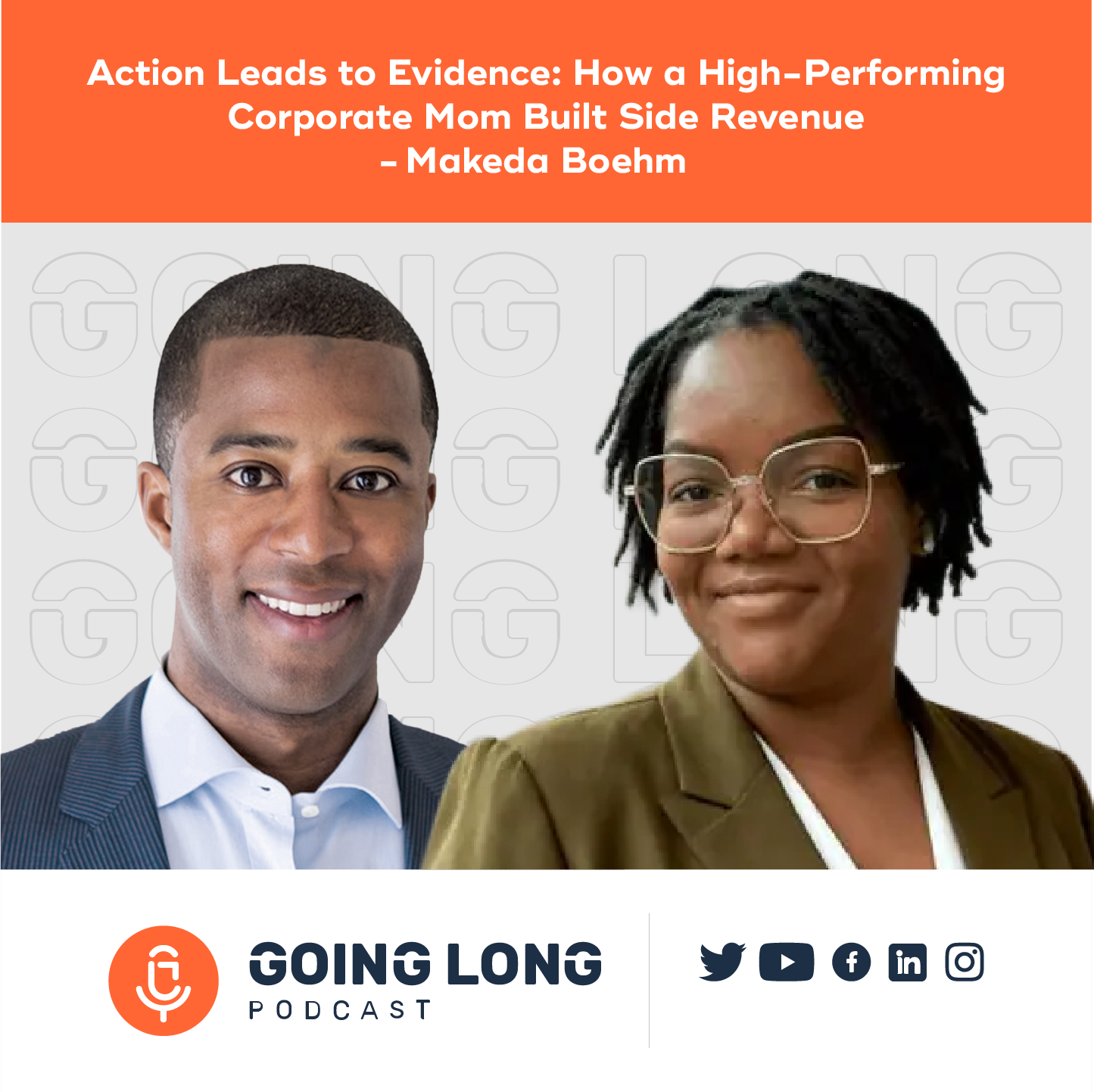
Action Leads to Evidence: How a High-Performing Corporate Mom Built Side Revenue - Makeda Boehm

Are you an overachieving sales director, VP, or enterprise tech leader sitting on valuable skill capital, wondering how to build an independent business without risking your steady corporate paycheck?
In this transparent guest conversation, host Billy Keels sits down with Makeda Boehm, an enterprise software professional, Amazon bestselling author, podcast host, and founder of Seed and Society. Makeda details the "lightning bolt" moment she realized that depending on a single corporate income source was a major risk and how she used AI automation to build a thriving side business while managing a 7-figure quota and raising two young children. Discover how to implement Makeda’s "Context Training" framework to automate business operations, why taking fast action builds the evidence you need for real confidence, and how to structure your time so your independent assets always serve your family first.
🚀 Want to make your corporate role optional? Grab your FREE copy of Billy's 3-Step Process eBook here: https://www.makeitoptional.com/?utm_source=youtube&utm_medium=social&utm_campaign=p2olm
Reach out, contact and connect with Makeda Boehm:
Websites:
https://seedandsociety.com/about
https://makedaboehm.com/
Instagram: https://www.instagram.com/makeda.boehm/
Podcast: https://podcasts.apple.com/us/podcast/seed-and-society/id1816787845
📌 Questions Answered in This Episode:
- How can a high-performing tech leader start a side business without giving up their day job?
- What is the "Context Training" framework for using AI to automate business systems?
- How do you balance a 7-figure corporate quota with raising young children and building an independent asset?
- Why is taking fast, imperfect action essential for high achievers wanting to break out of perfectionism?
- How do you ensure your independent side business supports your real lifestyle goals rather than consuming your time?
⏱️ Episode Chapters:
- 00:00 - Broadcast Recording Setup: Tuesday, September 22, 2026, with Makeda Boehm
- 01:05 - Moving at the Speed of Daily: AI in the Enterprise Software Space
- 01:40 - The Single Income Realization: Why High Performers Need Income Options
- 03:00 - Balancing a 7-Figure Quota with Raising a 3 and 6-Year-Old
- 05:00 - Finding Your Passion: Combining Tech Experience with Teaching
- 08:30 - System Thinking: Using AI Agents and Automation to Save Time Capital
- 10:45 - From Classroom to Enterprise: How Teaching Elementary School Sharpens Listening Skills
- 14:15 - Seed and Society & Context Training: Teaching AI Your Specific Business World
- 18:00 - Don't Tell Yourself No: Overcoming Perfectionism and Borrowing Evidence
- 22:15 - Keeping It Real: Managing the Time Trade-Offs for Family and Children
- 26:00 - Solving Real Problems: Why the Market Only Pays for Real Solutions
- 31:15 - Trough Principles: "I Have Nothing to Prove to Anyone"
- 33:45 - Connecting with Makeda Boehm and Seed and Society
📘 About Billy Keels & Corporate Optionality
If you're a corporate executive who wants to make your role optional, learn how to achieve true control over your career and turn your corporate skills into personal assets.
With 26 years of experience in corporate sales leadership, Billy Keels achieved true optionality through multiple income streams. Today, he has helped dozens of executives build a predictable path to take control of their time and start living their ideal day.
This free ebook gives you everything you need to identify, plan, and take control of your career while building financial optionality, leveraging your skills, and starting to live your IDEAL day - today!
- Get the Free eBook: https://www.makeitoptional.com/?utm_source=youtube&utm_medium=social&utm_campaign=p2olm
How to Leave a Review for The Going Long Podcast: https://youtu.be/qfRqLVcf8UI
Be sure to connect with Billy:
- Website: https://www.billykeels.com
- YouTube: https://www.youtube.com/@billykeels
- LinkedIn: https://www.linkedin.com/in/billykeels
- Instagram: https://www.instagram.com/billykeels
- Facebook: https://www.facebook.com/BillyKeelsFanPage
- Twitter/X: https://www.twitter.com/billykeels
Episode Transcript
Billy Keels 0:00
Relying on a single corporate paycheck is the biggest risk an executive can take today. In this episode, tech insider Makeda Bohm reveals how she leverages AI and her enterprise experience to build independent income streams without sacrificing her day job. Let's jump in. Let's get you to optionality. Today's episode is sponsored by Billy Keels Advisory Services. If you want to learn more about how to make your 99 optional, just go to makeitoptional.com. Once again, that's makeitoptional.com.
Speaker 1 0:34
Helping you build freedom without losing your edge. This is the Going Long podcast with Billy Keels.
Billy Keels 0:47
Did you know that AI is moving at the speed of daily? If you're in the enterprise software space, you've got a front seat to this. You know, in today's guest, well, she works at one of the world's most recognized enterprise software brands by day, and then by night. You know what? She's helping build, help her clients to be able to build and create results through fast action and AI. Gives me great pleasure to welcome to today's conversation not only the Amazon best-selling author, also podcast host, as well as the founder of Seed and Society, none other than Makeda Boam. Makeda, welcome to the show.
Speaker 2 1:30
Thank you so much for having me, Billy. I'm happy to be here.
Billy Keels 1:33
Hey, Makeda, you know what you've done? You have done and are doing so many amazing things, and I'm absolutely sure that so many people are going to be inspired by your story, and the whole point of this, as you know, because you're also you have got your own podcast that I just mentioned a few minutes ago, is to jump right in so everybody gets a chance to know you. Are you ready?
Speaker 2 1:50
Yeah, let's do it. All right,
Billy Keels 1:51
perfect. So you know, one of the things is, and I invested 26 years of my life in corporate. Corporate was very good to me; it was absolutely fantastic. You know, it's a great place to be able to to develop lots of different ideas, etc. But there's also a moment that maybe you decide that you want to also be able to do something else and build on on on that. Can you talk to us about what was that moment for you like when you decided, hey, you know what, I really like my role or my roles in the past, and at the same time, I really want to be able to build something else.
Speaker 2 2:24
Yeah, I actually talk about this a lot. It was a moment when I sat there, and we were, you know, looking at finances with my husband, and it hit me almost like a lightning bolt that if this one source of income went away. We had nothing else, and then we're also in this age where there is so many layoffs happening, especially in tech. And it would have been naive for me not to take note of that. Although you know I'm doing really well in tech, and I was doing really well in tech, and I plan on continuing to do really well. But then that combined with this synergy of AI being everywhere and ubiquitous, and I've been in it since 2024. It was like my light bulb moment. I sat there and I was like, I can't not have another option if this one goes away, and that started my journey.
Billy Keels 3:25
So you started this journey for you. It was the single source of income, right? And that's something that is maybe a lot of people kind of forget that, especially when you're in in the enterprise software bubble. Because, like I said, of the 26 year career, 16 of mine was inside of that enterprise software bubble, but there's also this moment where you're like, you live really well inside the inside the enterprise software bubble, and you talked about yeah, there's some things that can happen, and maybe there are companies that want to reduce the size that they have or right size, as they say. But you must have had some type of emotion going through that because most people are like, yeah, just do your job, and that's the only thing that you should do. First of all, did you have those kind of emotions, like, hey, should I be doing something else? And if so, how did you navigate through that to be able to say, yeah, you know what, I am going to start this other thing as well?
Speaker 2 4:14
Yeah, I think there's definitely a level of fear and conditioning that goes with that. But I've always been an entrepreneur. My husband's an entrepreneur. My grandfather was an entrepreneur. Right, his dad. My father-in-law is an entrepreneur, and I have an MBA, but in organizational management. So for me, it was like I always knew I wanted to start something. I just had no idea how with working a full time job, I give everything to my role as well. I have a three year old and a six year old. Wow! Whoa! Hang on!
Billy Keels 4:50
Hang on! Hang on a second! Hang on a second! You just added a whole nother level to it. Three and six year old. You said yeah.
Speaker 2 4:57
Yes. Oh wow! I have a three and six. So I'm in the thick of
Speaker 3 5:02
it,
Speaker 2 5:02
and and I had 2c sections with both of them, and I nursed them. My daughter until 19 months, my son till 16 months. So I'm not, and I work from home, so I'm not phoning this in. We didn't do daycare. It became very clear that you know something had to give me time to do all this, so I understand that struggle of being like, "Hey, I've done all of these things in corporate. How do I translate it into something people will pay me for?" I had to learn what a lead magnet was last year, like the whole internet game, the marketing. Right? It's it's a lot to go through. So the emotion going through me was, I know I have to do something, and it's better to do it when you have another choice or a steady paycheck and you know work that you enjoy rather than needing to figure it out because the rug was pulled from underneath you.
Billy Keels 6:03
Yeah, and that's such a it's such a key thing. And I want really the entire Going Long family to really key on those words that Makeda mentioned at the ending. At the end, it's really about being able to have options. I mean, I talk about it all the time. I was I really really liked my corporate role, and I was in corporate for 26 years, but it wasn't. It had nothing to do with corporate the reason that I was no longer in corporate, and the more options that you have, and we here we just it's a given. You are performing or overperforming in your corporate role, and at the same time, when you are able to do that, then okay, well, what else is going to also help you to provide more options? So you were able to find out about you know some of the tactics, and I love that you're talking about the the lead magnets. And you talk to us about some of the different emotions striking that you know you can be fearful of going through things, and then you've got to lean into that, and you continue to do it. But how did you get to find and decide on what your path is? And what I mean by that is, there's so many different experiences in life. There's so many different options. Sometimes when you have so many options, it's hard to choose. What is it that you want to actually do on the side? But I'd love if you could talk to us about, you know, what was that decision path like for you, and how did you get there?
Speaker 2 7:17
Yeah, I I would love to be like, oh, I just knew. Not true. My business has gone through so many iterations so far. I launch fast. I figure out stuff fast, and I iterate. That's how I believe in compressing time. And in this case, like I talk about that all the time, I feel like AI came out, and I think about AI only as much as it can give me more money, more time, or more options. So that's what started to happen. Where I had to sit back and say, if nothing else was happening in the world, if I didn't have to think about politics, if I didn't have to think about my gender, my race, and or money, if nothing was an option, what would I do anyway? If I couldn't post about it, if I couldn't tell people about it, if nobody could know I was doing it, what would I get up and do anyway? And then I added my other level to that, which is what would I actively pay for? What do I spend my time on? Right, because I I often say that time isn't money. Time is time, which is priceless. What would I do anyway? And that helped me to really hone in on what I love to do. I'm a teacher. I've always I didn't go to school to be a teacher, but I became one the day after I graduated on Friday. I was teaching on Monday. I love to show people how to do things and talk through it and educate them. And then we have this cool new technology that came out, and I often joke that it took to my 30s to truly know my passion because it didn't exist. The generative AI, where I feel like it's like a magic wand. Almost anything you can think of, you can now build it and create it. And it just was the perfect meshing of technological innovation, all of the education that I've gone through. I'm working on my second master's degree right now. I'm actually in my last class for it, so it was just the perfect combination to be my time to to teach this and do it because, as my husband says, my personality is like 98% AI at this point because I just truly like to teach about it. But often, how can people get more money, more time, more options? That's what I'm interested in. So you can go do the things like hike and travel and hang out with your children and not check your phone and not check your calendar,
Billy Keels 9:52
and even be very comfortable sitting, talking, having a conversation on a podcast like this one, and not worrying about everything else that's going on around. I
Speaker 2 10:01
do time block.
Billy Keels 10:02
Love it, love it, absolutely. Time blocking, batching these strategies are fantastic. You know, actually, speaking of that, because I know that I went through this, and and I know a lot of people that are watching or listening are thinking about it as well. Like you know, you talk about time blocking. I'm just kind of joked and build on that, and talk about you know batching things and so what are some of the strategies that you found you know as a as a mother of two as a you know leading house and leading family and and also being able to overperform in your corporate role building a business on the side like there's a lot of different moving parts there yeah how do you what are some of the structures or tactics that you found that work for you aside from what you just mentioned?
Speaker 2 10:45
Honestly, for me, when I do say AI, I'm talking about like systems, and I have always been a systems thinker. But it allows me to have a level of automation that I have no idea how you and so many people had did this before having a full time corporate career when you're actually very you know like I have a seven figure quota, I'm not phoning it in. So you have to be fully present for that. I'm traveling all the time. I can't remember to always do a LinkedIn post or an Instagram reel or even my podcast, I had to build systems that the technology gives us the ability to do today, so that it could be sustainable. One of them I talk about is for my podcast. It's done with my professional voice clone. Sounds like me. I have a podcast script writer where I drop in like a two or three minute voice memo from my week or the point I want to get across. It uses my structure and it makes the script. I read it in a few minutes and then I send it off to my podcast agent to then render it in five different languages, all using my tone of voice. That is also what I do. So it's showing the systems or a different way to do something specifically for people in corporate or mothers or people who have whole busy lives, even with their business and the marketing part. Just takes up too much time. Like that's not what their actual business is, so that's where it. For me, I couldn't even imagine doing this without AI. Not in the way that I've been doing it.
Billy Keels 12:30
Yeah, and by the way, when you when as Makeda was speaking about agents, she was speaking about her virtual AI agents, not her agent that's on her podcast. So just just to be very clear, just so everybody is understand, just to be very clear, which is fantastic. So it's really about integrating what we you say all the time is you know you're kind of you're eating your own dog food because this is what you do, and so you're actually integrating it into your day to day, being able to demonstrate and show how AI is allowing you to get more leverage at the end of the day because that's really what what we're talking about and doing it in a in an automated virtual way. So you also talked about being a teacher earlier, and I know early early days you were in teaching in charter schools and and now you're in the enterprise space. So I'm wondering what like what did those early days as a teacher? How are they serving you? Not just in your corporate role, also too, as we think about seeing society. How is that helping you today to connect more with your clients?
Speaker 2 13:34
I think teaching basically taught me everything that I know. There's nothing like having. I mostly taught second through fourth grade. There is nothing like having an eight-year-old ask you a question, and you have to sit there and reflect that it's your responsibility for them to know this like academic information in the world. And then you become a parent, and you realize I need to teach you virtually everything. Like it's on me. If you go into the world and don't know this, so for me, I feel like teaching, especially, taught me how to communicate and how to listen better. Because I was also a special education teacher towards the end, and it was very clear that everyone learns differently. Everyone understands and comprehends things differently. I can be using the same word in the same language as you, but have a different meaning for it. And it doesn't make you wrong or me right. It means that we need to be able to talk about that, and that served me really well in enterprise technology because I also think it comes from the caring. Like I genuinely want to help. I want to hear your pain and how we can make it better, and what my solution can do for you, or even recommend another solution if it's not mine. I just genuinely care, and I think that. Comes from you know teaching days where it's like these are children. It's literally the next generation. I don't know how you can care any more. Like they're just so innocent, and they need you, and they need you to show up. So that's how I kind of feel when I go into technology, and I started in higher ed technology, but even now I do state government. So it's like what I help to talk about and what I help to bring to the room can affect millions of citizens. That's like a huge responsibility to me, and it's one that gives me so much meaning. Which is why I see me staying in corporate for a long time because you get to be around more brilliant people and learn and teach, and it's just in a different classroom, essentially.
Billy Keels 15:50
Yeah, I love that as well. And one of the things I also find as an advantage there is when you are, you know, you talk about improved listening. There's also when you can explain something to a second grader, a third grader, a fourth grader, or at that level, it's one of the ways that means you really understand what you're talking about because it's very difficult to make something appear to be simple. And so when you have that mastery, it's it's also one of the things. I mean, it served me really, really well when I was in enterprise software, because there are some of these concepts, I was like, "How in the world am I going to explain this?" Because I don't even understand it myself. So you've got to go through these iterations. I love
Speaker 2 16:27
that you said that because that is one of my favorite prompts to give to AI. Speak to me like I'm five years old or I'm a kindergartner. Break it down to that much. It can take the most complex concept and do that now in the snap of a finger, and it's been a game changer. And it's one that I tell people to use all the time.
Billy Keels 16:49
I've been I've been a third grader for a really long time with my LLMs, so it's one of those things. There you go, telling on myself again. So we've talked about a lot of the the really good things. We've talked about where you are are going. I mean, I'd love to know more about you know as we think about seed in society, right? Because you you found what you want to be able to do. You found you know you ask yourself those two really key questions, and you've and it's taken you in that direction. And now Makada. But I will tell everyone: this is the real Mercedes. This is not the 98% virtual voice. And right, we we today we are very fortunate. We have the real McKayda that's here with us. But can you talk to us? You know, specifically around seed and and society, and really as you look at AI, the agents, automation, and how that is, you know, just really becoming a part of what you're doing on a day-to-day basis, and also helping to enable others and do that fast.
Speaker 2 17:46
Yeah, I mean, see it in society. Like I said, it's gone through a lot of iterations, but the clearest articulation of it is it's an AI education, media, and technology company, and that really shows up through context training, which is my framework for teaching AI your world, so that it stops guessing and actually does work for you. Which is funny because context training is not an inherent AI skill; it's an inherent communication skill. Knowing what you're trying to achieve, knowing how to describe your role, what you do, what you want to get out of it is the part that many people skip before they go into AI, before they go into relationships, before they go into so many things. They never sit down and think, "Hey, what is it that I actually want, and why?" And if you are able to be super clear on that and get feedback, so you know it's not set in stone, you're able to change your mind as you go and do something. That's where I have the connector method, which is action leads to evidence, leads to confidence, and repeatable results. Doing the thing is what gets you the ability to get true confidence to keep doing it. So that's where Seed in Society is really a container for those frameworks, and then it's iterated through a podcast, a newsletter. I'm releasing my app should be coming out in a couple of days now to beta testers, and all of this is just a house for context training. And that app will help speakers book speaking engagements in a click of a button. And same thing with grants for private business owners.
Billy Keels 19:41
Oh, fantastic! So appreciate that, and appreciate you giving us a lot of the vision of where you're going. Also, who this is primarily for for founders, solopreneurs, small businesses. Would would you say that is that accurate? Okay,
Speaker 2 19:53
all right. Or anybody who's a speaker, and they're like, "Hey, I need." If you are a speaker, you understand that the business. Speaking actually takes up way more time than the time when you're on stage. So this is like now we have AI go find open calls and all these things. It can generate all of those for you, and then actually filling out the application tends to take more people's time. Again, it's like a whole day. Well, now it can take your context train the library, and in a click of a button, auto populate that form mostly exactly how you'd say it, or almost exactly, and now it becomes an hour to rather than a whole day.
Billy Keels 20:35
And once again, getting back to that whole point of being able to help to save time coming to your two core questions, which is fantastic. Now, there's two things that are really running through my mind right now. First of all, is this whole notion is I'm now everybody here at the Go Along family, and they're all laughing as I get ready to say what I'm getting ready to say, or once they hear it, because I've said it like a million times, I sound like a broken record. Like I am a recovering perfectionist, so I always want all the eyes dotted and T's crossed. So, so this whole thing of like going fast and sometimes you know not getting there really, really quickly, or or starting before you're actually ready. How do you help people to actually get through that, especially for those high achievers who are corporate and now they're going down the solopreneur path as well? Talk to that, please.
Speaker 2 21:22
Yeah, I mean, one of my favorite quotes, and I say this often if people hear me, is the difference between hoping and having is action. You can sit there scared and stuck of the like, just afraid of a no that leaves you in the exact same place where you are anyway. I often say you don't tell yourself no. My aunt told me that when I was 16 with a GED and homeless, and I'm like, who am I to apply to an r1 research university? And she would say, don't tell yourself no. You tell your you let them tell you no. And that has changed just a lot of my life. I applied to jobs before I hit all the qualifications. Now I raised my hand to be on stages even before I had a keynote finished. I did it two days before because it was like, well, it's here now. You know, figure it out. And it wasn't like sink or swim. I do this every day for a living. I talk to people. I teach. I've been, you know, in rooms. It just was a different iteration. You have done so much more than you think you've done in your life, and I call that your evidence library. Actually, sit down and celebrate yourself. You got three kids ready for school. You are a project manager. Like you have so many skills: managing a house, doing a job, coordinating calendars. All of these things are true corporate skills. They're entrepreneur skills. They're business skills. And now you have AI where you can sit there and write all of these weird things that you've done, and say, "How can I make money from it? How can I build a million-dollar business from it?" And it can give you a plan that you may not have seen right away. And then another big thing I often say before you're ready: borrow evidence. I invested a lot in coaching last year in different programs. I looked back at my taxes. It was like, oh, I spent $50,000 in courses and coaching and everything last year. But it helped me to compress the time. I learned things I didn't know I didn't know, and it helped me to move so much faster. And when it gets hard, and it will, because entrepreneurship is hard, just like a job is hard, just like parenting is hard. You know to stay the course because you've seen it work for other people, and you then can see how it can work for you. So those are the things that help me, because staying stuck is way more fearful for me than going out and doing something scary.
Billy Keels 24:05
Yeah, no, and you've hit like the nail on the head with that one because there's so many different times where you think, well, I've got to get it right. Well, eventually, but right now you just need to go because if not, you're going to be waiting here, and everybody else has already gone by so so fast. So, and I appreciate you you you talking about that. Appreciate you also talking about the fact that hey, look, one of the and you keep coming back to this core theme, which is, are you helping to save time, earn more money, which will ultimately be able to provide you with more options when you can do those consistently. Then it's you know then it's off the charts, and not being afraid to invest in yourself. Kudos to you. So we talked about so many of the positive things, and you, I mean, everybody that's watching the video version, they're like, "Oh my gosh, McKay is like gives off this amazing energy, this you know fantastic." But I also like to keep it real here because this is part of what we do. And if everybody went away thinking. Well, everything that Makeda does, it's absolutely fantastic, and everything that she's tried gets right perfectly the first time. I don't think people would be coming back very often, so I do want to know if you can share with with us, Makeda, what have you found so far, right, and through this version of where you are that you would say is your your biggest challenge that you are that you're working through at this point in time, as it relates to yeah, as it relates to you know the side business and and things like that.
Speaker 2 25:29
Absolutely, I still think it's time, and honestly, it's not even for my business or my job; it's for my children, and that's the reason I started all of this, so I found myself being like, "Oh, let me build some more." Or I told you before, the podcast was coming out three episodes per week in five languages, so 15 episodes per week. And then I was like, "Just because I can do it doesn't mean I should." Like, what could I do with the time back from editing these scripts or doing whatever. Now it's like those three episodes can be across three weeks. It takes me an hour a month instead of an hour a week or two hours per week, and that's enough time to sit there and play Pokemon with your children, to do an arts and crafts project to cuddle with them to read with them, like that is the purpose and why I do anything. I said it's the only reason I got into enterprise tech because I realized I needed to pay for these diapers, and and we wanted them to be bio based because it's not cheap. So honestly, they're my reason, and I was starting to do everything around them, saying it's for them, and I didn't want to fall into that trap. So it still is hard to be fully present, to close the laptop, to turn off the cell phone, to not do one more post, one more comment, one more engagement as you're working towards the thing, whatever that thing is, I had to be like, I already have that thing, the ability to be present with my children. Everything else has to support that, and it's something I'm still working on, and it's something I've become more intentional about just over these past few months, and it's having the congruence between what you say you really want to do versus what you think will get you there. And at a certain point, it's like more money won't do that. You're not struggling, you know, for your bills or your groceries or whatever. So, what is really your excuse? It's the fear that you could become struggling for those things. But when you focus on what you don't want, it's like praying for what you don't want. Instead, let's focus on what I do want and enjoy it while I have it, or I'll never enjoy when I have more.
Billy Keels 27:58
Yeah, it's amazing when you come back to these, a lot of these concepts are core concepts, and they affect everyone. And so, as you talk about time, like one of the things I talk a lot about with with my clients is, you know, the one thing that is the great equalizer across the world. No matter how rich you are, no matter how poor you are, no matter how healthy you are or not healthy, everybody gets the same 168 a week. And it is how are you using those 168 hours, those 24 hours a day, seven days a week, and are you in alignment with what you say you want to do? I mean, you're talking about being with your children. That for me was core to one of the reasons that I decided to actually start to build a business on the side because I was attending a business meeting in Germany for the company that I was working for at the time, and it was not in alignment with me as a father who had young children, and so that very painful, emotionally painful moment for me actually became the the the foundation for why I actually started to go out and and build another business. And it is one of those things that it's great when you can have that reflection and say, "Hey, look, do I really need to do this last post today? I started this because I wanted more time with the kids, but I'm actually doing exactly the opposite of what I said I wanted to do." So, thank you so much for keeping it real, Makeda. I appreciate that. I didn't know if there was anything else that you may want to add onto that by any chance. If not,
Speaker 2 29:19
no, I'm I agree with that completely. It's just the idea of like doing what you say you're gonna do. I decided I like health was a priority. I kept saying it, and then I wouldn't go to the gym, and then I wouldn't do the workout, and then I. So it was like when you're not in congruence with your word and your actions, nothing can sync up, and it's not easy. I'm not saying it, but I think that knowing and knowledge is half the battle. You can't now. If you listen to this, you can't say you don't know. So now there's a responsibility to sync that up.
Billy Keels 29:53
Yeah, love hearing that. And then I, you know, I've got one other question for you, and it's it's one of the things that. You know, especially when you start talking about the vision, and you've painted the vision really well for us for seed and society, and you talked about the container and these different areas. But I also mentioned, you know, Amazon best-selling author and speaker, and there are a number of different things that you're able to do now to add value. Was this all part of a amazing vision in the beginning, or is this, or were these things that have just kind of shown up along the way? And how did they show up?
Speaker 2 30:31
Honestly, that's why I say to go fast before you're ready, because your market will give you feedback first on what they will actually pay for. The people you're around will tell you what they actually want. You are going through some type of pain or some type of problem. That's what built ever freely my app, where it's like, oh, I'm gonna be a speaker, and then I'm like, oh, I need to be a full time salesperson to be a speaker as well, and I'm a full time salesperson in my life, right? So you have some type of pain, or and that that's the key thing. If you're going to start a business or do anything, what pain does the person have? What problem do you solve? Come from it from a problem perspective, because a lot of people like to give solutions that nobody asked for, and that's great for you, but it'll make for a very difficult business. You need to be solving someone's problem, and that is the best place to start.
Billy Keels 31:31
Yeah, so I, you know, I cannot add anything on top of that, but it is one of the things we see very frequently on the client side of things. Is you know someone wants to start a business on the side, and it's one way. And as they do that, and and the one thing that I know, there's something I would add on to what you just said is, not only are you solving problems, you have to actively be asking the question because people won't just tell you what their problems are. And that you know, Makeda and I love the fact that you're simplifying it, right? Talking to us as we're as we're second graders and third graders once again, but it is also being active and being proactive to really understand what those people who have already voted with their wallets to say yes, we want to be clients. Making sure that you're staying in touch with them and understanding what is the next level problem that they're having, and I also say this with with my clients is it could you may perceive it as a first world problem, however, it is your client's problem, and it is your duty as a business owner to help them solve that problem, to come up with a solution for that problem, and be okay with them actually paying you to help solve that problem for them. So, I do appreciate you breaking that down, giving us some more insight, and and yes, you start down one path, and as long as you are open to and are able to solve those next solutions, well, why not? Because then you can do. You know, you start one place, and you're creating a lot of different value in a lot of different ways. So, Makita, I can't believe like conversations go by so quickly, like literally fly by. But I do want to ask you one last question because one of the things that I've learned in life is, you know, I was as classic overachiever, and things always went well perfectly. And one of the reasons I want to make sure that we don't paint every picture as perfect here is life is real. And so there was a moment in in my life where things kind of changed in a different way. Everything wasn't always going up into the right. And during that moment in life, it was the first time in my life where I had to say, "Hey, look, I actually need to go ask other people for their advice." Normally, people come to me as the high achiever and you know help them figure all their stuff out. Well, I needed to do that, and I needed to allow others to pour into me. And those things were happening and happening really well. But I realized that no matter what happened, nothing changes until I change, right? And there was a moment that I had to actually, literally, say some words to myself that that really got me into the fact that it helped me snap out of it and say, I I needed to hear myself say this, and then from that moment on, I started to take action, and things went up into the right, and so that, as a context, you're overperforming. Well, that's not important. Here's what's important. Here's what's important. But but at least it does its job. So thank you very much. You just let me know that. But but this is about you, really. But as the back backstory, what I do want to know is like you're overachieving in your corporate role. You're continuing to add value with your clients and your business on the side. You're speaking. You're you're you're leaving your content and creating and helping make impact on others. And I want you to project three years, Makeda. And and I want you to three years from now. You're looking back and you're going, oh, you know what?
Billy Keels 34:39
So many things went really, really well, but there was a moment where you were in a valley as well, and you knew that you needed to say something to yourself to get you out of that valley and get you to go back up and to the right. And I would love for you to share with me and the Going Long family what is that one thing that you know that you need to say to yourself that gets you going back up into the right.
Speaker 2 35:01
Honestly, it's it's become my new thing. Like I have nothing to prove to anyone. I don't have anything to prove. It's like the only person I need to make sure is happy is me, because when I'm happy, I'm a better mom. My kids are more happy. I'm better at my jobs. I'm better at my work. But taking care of me is the point. That is the point, right? Like there's no far away peak. There's no thing that I have to get To the journey is the destination.
Billy Keels 35:45
Absolutely, I'm already
Speaker 2 35:46
there. I'm yeah. It's it's you're already there.
Billy Keels 35:50
Fantastic. So nothing to prove to anyone. That's the thing that's going to help you to continue to move up into the right. And like I said, Makeda, thank you so much for that. You know, these literally these conversations fly by. I'm thinking at the very beginning of this conversation, as you start to help us understand where you are, and you recognize, like, yeah, you know what, you really enjoy what you're doing. Your corporate is good, but there's so many different things that are changing. You wanted to be able to, you know, not have to rely on one single source of income, and so then that inspired you to get out and start realizing what is it that you want to do? And I love the fact that you ask yourself two really core questions. And after you got through the fear and you broke through the fear and said, "Hey, look, I'm going to take the action," it was really like, "What what would I do anyway? And what would I actively pay for?" Like those two questions are so fundamental that help you to go out and to continue to figure out what is the next thing? And as you talked about, yeah, 2024 life is happening. And yes, I am time stamping this because I want everybody to know. As you go through that, it's the thing that you started to realize. And as you are already in the enterprise software space, you started to recognize how can I also help others that are founders, small business owners that want to be able to embrace this technology of AI and AI agents and automation, so that they can actually get the same type of leverage that will allow them to either do things faster in less time, make more money, which helps them to provide more options, which is what we're all about here. And so I know everybody here is going, you know what, Billy? Just ask her the question. So Makeda, I'm just going to ask you the question: What is the best way for the Going Long family to find out more about you, more about what you have going on with your podcast at Seed and Society. Talk to us, help us understand.
Speaker 2 37:28
Yes, Seed and society.com. It has everything there: my podcast, the newsletter, what I'm doing. That is the best place to reach me, and it was built with AI.
Billy Keels 37:42
All right, fantastic. So just check it out. Go to Seed and Society. Check it out over there as well. If anybody ever happens to reach out to Makeda, if you reach out, definitely let her know that you've already invested time getting to know more about her, her story here on the Going Long podcast. So, Makeda, I would like to say on behalf of the entire Going Long family, thank you very much for deciding to invest your time with me, with us, and really, really appreciate it. Thank you.
Speaker 2 38:07
Thank you for having me.
Billy Keels 38:08
All right, fantastic Going Long family. Listen, Makeda just crushed it. Make sure you reach out to her. Make sure you go check out Seed and Society. You know what? And she's getting ready to leave, and so you know what? I'll be doing. I'll be preparing for the next episode. So until then, go out and make it a great day, and thank you very, very much.