
From Asset Management to MYCOlive CEO - Mani Yanika

Subscribe to the podcast


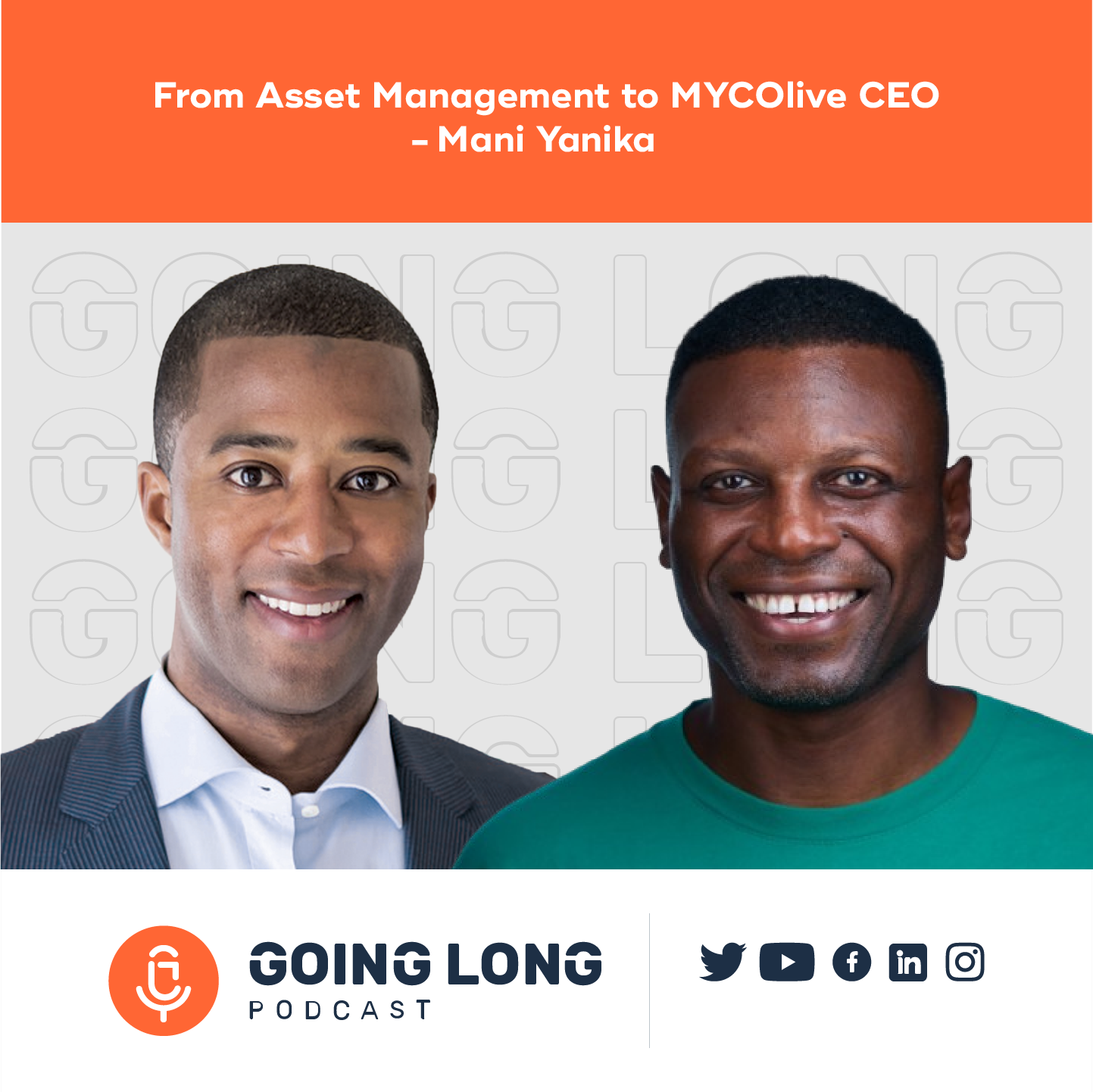
From Asset Management to MYCOlive CEO - Mani Yanika

Going Long Podcast Episode 612: From Asset Management to MYCOlive CEO - Mani Yanika
( To see the Video Version of today’s conversation just CLICK HERE. )
In today’s episode of The Going Long Podcast, you’ll learn the following:
- [00:24 - 02:02] Billy welcomes and introduces today’s special guest, Mani Yanika.
- [02:02 - 05:03] Billy asks Mani to share more about himself in his own words.
- [05:03 - 08:13] Mani describes the experience and process of working towards new personal goals while already in a successful, high-earning corporate role
- [08:13 - 16:03] Billy asks Mani what the event and circumstance was that led him to want to move towards actioning a ‘Plan B’.
- [16:03 - 21:30] Mani explains how his earlier corporate experiences and learning opportunities help him in his life and work today.
- [21:30 - 27:28] Mani describes the practical understanding behind the philosophy of “Everything is perfect, until it’s not”.
- [27:28 - 30:40] Billy asks Mani what his mindset and motivation behind sharing results publicly is.
- [30:40 - 34:12] Mani tells us all about his business MYCOlive, the backstory, and the people he serves.
- [34:12 - 38:35] Mani shares the message that he would like to hear from himself three years from now.
- [38:35 - 41:19] Billy sums up all we’ve learned from Mani today and asks him to share the best ways we can get in contact and find him online.
- [41:19 - 42:36] Billy wraps up the show
How best to get in touch with and find out more about Mani Yanika:
Website: https://mycolive.com/
LinkedIn: https://www.linkedin.com/in/maniyanika/
If you're a corporate executive who wants to make your role optional, then grab your FREE ebook with Billy's proven 3 step process at: www.makeitoptional.com
What you can expect to get out of this ebook:
- Learn how to achieve corporate optionality
- Gain true control over your career
- Turn corporate skills into personal assets
With 26 years of experience in corporate sales leadership, achieved optionality through multiple income streams, Billy has helped dozens of executives build their paths to take control of their time.
This free ebook gives you everything you need to identify, plan, and take control of your career while building financial optionality, leveraging your skills, and start living your IDEAL day - today!
Go to: www.makeitoptional.com
Click the above link or just copy and paste the following directly into your browser to sign up and get your free ebook: https://www.makeitoptional.com/?utm_source=podcast&utm_medium=social&utm_campaign=p2olm
To see the Video Version of today’s conversation just CLICK HERE.
How to leave a review for The Going Long Podcast: https://youtu.be/qfRqLVcf8UI
Be sure to connect with Billy! He’s made it easy for you to do…Just go to any of these sites:
- Website: www.billykeels.com
- Youtube: billykeels
- Facebook: Billy Keels Fan Page
- Instagram: @billykeels
- Twitter: @billykeels
- LinkedIn: Billy Keels
Episode Transcript
Billy Keels 0:00
Today's episode is sponsored by Billy Keels advisory services. If you want to learn more about how to make your 99 optional, just go to make it optional.com. Once again, that's make it optional.com.
Speaker 1 0:14
Helping you build freedom without losing your edge. This is the going long podcast with Billy Keels.
Billy Keels 0:27
One of the things that I love about hosting this podcast is I get to meet so many amazing, impactful global leaders, and today is no different. I cannot wait for you all to meet this guy, he's absolutely amazing because, you know, early in your there are early moments in your corporate success that can definitely craft the path to help you build your own dream. Today's guest is no different. You know why? Because, you know, he actually began his corporate career in the area of asset management for one of the world's largest consultancies, and I'm sure he's going to tell you about that, and he has actually taken so much of that experience, as well as experience in other consulting, sales, trading, investing, in investment banking. He's going to tell you all about that. But the really cool thing is, he's actually taken so many of those skills and disciplines, and he is now leveraging it so that he can go out and be the leader his his company, the leader in automation platform serving professionals and others. And he's going to tell you more about that. But it gives me great pleasure to welcome to today's conversation, the CEO and co founder of Michael live. Mr. Yani, Mr. Money. Yanika money, welcome to the show, man.
Speaker 2 1:38
Hey, Hi, Billy. Thank you very much for having me on the show. I really appreciate it, so I'm looking forward to share my experience with our listeners.
Billy Keels 1:47
Yeah, man, I definitely am. And you can tell I get so excited that I'm like, okay, but I just mispronounced your name. So sorry about that. Mr. Money. Yanika, as we, as we all know I'm a real person. This is how, this is how I like to get down, as we say, so money, I have shared a bit of your story, but what I would love for you to do is share more of your story in your own words, and then basically what we'll do is we'll see kind of where you and I take the conversation from there. That Sound like a plan.
Speaker 2 2:18
Yeah.
Billy Keels 2:19
Okay, over to you all right, please
Speaker 2 2:21
share so. My name is Manny elica. I was born in the Congo in Africa. I left when I was nine years to Belgium, where I grew up till the age of 16. Then I moved to the UK, where basically I spent almost 20 years of my life studying in the UK and working in and out of the UK. So I started my career management consulting for UI, before moving into oil and gas trading and then investment banking. So I've done my master's, my MBA, that's how I joined JP Morgan investment banking, where, basically I was working for the Chief Investment Office responsible for looking at new projects, new markets, new investments that we were doing for the bank. So that also includes looking at our technology stack. How do we do business? Basically looking at the risk, looking at pretty much everything across not just trading, but across business development. So with that, I learned a lot about how you interact with all sorts of stakeholders. I learned a lot about risk. I learned a lot about the market and so on. And then, fast forward, I started doing something on the side of my corporate career. So it was not like I wanted to go and then become this big entrepreneur or something like that. No, I just wanted to do something that I was passionate about alongside my work, because I knew that one day, maybe I won't did it anymore, you know, at the corporates, maybe I need to get ready now. So it started very small. You know, I was just investing on the side for actually, two or three years before I decided to actually go full on because I saw it roaring, and that's it. So how do you want me to continue? I mean, feel free to ask me any questions along the way.
Billy Keels 4:35
Yeah, man, so there's a, there's a lot of, there's a number of different things that come to mind, but you mentioned early on, right you started, you had this idea that you wanted to do something else. And for so many people, so many of our listeners and our viewers, there is this security that we believe we have, that we feel when we're in corporate because we have the great title. We have this identity that is a part of. What we're doing, and at the same time, there is this constant risk factor. So you talked about managing and mitigating risk. What was the process for you? Or how did you feel actually knowing that you were successful because you worked with market leading companies, always having very high titles, and at the same time, you have this desire to do something else. And for some times people, especially when you're in these high paid positions, you feel like you're cheating on your employer. Did you ever go through that? And if so, what did what did that feel like, having this big title and then also wanting to do something outside of your core role,
Speaker 2 5:42
absolutely. I mean, you know, don't get me wrong. For me, the key thing was always to have a plan B, like later on. You know, in life, it could be 10 years from now, five years from now. I didn't have a specific timeline, you know, it was just like, okay. You know, working is great, but What? What? What else you know, what else is there out there? You know, my free time, what else can I do? So for me, was just an experience that I have lived myself as a international student before actually starting my corporate career, I found this huge problem of finding accommodation when you are abroad, being a huge pain. And that pain stayed in my mind. So when I started the side gig, I started off as an investor. Actually, many, many people have investments in real estate, but also many people tend to do the same thing. So for me, was like, Okay, can I do something different? Still part of the investment world while I keep working. And the one thing that I wanted to do was to solve the problem that I faced when I was an international student. So I started investing in that specific asset class, which is CO living. It was very small back then, and my idea back then was not even to build a platform at that stage. It was simply to do something nice accommodation that can cater young professionals, students and so on and so on. As I started, it started to play golf, and then I was okay, maybe, what if I do this? What if I do that? You know, and slowly, slowly, I never anticipated to do something big. At the moment, when I was working, it was more like, like a hobby. You know, people have hobbies. So you go, you play golf, or you do something. For me was doing that side gig on the side, that's what really drove me to start doing something.
Billy Keels 7:50
Yeah, I love how you how you talk about that, because it is really you can have these moments where you want to use your additional energy, because nobody works 24 hours a day, it just doesn't happen. But you're using your time. You're using your energy to go to the gym or maybe to run or maybe to cook or whatever the case may be you are, you're using that additional time to do something that fills your emotional cup. You mentioned something that you were never looking to build a business. You were just wanting to solve your own problem, and this was your own problem that stayed with you, and you thought, how can I how can I figure this out? One of the things that I see working with clients very frequently is that there's usually something in life that begins to change when you start to say, Okay, now is the moment that I actually want to figure out this plan B, as you talked about or solving this particular problem, that maybe you happen, was there any event, a particular event, that happened in your life when this plan B became more relevant for you to start to take action? And maybe, if so, can you talk about that? Because it's something I see a lot with, with clients.
Speaker 2 8:57
Yes, absolutely so for me, was I worked at this big corporate, and then I was head hinted to go into a startup, you know, to lead plant relationships for banks. And that startup had a big vision, basically, you know, and that big vision meant that they needed to raise a lot of money in one go. And the solution that we were doing was to help many banks, but with one solution, where that solution will be shared across banks. So it'd be like you are competing with someone, but you're using the same tool to compete against each other. So it's difficult. You know, it's not, not every banks are friends, so they were looking to raise 100 million, and they never managed to do so. So one day, in the morning, we got called into the office. We were really highly paid. We're a bunch of 20 bankers, really highly paid. I was even more paid than the big names. Yes, we were called in at eight o'clock in the morning and let go, literally like eight o'clock in the morning. They call us and say, Hey, sorry guys, but we couldn't raise enough money. We ran out of cash, so we cannot pay you anymore. So we need to change direction. We gotta let you go. That was the moments that things changed for me. So I had the chance to either go back to investment banking world with the likes of JP Morgan, because he's the one bank that I really, really enjoyed working out, or build my own thing, or go to a technology company. So I had this options, you know, I've applied for a number of jobs. I mean, not too many, because I already knew exactly what I wanted to do. So I've applied for three companies, actually, J Morgan to go back, but I wanted to create my own job, you know. And then one Amazon, and one is Salesforce, I've succeeded. I went I had eight interviews at Salesforce. I had a number of interviews at Amazon, but that's when I realized, also, at the end, I was not successful. I didn't get a job. After eight interviews, I was like, How is it possible that I met every single senior leaders out there, and I had eight interviews, only two, four shots, something is wrong with me? You know, I told that I had a problem or something, and then I go for something to go back, a JP, Morgan, but it was a bit like I felt it'd be like going back, not progressing. It'd be like you're going back to what you used to do, you know, like we all have this kind of feeling, like you feel like you you're loser. You lost something, you know, and this is one thing I didn't want to do. I didn't want to go back to what I used to do because I didn't want that feeling, you know. And then after I go rejected a Salesforce and Amazon, that was the moment that I realized that, hold on a second, I've been investing on the side already, he's doing well. Why? I don't give it a go. And partner told me at that time, like, hey, you know, you're making more money actually, than working. And I did not realize, because I wasn't doing it to make a lot of money. I was doing it because I wanted to solve a problem, and I was passionate about it. And once she made me realize you're actually making very good living. So what do you need to go back to actually focus on this? This is your future, in a way. So that's how you can build a business. So from that moment, and also my partner is a lawyer and Hungarian, that's how we started the business in Bos. So we were based in London. I was working in the city in London. And then we moved from London. My son, at that time, was three months old when I go let go, and my partner was selling masters in Go, so not really actively working. She was like on the break, while I was the one bringing in money at home. So when the money kind of stopped, I planned it a little bit. I was like, Oh, hold on a second. You know, you have a little baby, right there, three months old. You have a partner. You need to do something. But then when she made me realize, Wow, you really have this well, you know, focus on that. Let's move to Budapest, because that's where I was doing my side gig. I started off in London, but I saw a big opportunity there, because the cost to enter the market was cheaper than big cities like Paris, London, Barcelona or New York. So the risk was worth it, because you could afford to not succeed and still managed to somehow to get by. You know, that's how I decided to focus a little bit more on that so that that moment of me failing to secure that another corporate role, that was the turning point for me. Actually, I was like, you know, let's go and do this. And from that moment, I spent literally almost two years building out the business before launching it, because before it was not really a business. It was more like a side. I was doing it. I didn't have a company, none of this. So I have to learn all this. Get an accountant, get the company, because
Billy Keels 14:41
of
Speaker 2 14:42
the smiling,
Billy Keels 14:43
because this is one of the things money. I originally started my first business because I went through a pain of missing my son's third birthday party, and that was the thing I would just want to I was just wanting to have more agency, have more. Ability to control income, even though I was earning a lot more than especially people where I was living, right? It was just like, not even comparable. At the same time I hear what you're saying is that you had already started this because you were wanting to solve your own problem. You had two major events that, I would say were happening so you have a very young, three month old, and at the same time, you were being told that it was all the all the work that you had been done, had been doing, it was no longer valued because the money ran out. And so you had these two very, I would say, emotionally impactful things happen for you, right? They happen to you in the moment. You probably realize now there was a reason for that. It's hard to see it in the moment. And as a result, you went through your process, and then you realized that this was, you know, you listening to others said, Okay, this is the moment to take this and move this forward. So I'm just curious also, too, because you mentioned earlier, like, and I'm a big believer, like I am someone who I'm a fan of corporate because I invested 26 years of my life there. I learned a lot, I gave a lot, and at the same time, I realized that there is also life beyond corporate, but and there are a lot of there's a lot of skill sets, and there's a lot of things that especially when you are very good, and you're a high achieving corporate executive, that you can then use those same skills. Because you don't think about it, you think that they can only be used inside of the corporate walls while you're there,
Speaker 2 16:30
but
Billy Keels 16:30
when you decide you want to do something else, yeah, they can also serve you. And I'm just curious how that, how that exposure that you had early days, like in the energy and finance, how they also is influencing or even the sales discipline, how those things are actually now influencing the way that you have not just built your corporate your company vision, your enterprise vision, but how it actually is helping you go out day to day, to make your company even more successful,
Speaker 2 16:57
a lot a loss. So the I mean, one of the skills that I learned during my corporate career was being able to work with people from different discipline. So whether you're working with someone in technology or someone in risk or someone in cells from different region, you know, you work at large corporates. So I had to deal with people from the US, Europe. You had Asia, you know, different region. So that really helped, because setting up my company, when we were building the platform, I had to work with developers who were based in California and India, and me being based in Europe. So the time zone difference Crazy, right? So that really helps. And another thing that really helped and continue to serve me today is communication skills. A lot of people you know, tend to undervalue these skills, but to be honest with you, is probably one of the most important skill today, is how you come across, how you communicate, how you convince people. Because I could not do this alone. Started off as a side gig. I was alone, but when I decided to turn that into a business. I had to seek outside help, and that comes in form of investments. You know, that's how you raise money. You get the right investors with you. And so these things really, really helped experience that I learned helped me to go out there, build a confidence in order to go and talk to people and tell them about what I was working on and not be ashamed of rejection. You know, because people, a lot of people, will always tell you, Oh, well, you know, what you're doing is not good. Or other people will do it, or, you know, whatever. But the one thing you need to always remember is believe in yourself. So that confidence working in corporate you have to be confident because you have to present. You remember this slide, you know, like you had to present in front of people. So presentation skills really, really help a lot, and how to manage conflict as well, because you could have conflicts in projects. So you have your idea like, hey, let's do this. Someone else in your team may have had different ways of doing something, so conflicting agendas. So that really helps, because building a team now I'm I'm kind of the manager that people look up to, and when I see my super audience, I try to guide them in a way, to work together. And I see conflict. I see this all the time, and I cannot step in. Make sure that people understand the big vision, so the strategic vision, where we going, so regardless of small internal conflicts. So, so, I mean, I have a lot of examples that I can tell you, but yeah, no, me,
Billy Keels 20:17
yeah, no, I was gonna say, I think those, you know those examples, and whether it is looking at leading teams, managing conflict, working across different departments, different regions, in those communication skills, those interpersonal skills, those are always extremely valuable. And also you use a really great analogy, when you are there, you're thinking about, you're presenting. You are presenting in the rooms, in the boardrooms, or in just inner meetings, client meetings. But those are the same skill sets that you're using when you are now selling your vision or presenting your vision to others, and whether that is in clients or customers or investors. There's so many different ways that you can leverage those same skills. So there's, there's this other thing. So thanks for sharing that. I've talked to clients as well. Sometimes people are going through and they're saying, Hey, listen, you know what I'm gonna Well, I'm gonna do that, but I have to wait until I close the quarter, or I have to wait until the next fiscal year, or I have to wait until I have this amount of money in the bank, or I have to wait until to start doing your side business. Now I think, if memory serves me correctly, when you started your actual business, because it went from a plan to actually starting your business, all of the conditions for you were perfect, right for your business model. I mean, you were starting during a global pandemic, and everything was just perfect, correct? Or did I misunderstand
Speaker 2 21:48
it? No, no. I mean, everything was perfect until it wasn't.
Billy Keels 21:52
Yeah, there you go. That's it. So this is what, this is what I really want everyone to understand. So So money. Thank you. Thank you for that is what money is getting ready to explain to you, especially for his business, everything, you're always waiting for things to be perfect until they're no longer
Speaker 2 22:09
perfect. Exactly. So just imagine you leave your corporate career. For me, it was in 2018 and we launched the business is because I'm 20, so that's two years in between. So during these two years, I was planning moving my family abroad and setting up the business, you know, like the job restriction, the registration, the tax, all the stuff it takes time, you know, so and then boom, you have the pandemic that happens. So all the plans that we had in mind kind of go knocked. But for me, was also a moment to show that you know what everyone is preoccupied with, the pandemic, so no one cares if you fail. Literally no one cares. That's what really got me going. So we started building the platform, my colleague app, and we were not even 50% ready, not even but we still launched it because I didn't want it to be perfect. I was like because the world is so imperfect right now, everyone is preoccupied with their own life, so therefore I can learn from the fact that it's not perfect, you know. So we launched it in August, 2020 not being perfect, but we got a lot of feedback as we go. It was very hard because, you know, the revenue that we were planning to get for the year one was not even half of that because of the pandemic. But at the same time, as I said, you know, it was a test of, can you keep going when you have a shock? Do you give up before you even start? You know, all of these things. And then I was like, No, we can't give up. We need to do it. Because this is the moment. Is your proof of concept live. There's nothing better than putting a real life scenario rather than on paper, you know. So we did it, and it was a bit shaky. Six months later, we doubled or and then it started growing. I mean, you know, we've grown every year since then, uncomfortable. You know, we've been very profitable from some from the first year actually, you know, so, so I'm thankful to that, the fact that we didn't give up, and the fact that this global events kind of shaped the way we see things risk, you know, I'm, I'm, I'm a little bit of a risk. Which I always look at, I always look at, you know, what happened if we don't do this? What happens if we do this? And then what happened if this event is happening? How is it going to impact us? What happened if we go to this new market? How do we go to this new market? Because how is it going to impact our revenue, our current review, and how is it going to impact a runaway because we are a sustainable growth startup. For those who don't know what it means, it means that we are self sufficient. That's what it means. We don't need external funding to survive. So, you know, we hear a lot about unicorns, about, you know, startup like, 1 billion valuation, but all this is on paper. But we don't hear enough about sustainable growth. Startups like, how do you keep going? And how do you become self sufficient as first place, you know? And for me, it was about discipline, you know. And discipline that we had to go through the pandemic helped us shape, literally, how we execute on our operation forward every single market that we go, we have what you call like unit economics. We look at how much profit you will make per additional business. We don't, we don't look at it like, Hey, we're going to start making money in five years. No, no, we need to survive right now. Can we? Can we afford to lose money for one year? You know, all of these things.
Billy Keels 26:34
Yeah. These are part of the, the the, you know, first of all, everything is perfect until it's not. And so regardless of what happens, it is, you know, this is one of the things I talk a lot about in you know, you have to be really clear on what it is that you want to do and why you want to do it. Because not if, but when, things don't go according to plan, if you are not crystal clear about what it is that you're doing and more importantly, why you're doing it. It's the moment that the proof of concept collapses. And so you have to be clear on what happens. And also, one of the things that I've noticed money that you do very uniquely in the marketplace. You talk about profitable I also talk a lot about, you know, it's not just building a business on the side, is building a profitable side business. It's not about how much money that you're making, it's how much you're actually keeping that's more important. But you also do something that I find to be very unique, in that you're not afraid to share publicly the results that you are, that you're doing, and so it's something that most people don't do. Can you talk to me about the mindset that you have in terms of what is the just the mindset in the motivation for being able to share publicly how you're how what the results look like?
Speaker 2 27:51
Yeah, sure. So for me, first of all, I'm not against companies who are not sustainable. Well, not. I'm not against VCs either, you know. I'm just trying to share my experience, to show that they are not only one way, you know, what we always read like when you watch the news or the media, whatever it is, it's not always what you see. There are always. There are also stories in the back, you know? And for me, because there is no enough coverage of sustainable growth companies who are growing sustainably, so they're not looking for 10 times growth in two years. No, they're growing sustainably. There is no much coverage you can go on LinkedIn. You don't really hear stories like this at all, and that's the reason why I decided to dedicate my own profile or whatever I post about being authentic. So if we lose the assets, we lose, if we make, we make. But this is the process, how we're getting there. So it's not to show up or anything like that. It's more to show people that is not always about the big millions that people read about. Sometimes the small wins can actually have a bigger impact in you, in your confidence, in your company, your colleagues and so on and so on. And maybe motivate others. You know, I'm trying to motivate others because some people like you say they're scared or they're afraid to share something because they feel like they don't belong to this whole big media that we all hear about because different like you said, you know, it's very different. Don't be afraid. There are other people like you out there, afraid to come up with a new idea, with a new project, or simply afraid to communicate about what they're working on, because they don't want to be judged or something. I don't think you should. You know, be afraid because people have their own life, and maybe some of these people. So sharing all these big stories, they also have struggles that we all do.
Billy Keels 30:06
Anyone who have, anyone who has everything perfect all the time, just be wary, because it's probably not that. It's probably not that. So I have another thing for you, money, just to understand. So you've had this corporate experience, and you've had different areas, consultancy, you've had financial services background, you've had sales, you've had risk, you've had a number of different, different disciplines, different geographies that you've managed in, that you've led in, and that's taken you now to Michael live. Could you just like, maybe like in, I don't know, 30 seconds a minute, I talked about it in the very beginning, but really would love for the going long family to understand who Michael live is actually serving today, so that we have a better understanding of how you've taken all this corporate experience and led to your own vision to help solve a problem that you were having early on in life.
Speaker 2 30:56
Sure. So my colleague, what we do is that we're building a network. A bit like a franchising network of rooms like accommodation Qatar, professional young, professional international students, but we also have some families as well. So the idea was to build a platform that will serve that people will recognize. You know, think about it like a hotel chain. So if you book EBS hotel, the Hilton Hotel, you know what you are getting. You know, because the network is not owned by one single person, there's a group of owners, the same thing. So my colleague is the platform that power the network. So the platform does three things. One, enables people to book accommodation, whether it's a room or an apartment. The second thing is, enables operators to automate their processes, things like check in, check out, cleaning, maintenance, rental agreements, all these are all automated. And then the third thing is, we enable investors and owners to be part of the network without them being active into it, not to franchise so because we are handling everything on their behalf, automation. So this is how we are growing, actually. So we'll always look for partners. So you rightly say earlier, we are now in our third country, which is Egypt. We are launching Egypt. We already have two properties there. So if anyone wants to go to Egypt, check my colleagues and I'm actually going on Sunday to meet MVC, who are interested in us, because they've invested quite a lot of money in Egypt, and they want to optimize it for a kind of functioning network, and they want to see how we can Help them. So so we are also kind of, you know, as you grow, you kind of adapt, you know, with the plan, you know, so because it's not always black and white. So the idea is to keep flexible, to stay lean, and then wherever the opportunities are go for it, but always look at how is that going to impact your current business? You know, because you don't want to go too fast or too big and then end up neglecting what made you where you are today, basically, so. So everything I do, I always look
Billy Keels 33:41
at this. I appreciate you sharing that. And of course, everyone, there's going to be links in the in the show notes, but one thing that I do want to ask you, just really quickly, money is and it's just sharing an experience, and I'd love for you to share with the going along family. It's really one, one sentence for many years, I always think things always happen positively, like, I kind of life always happened, like, in the in the ideal way, there was a moment in life where kind of two major things happened for me, and it helped me to realize, like, there are moments in life when, when things are going really, really well. You take it, you notice things are going well, but you don't really think about it, because things are going well. But when things are not going well, there can be a tendency to think this is going on forever. Nothing is going to change. No matter who tells you anything, it's just like you feel like it goes on forever and it's really, really difficult. Well, I know that no matter what number of friends poured into me and they told me that, hey, listen, you can do this and you'll get over this. All of those things helped, but I never made the actual mental switch until I started looking myself in the mirror to help me get through those really, really, really difficult times. And it was a matter of me saying sending a message to myself. And it was in that moment that things began to change, because I thought it, I lived it, and then I started to put it in action. And so knowing that I'd like for you to think of money three years from now, and you're looking back to money today, and what's the one message that you know you need to leave for yourself today that is going to help you get through those difficult moments that are going to happen between now and the next three years, so that you can continue to move forward. What's that one very simple message that you want to leave for yourself?
Speaker 2 35:33
Transparency. So be transparent. So for me, whenever I face challenges, I'm always transparent. I call my clients, the investors, and I tell them that, hey, this is the challenge that we're facing. So these are the action that I'm going to make to kind of go through these challenges. So I'm very, very transparent. This is one thing that that really helps me personally. You know, I'm transparent with my team. One was facing challenges, so they all understand, and they all kind of work towards overcoming this challenge. So one thing that happened to me, like one event, which I think the listeners might be interested in this is early on, when we launched my colleagues, like, not even two years in, I had an investor who was pushing me, putting a lot of pressure to grow faster,
Billy Keels 36:34
you
Speaker 2 36:34
know, like, hey, you know. And then he was always criticizing the moves, you know, like, if we do these ways that criticizing. And then we had the first investor meeting. It was in Paris, and then the guy was criticizing me, and then I said to him, like, look, we cannot grow faster, because it's touristic. If we follow the way you want to go. We need to raise a lot of money, and nothing guarantees that this is going to succeed. So therefore we need, in my honest opinion, we need to do it this way. And then I said, plus, you are an investor, you are not my boss to tell me how what you should do. You should support me. That's what an investor should do. And you know what? He responded, yes, I am your boss. So I felt like that moment. You felt you really it was a wake up call that the investor is not always by your side. Is not always your friend. Is there looking at ease interest. So therefore you need to be careful to protect your vision, because it's very easy to derail, to go off topic, to go off your plan, and then end up doing that a lot of things investor. So what I did is I ended up buying back my share from the investor, and then today we are where we are today.
Billy Keels 38:04
I love that. So be transparent. Number one, and this is also one of the benefits that a lot of people don't talk about, is that when you are managing and leading your own business, that you can and it's one of the things that I really enjoy, is you are able to surround yourself with the people that provide you with the most positive energy and that are there in the fashion that you really want to do, so in the way that you want to you know, have have life lived. So all these things are so awesome. And I cannot believe money that these conversations fly by so fast, because like I'm thinking at the very beginning of the conversation, like you're talking to us about being born in the Congo, and then you're moved and you're living in Belgium, and then you spend a long time in the in the UK, and all of these different places helped you to recognize, okay, well, what are some of the different things that you wanted to be able to do you then as you had these different life experiences, as you got into your what I like to call your corporate lifestyle, you start realizing that you you were gaging risk constantly. It's something that you enjoyed. It to gage, not just financial risk, even stakeholder risk. And you started to recognize like, hey, this thing, this life event, happened for me and a bunch of other people when we got called into an office at 8am and I had a three month old and all of a sudden they said, hey, look, you're not your services are no longer needed, you recognize that plan B that you'd been thinking about was a really good thing. And so as that plan B happened, and you recognize, and you had someone say, Hey, you you know what this plan B that you started years ago, how about rather than going for the roles at the three different companies that you talked about, and two of which you didn't get the role, and you went through eight interviews, and you started going, well, hang on a second I used all this time the third company you got the interview, but you didn't want to go back to something you'd already done. So it was time to lean into the side hustle that you started, which is now the side business. And you recognize all of these different disciplines, and whether it was in tech, whether it was in sales. Whether it was in risk, whether it was in managing businesses across different regions, whether it was India, whether it was then in the US or being in Europe, you recognize that at the end of the day, you could leverage all of these different skills experiences to help to solve a problem that you experienced overall, and that led you to being able to not only be the co founder and CEO of Michael live. It makes also the entire go along family say Billy, just ask him the question so we can find out. So let me ask the question on behalf of the entire go along family, what is the best way for us to find out more about you, money, more about what you're doing at Michael live, so that we can continue to be here and support,
Speaker 2 40:42
yeah. I mean, you know, you can follow me on LinkedIn, for example, because last year, every week, I share at least two posts about what I'm up to, about what we doing, you know, and just how you find out about what my colleagues is up to, in terms of next steps and so on. And I'm very open. I'm also happy to respond to additional questions and so on. Okay,
Billy Keels 41:10
okay, fantastic. Well, listen, the one thing that I always like to ask, especially when someone says LinkedIn, because I spend a lot of time where I invest a lot of time over there on LinkedIn myself, but when you reach out to money, not if, but when you reach out to him, Do yourselves a favor. Make sure that you let money know that you've already watched and if you're not checking out the video version, I can't believe I didn't say this like you should check out the video version. Money's got on the coolest t shirt ever. And I'm not going to tell you what it is, because you have to go see it. Go check it out. But it'll help you understand a lot more about what he's doing. So just check it out. Check it out for sure, and make sure that you leave him a personalized invitation on LinkedIn. It will help the conversation for everybody just to continue even more so money. What I would like to do is say thank you. On behalf of the entire going long family, I want to say thank you so much for deciding to invest your time with me, with us, and sharing a bit more of your story. So thank you very much. Money. Really appreciate
Speaker 2 42:05
it. Thank you for inviting me again. I really appreciate
Billy Keels 42:09
it. Yeah, my pleasure. Listen. Go along family, go out, make it a great day. And thank you very, very much. Bye,