
From Corporate Burnout to Breathwork - Sylvia Keijzer

Subscribe to the podcast


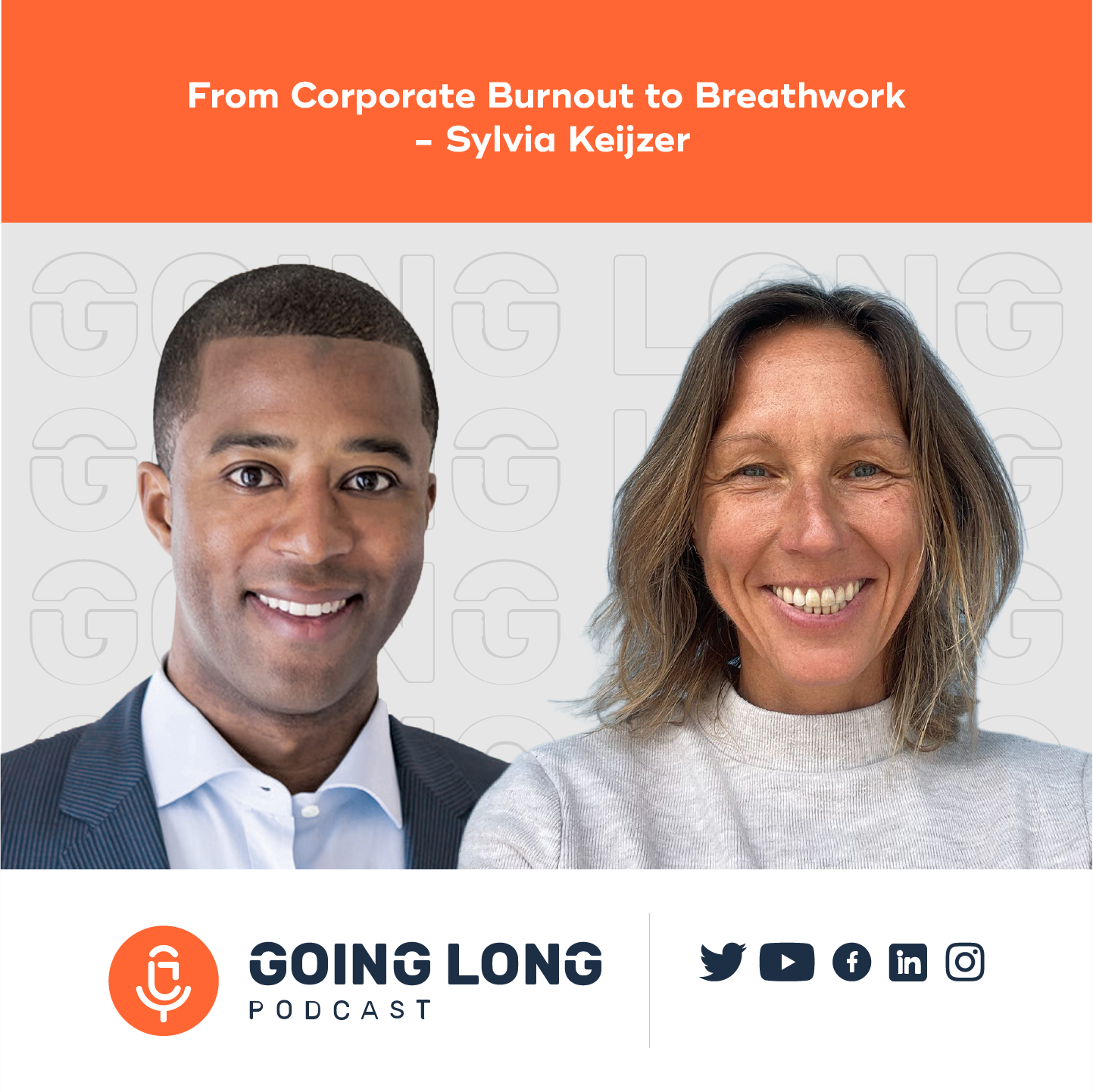
From Corporate Burnout to Breathwork - Sylvia Keijzer

Going Long Podcast Episode 627: From Corporate Burnout to Breathwork - Sylvia Keijzer
( To see the Video Version of today’s conversation just CLICK HERE. )
In today’s episode of The Going Long Podcast, you’ll learn the following:
- [00:24 - 02:28] Billy welcomes and introduces today’s special guest, Sylvia Keijzer.
- [02:28 - 06:01] Billy asks Sylvia to share how the end of her corporate relationship helped to open up a world that she hadn’t been thinking about at the time.
- [06:01 - 08:04] Sylvia describes her experiences of first being in different countries and cultures.
- [08:04 - 12:04] Billy asks Sylvia to share insights into some of the transferable skills and experiences she has been able to take forward from corporate.
- [12:04 - 13:40] Sylvia shares some of the more taxing elements of being in a totally new environment and country.
- [13:40 - 18:39] Billy asks Sylvia to describe how she came to realise that she wanted to help other people in stressful corporate roles by starting her own new service.
- [18:39 - 22:37] Sylvia describes the different ways people reacted to the news that she was moving away from corporate to start her own entrepreneurial project.
- [22:37 - 27:57] Sylvia shares how mentors can help you on your entrepreneurial path.
- [27:57 - 33:22] Billy asks Sylvia to share details about the specific services she provides, and also to explain all about her own podcast.
- [33:22 - 36:14] Sylvia tells us the message she would like to hear from herself three years from today.
- [36:14 - 39:09] Billy sums up all we’ve learned from Sylvia today and asks her to share the best ways we can get in contact and find her online.
- [39:09 - 39:51] Billy wraps up the show.
How best to get in touch with and find out more about Sylvia Keijzer
LinkedIn: linkedin.com/in/sylvia-keijzer?originalSubdomain=es
Website: https://keijzeracademy.com/
Instagram: https://www.instagram.com/sylviakeijzer_/
If you're a corporate executive who wants to make your role optional, then grab your FREE ebook with Billy's proven 3 step process at: www.makeitoptional.com
What you can expect to get out of this ebook:
- Learn how to achieve corporate optionality
- Gain true control over your career
- Turn corporate skills into personal assets
With 26 years of experience in corporate sales leadership, achieved optionality through multiple income streams, Billy has helped dozens of executives build their paths to take control of their time.
This free ebook gives you everything you need to identify, plan, and take control of your career while building financial optionality, leveraging your skills, and start living your IDEAL day - today!
Go to: www.makeitoptional.com
Click the above link or just copy and paste the following directly into your browser to sign up and get your free ebook: https://www.makeitoptional.com/?utm_source=podcast&utm_medium=social&utm_campaign=p2olm
To see the Video Version of today’s conversation just CLICK HERE.
How to leave a review for The Going Long Podcast: https://youtu.be/qfRqLVcf8UI
Be sure to connect with Billy! He’s made it easy for you to do…Just go to any of these sites:
- Website: www.billykeels.com
- Youtube: billykeels
- Facebook: Billy Keels Fan Page
- Instagram: @billykeels
- Twitter: @billykeels
- LinkedIn: Billy Keels
Episode Transcript
Billy Keels 0:00
Today's episode is sponsored by Billy Keels advisory services. If you want to learn more about how to make your 99 optional, just go to make it optional.com. Once again, that's make it optional.com.
Speaker 1 0:14
Helping you build freedom without losing your edge. This is the going long podcast with Billy Keels,
Billy Keels 0:27
sometimes you should really pay attention to what aspects of your corporate experience, not just other good things, but what are the parts of the your current corporate experience that you're suffering with today. I know you don't like thinking about that, but it may be exactly the thing that suffering, that exact thing that allows you not only to expand currently and in the future, but it's also going to allow you to help others in the future, you know? And I'm really, really positive about this, because today's guest not only invested 26 years, and it's hard to believe, but yes, she invested 26 years in a high growth industry, in the pharmaceuticals industry, and she did that across brand strategy, global operations and even organizational transformation. And aside from that, this is also something that a lot of you will be able to understand. She worked across different cities, different countries, even different continents, which I absolutely love. And today she helps executives to perform at the highest level without chronic unhealthy pressure, chronic unhealthy pressure. And it gives me great pleasure to welcome to today's conversation the host of the stress reset podcast, as well as founder of the Kaiser Academy, Sylvia Kaiser, welcome
Speaker 2 1:47
to the show. Sylvia Billy, here
Billy Keels 1:51
we are. Here we are. No I'm really excited, really excited for you to be here so much of the experiences that you've had across different continents, different continents, different cities, and also within corporate I know that what you have done in the past, what you're doing today, and even what you will continue to do in the future, is going to be very helpful for so many people. So you know, I usually ask a kind of a wide open question, but this time, because you and I have chatted a little bit before, I do want to ask you a question, because this is something we talked about, and having had a chance to meet you, I know that well, this is something that you'll be able to answer, because a lot of times I've talked about every relationship ends, right? Every corporate relationship ends for whatever reason, right? And so I'd like to start there just from the very beginning. How did the end of your corporate relationship help to open up a world that maybe you weren't even thinking about at the time?
Speaker 3 2:50
Curiosity. It's there's always there the curiosity and the what if question, what if I would quit my job? How would life look like for me, the most important question was always something like, what would I regret not doing when I look back at the end of my life, when I will be 80 and not having the possibilities anymore to change or to do what I'm curious about, to at least discover if I'm able to enjoy that other life as well. So for me, that question and really being honest to myself, what would I regret not doing? Yeah, then I needed to close one door to open another world, and another world means also discovering yourself and pieces and different parts and resistance, overcoming hurdle. Nothing is easy, but the fact that I did it is so yeah. How you say worth doing it?
Billy Keels 3:58
Yeah? Well, and it's one of those. I love the way that you think about that, right? Because we're always work like so much time we invested in corporate life, and we're thinking, what is the next thing that I want to do? What do I want to do? What do I want to do? But the reality is, is, when you can understand what are the things that you don't want to do, what are the things that you would live with regret, especially if you're looking back on your life, that can help you determine whether or not you continue to move forward or really stand still that seem about right?
Speaker 3 4:27
Yeah, absolutely. It's a big question, of course, what would I regret when we also underestimate the changes you can make? If I look back at 10 years ago, I was still needed to go and move to the US, and I was living in Berlin, and now I'm living in Spain, and I changed careers completely. So sometimes we think things are too late to make a step, or we don't have the capabilities or the capacities, or maybe tomorrow is better, but before you know it, tomorrow never comes, and this that's why it's really important to. So to ask yourself, if you know, I always had this feeling of curiosity I want to investigate maybe one day. So it was always the last years hanging there around so, yeah, then one day, you sit still and you think, okay, is this then really the right time to doing it? And of course, it's never the right time, but you need to have the courage to do it and say, Yes, I go after it.
Billy Keels 5:28
Yeah. So having the courage, and we'll definitely come back to this, because this is one of the, one of the key points that I find very frequently, especially in these, in these kinds of conversations. But I remember back, because I'm originally from Ohio, in the US and and and from a very early age, always felt like I needed to continue to keep moving, keep doing things. And at a certain point my there was something inside of me I could never like. Now, as I start to understand more about myself and energy and things like that, I realized that there was something that was happening, something that was my body was telling me but did like, whenever I meet people who've lived on different continents, different cities, it's just like, how much of your surroundings, like the other people that were around you were similar? Or did you have a feeling that you were very different than maybe the area where you were born? For instance,
Speaker 3 6:17
100% different. And that is, that is, that is in reality, also the strange thing of my story, my environment when I was raised didn't stimulate me to go, to go out, to look. I wanted to study, not in the village where I was born. I wanted to study, really in the city where I was studying. It was only half an hour away from my house, but I wanted to to live in the city and to go by myself, although my parents founded it, yeah, not so easy to accept, because I was the only one who was doing that. I also wanted to go to another school. I wanted to go to university in Rotterdam, and I wanted to have my first experience in studying abroad, which was all new for not only my the family where I come from, but also the larger family. So it's true that that you need to surround yourself with people who stimulate your future behavior so you can move already to that direction. So I was moving in that direction, which means, because I could not find it around me, nearby, and I always have looked forward where I want to go. So looking always for the role models, in a way, so that I thought, okay, that is, that is, that is where I would like to see myself. And then looking for person situations which could eventually also bring, bringing me there.
Billy Keels 7:48
Yeah, okay, so, so there's this, this difference where you were kind of born doing things differently than you were, looking for role models, looking for people who have done things differently. I'm sure we're going to come back to that. But before we get too much into what it is that you're doing now, you've talked about having your following your own path on one hand, but I also led with something that really talked about the 26 years of life that you invested in corporate and having done a number of different roles. Could you go back and just talk to us a little bit about because, like, there are very few people that stay in one industry for that amount of time, right? I was in the it in the enterprise space between hardware and software for 21 years of the 26 year corporate career that I had. And you were very much in a similar industry, different types of roles, from strategy to brand, so marketing kind of stuff. But can you talk to us about some of the really positive aspects that you were able to take away from or what, what that corporate experience was able to give to you?
Speaker 3 8:52
It gave me expansion. It gives me a different perspective of the world. When you step out of the environment, you're very familiar with it, then you also need to, need to adapt to the environment. Try to understand it environment. See what kind of skills, what kind of opportunities there are in that new environment. I always had a, yeah, innate curiosity to discover places and to see how I will do in that environment, because the world is huge. And I moved to I started to work in the company where I stayed for 22 years in one company and but all the different roles. And then moving from the Netherlands, I had always the idea like, oh, I would like to live in Berlin, because Berlin is a cool city, and when you start to work in a international environment, corporate that gives you opportunities, that's broadening your perspective, that with a headquarter in Berlin and in Germany, all of a sudden there was a possibility. Ability to really make this dream of I would like to live in Germany. I would like to live in Berlin. That made it become possible, because there was in my company an office in Berlin. So that really allowed me also to move in that direction. I moved first before ending up in Berlin. I moved first to Italy, and that was initial culture shock, Europe is not all the same, and Northern and Southern Europe is totally different. And there I learned shaping your how you say, softening more more more, improving my communications, my interactions, the deals are made at the coffee machine, not in Holland, very straightforward and direct. So it's a learning and growing. So it's a continuous internal and self development. And it gave me a lot of possibilities to enlarge my world. And that is one of the most rewarding aspects of my of my work in corporate, always changing roles, interactions with colleagues all over the globe, from the head, from the US, from Asia, from Latin America. So the world becomes, all of a sudden your workspace. And that is amazing, and that's also what I still feel now in the work it's easy to interact with people from all kinds of nationalities, because I've been working in those environment, and it enriches a lot of who you are. So it expands its expansion of of my world. I'm very grateful also for that.
Billy Keels 11:36
Yeah, so And when one of the things, and I hear you say is like you led with expansion, and you're talking about how working in different environments has helped to open your mind and also your ability to interact in different language, different culture, like I relate to that so much like as an American who's worked and traveled throughout 90 different countries and has lived on two different continents in the last 25 years, in four cities and three countries and blah, blah. But the thing is, in just to also level set for people, right? Was it perfect? The first time that you started like when you left the Netherlands and went to Italy and then went from Italy to Switzerland? Was it like perfect? The first time? Did you get it right from the very beginning, when you were culturally engaging with the Italian culture, and then you went to the Swiss culture, and then German culture. Was it perfect the first time? Or
Speaker 3 12:27
did you know the answer? Totally not. Totally not. The hardest period I had was definitely the first year I was living in Italy. Because in Italy, when you think of Italy, everybody think about the touristic side of Italy, and that's super cool. So you feel like a tourist in one way, but then you need to work, and then you are in a corporate environment where everybody speaks Italian, and you're the only one not. And I need to make your point. I was the youngest manager in a management team, female and also foreigner that is far from being easy. But normally, the things you learn the most from from the things which are so much out of your comfort zone that afterwards, you look back and think, wow, gee, I just, I just did it. I just managed. But at when you're in is, is not it's totally not easy. No,
Billy Keels 13:21
it's and I will, I agree with you. It's not easy at the same time, it can be simple, and it's extremely rewarding once you go through the moments of the growth to get to that point where you're talking about the expansion, which I think is fantastic. So I do want to, like, take a step back again, and you talked about the things that you learned through the through the end of a corporate relationship, at the same time you went through a particular moment. And you really focus today on helping others that are, as I talked about before, like helping execs to operate at the highest level, and do that in a way that is with not having chronic, unhealthy pressure, right? But what was the, what was the moment for you, where you knew that that was the path that you wanted to go down, because you could, you could have taken any number of paths, but to decide that you wanted to help others that are in corporate roles to perform at a high level without that chronic stress. If you could talk to us about that?
Speaker 3 14:29
Yes, of course, normally, you start to do the things which you needed the most yourself. That is, that is, that is basically it. I discovered only when I slowed down that I was chronically stressed. I ended up also before, years before, but that's where my journey started to look to take better care of myself. I ended up in the intensive care with super high blood pressure and arrhythmia already at the age of 35 and nothing, nothing really was to be found. Yes, but there was something off. And when you're so young and you end up in that situation, you think, hey, and nowadays, I meet a lot of people, they know that their things are off, but they cannot really pin it, they cannot really give a name to it, but they feel it in the body. So whatever you feel, take it. Take it seriously, because that means that there is something off. It doesn't need to be serious. You don't need to end up in the ICU, but it means there is little signals who are starting to increase. And I had for years hypertension. I didn't sleep well. I had body pain, so that was also because of the tension I kept in my body. So working under pressure, especially when you're moving around countries, different cultures. You need to, you need to. You want to. You want to be able to manage it. You want to, you want to be able to do it. But it's all is about, how do you want to get through it? So giving yourself the space, allowing from moments of stress to also recover. And I didn't, didn't do so good in the in the recovery phase, in the slowing down. So I thought always that my energy is the thing which is really different. But my energy was basically, I was always working and thriving on adrenaline. And when you do that, yeah, slowly, slowly, slowly, you're you will lose your energy, you will lose your spark, you will lose your motivation, and then then you get pains and hypertension, and you don't know exactly where it comes from. So that is, that is how my journey started, by allowing myself to slow down. I ended up in the world of doing yoga thinking that it's nothing for me, because I like to do intensity, high duration sport, like running, which I'm still doing. So yoga was exactly the opposite of speed, but it gave me what I needed, because it got me into contact with breathing. It got me into contact with self regulation and nervous system regulation, understanding how you can influence that and that you can play with it. It's all about your energy levels within an unhealthy way, and that slowing down doesn't mean that you are, yeah, sort of staying behind, or that you're not able to cope with it anymore, but that is just taking care of yourself. And from that perspective, you move on with more, more clarity.
Billy Keels 17:32
So then, you know, it is very, very similar. So when you're when you're looking to, I like to just simplify and say, Hey, listen, you know you're looking to solve your own problem in the fact that you were able to take care of yourself, right? Solving your your challenge, your issue, your problem. Sometimes you both say they're first world problems, but as long as it's your problem, then you want to be able to find a solution for it, and when, when you find that solution, you really want to share it with others, which is one of the things that I know that you continue to do. It's something that you're extremely passionate about. And as you as you start to go into this new world, right? There's this world where, hey, you're in this corporate environment, things where you know you're living the corporate life, you're expanding, you're going from different continents, different cities, all of these different things, and then there's a day where that ends. And so the day that that ends, you will, you're moving your energy into into something else. But it's not always easy to do that, right? Did you have any I'm also interested this, because this is something that happens a lot, especially when you've been a corporate high performer. Was there ever a moment when the people around you were like, well, I mean, you had such a successful career Sylvia, like, just go back and get another corporate role, like, you can just go and do that. And I find that usually it's from this desire of wanting to help you. Did you experience any of that, or did you feel like those that were around you were really supportive? Meaning, go for it, versus Hey, go for this safe, secure thing.
Speaker 3 19:06
Most of the people my real sort of inner circle, they were supportive in my new direction in life. Also, because it didn't came completely out of the blue. It was something like, Okay, I like what I'm doing in corporate. It gives me a lot of possibilities, and I can travel the world and I see the different cultures, but there was also something missing, and I always have said, Yeah, I would like to discover also, if I can able to do something for myself and then have a more direct impact in the lives of people.
Speaker 4 19:43
So
Speaker 3 19:43
when, when that moment came, then there was, there was more support than holding me back and I, I didn't have the energy anymore to continue. I once you, once you have clarity on that, once you. Clear that my energy was gone. It's also because I was laid off, and that's another sort of stress point. But when that moment came, I thought, Okay, this is so it's such a clear signal for me that this is an opportunity to reinvent everything again. And instead of changing a country, I did also change a country, because I moved to Spain, I also just recreate who I want to be and what I have to offer. And then that is definitely also not easy, because having worked for so long in a regular environment, but at the end of the month, you got your paycheck, taking care of that yourself, not having this every month the same. Sometimes it's good. Sometimes nothing is happening. You're continuously also on like, Okay, who do I want to be? Who do I want to serve and need to figure things, so many things out, but the curiosity also here helps. Like I'm I, of course, I'm convinced about what I'm doing and the benefits I'm bringing, but people need to be receptive to hear my message. So how do I get that across? It's a very interesting learning again, and I don't always have the patience, but yeah, it's, yeah, is the reward of the learning, yeah, that's, that's it, and also the possibility to choose who you want to be very enriching, I think,
Billy Keels 21:36
when you, when you have so you're, you're Talking about having choice, being able to choose and you're you're looking that you're feeding your your curiosity, or feeding what gives you energy. You're able to explore that path, I think is, is one of the things I really want the the going long family, to take away from the message that you're sending. At the same time, earlier in the conversation, you mentioned that one of the things for you that's very important is always to be able to find someone who can be a person, to emulate a person, to follow a mentor. And sometimes, well, there are many times when you're walking this new path, right? Because in the corporate life, things are so especially the bigger the corporate it's really about, how do I just go out and execute and just do what this role is needed to to be done. And then when you're in your own creating your new identity, and you're creating this new space, many times, you're the first person that's walking the path now, and I know that you because this is for some people, it's a really important thing, because you mentioned in the beginning. Now you're telling us about how walking this path is a part of the identity. And I happen to know, and you've already shared with us in this conversation, that one of the things is you're very much in tune with your body, in exercise and things like that. And so as you look for mentors and people, there are some names that people may not even think about like Catherine Switzer, that they may have no idea who Catherine is, but you and I both know who Catherine is, and I would love for you to share how sometimes, when you're just by yourself, if you can just find that one individual that can start down a path, then That proves as a proof of concept for other people. So how has Katherine influenced your life?
Speaker 3 23:28
You did. It's a question which I didn't expect. Evidently, that things are possible, that if you have clear, I think the clarity is go here very important. If it's clear where you want to make a difference, is clear where you can add value. If it's clear who you are going to serve or the point you want to make, then you go after and you do it, but you need to be consistent. You need to follow through. That's exactly what she did. She wanted to make a point, she wanted to start, she wanted to finish. And she did despite all the hurdles on the roads. And that is, that is, yeah, a great metaphor, a great metaphor for life. And I think working as an entrepreneur, working for yourself, that even is more enlarged, because when you're in corporate and you said, your execution are not always because if you want to move to an exposition, you're also very much with networking. How can I get there? Who do I need to talk to? So you're also looking to, how do I need to expand my network to at least drink a coffee with the right person and get my message on that table. And that's the same when you're working as an entrepreneur. Is who is in a network where I want to be, who can help me out, people are willing to support up to a certain point, but I believe that. Then looking at role models, which can also be very nearby. I believe in role models, or people who are stimulating, who are doing what they really love to do, and continue doing it. And that is, I think, where entrepreneurship sometimes goes, goes wrong, is that you give up too soon. And in a corporate environment, you're in the drawers, you just go to the office and you come back, and the next day you do it again. You don't really think about, did I spend my time rightly today? Because, yeah, you just get paid anyhow at the end of the month. So if it was rightly or not for the for the influence of your paycheck, it didn't matter. But when you're an entrepreneur, yes, did I connect with the right people, at least, to be inspired to learn something new, to eventually get connected to the people where I need to be. It's finding out who you want to be and where, where can you find role models like that? I think started starting with what, what? What has your interest, what stimulates you. I always look at people who are beyond me. I'm a I'm a trail runner. I like to run, but I'm also 50 plus. So there are people who say, maybe you should stop with running through that mountains. And then I said, here you see this 80 year old woman. She just finished, I don't know which kind of ultra trill. I think so. And she did an Iron Man or so, and then she fell just for the finish, but she raised it up, and she made it after, I don't know how many hours of running and Iron Man, and I don't know what I said, That's my role model, because that's somebody who just had a goal in mind, went to training and she reached the finish line. I'm not gonna listen to the people say, maybe with your age, you should do it a little bit more easy. No, I need to. I would like to focus on the people who have done it already. What I'm doing,
Billy Keels 26:49
yeah, and this is in this is the really important thing, and I appreciate you sharing that story. And so for anyone who doesn't know Katherine Switzer, she is the correct me, if I'm wrong here, the first female to finish the Boston Marathon. And so in what's important about that is one you know, Sylvia's talked to us about her interest in in sport and health, and also being able to have that natural curiosity. And when you have that natural curiosity at times, it can be very difficult, especially when you're surrounded by everyone else that's doing the same thing, when you have this curiosity to explore, to do something differently, and it just takes one person. Now, I don't know if you've ever met Katherine Switzer, probably not, but she's influenced the way that you go about chasing or achieving your goals and also the way that you're impacting other people by sharing your story. So so I do appreciate you sharing that, because it sometimes we believe that you have to have somebody that's right there when you talk about a person or a mentor, but that person can be someone that you've never even known, but they had a similar interest in you, and they become what I like to call the proof of concept for you. So we've talked about a number of different things, and I talked about, in the very beginning, about your podcast, and I talked about the Kaiser Academy. Could you just share with us? Like, what is I mean, some people probably want to know, but like, what is the Kaiser Academy all about? How did you come up with it? And how are you helping people? Today,
Speaker 3 28:15
I'm helping people to get rid of their chronic, chronic stress, so that they can perform better at the highest level. And, yeah, that's basically it not getting into the burnouts and not getting drained completely, and just getting the things done while they keep on continuing performing, and not an Adeline, but just in a healthy way. And the tools I'm using for that is breathing, functional breathing that I learned myself that I was breathing wrong, I did everything and not correct, and it had a huge impact on how I feel, how I interact, how I recover, of my energy, my moods, my sleep. I sleep is an issue where a lot of people suffer from, and they come to me then for resolving their sleeping issues. Wow, in the end, it's they always are, yeah, chronically, chronically stressed. And that's where, that's where I'm helping people with, especially working in, yeah, in good in high level, high functional, high pressure roles in corporates. So I can also say I helped the previous versions of myself. That sounds like two of us,
Billy Keels 29:35
no, but it is. But
Billy Keels 29:37
it's a thing that you do as well we talked about earlier, right? When you have gone through a particular path yourself and you've been able to solve your own challenge, it's about, how can you also help others? Because it's a way, I like to think of it as, it's a way of being able to contribute. It's a way of being able to pay your experience forward, and it's and it's fantastic. So just really quickly, what did you notice when you stopped breathing? Through your mouth, and actually started breathing through your nose, just kind of as a sneak preview for for people
Speaker 3 30:04
sleeping better,
Billy Keels 30:06
sleeping the
Speaker 3 30:06
first thing, yeah, sleeping better. I I was a light sleeper. I thought it was just who I was. So waking up in the night, needing go to the toilet, five, six hours of sleep was just normal. Always waking up immediately, like go. But that means that I didn't really have a good sleep. I didn't have deep sleep. I never was dreaming, because I was just very much like so the biggest change for me was better sleep. And with a better sleep, you wake up with a fresher hat, you're more focused, you My mood is not so going up and down. It's more stable, like also my my foot intake. So it has a huge impact on how you go through, through throughout the day.
Billy Keels 30:53
So very, very practical applications of what you can do during the day, during the evening, to be more energetic, more revitalized, better better focus. You didn't say that, but I'm adding that when you can tell me if I'm if I'm wrong or right. Okay, okay, perfect. And then one last thing, Sylvia, before I asked the last question, you also decided to get into this podcast space. Now you and I both talked about podcasts for a number of times, and it's something that I really, really enjoy. What was it that made you decide that you wanted to start your own podcast? I'll talk about it once again, the stress reset podcast, so you should check it out, everybody. But what made you decide you wanted to jump into this space?
Speaker 3 31:37
There are a podcast I think it's a great way to get your message out, to get to reach a larger audience, but especially also, if I talk about stress and mental health, there are everybody has tools to manage stress, or how stress appears and show up, and many people also don't realize that they are stressed and living under pressure. So when others are sharing their stories, I would like that this recognition, maybe that people see, Hey, I recognize myself in this story. I have the same could it then be stressed so that you start to think about and increasing the awareness of where you are yourself, and how actually, are you managing it, and are you doing good? So that is the reason why I started my podcast, and it's a learning process, because it's about voice improvement. How do your acts? How do you smile or not smile? How can I keep the conversation on going? So it's also something which needs to, it needs to grow and improving in, but getting started in, my idea is always the best thing of learning. So you just start walking. It's not perfect. It doesn't matter that it's not perfect, but at least you're doing,
Billy Keels 32:59
yes, when you're doing and I can tell you, we're 600 and I don't even know, every single day I'm learning something new. We're learning something new all the time. So Well, I do appreciate you sharing that, and it is. It's such a great way to be able to share thoughts and be able to help others. Once again, another form of being able to contribute. So Sylvia, just in the kind of last question wrap things up is, you know, one of the, one of the things that I, that I realized and have shared with you, one of the associations that we're part of is, you know, 2023 was a really important year for me, and that, you know, life really started changing, and it helped me to realize that when things are going really, really well, you tend to not pay attention, because Things are going really, well, but it's just a moment, and at the same time when things are not going according to plan, and things didn't go according to plan in 2023 for me, you start. You can have this tendency to think that it's never going to change, and you get stuck in the bottom because things are not going according to plan. Now I can tell you that dear friends, inner circle really poured in, allowed myself to be loved, to be helped, to be supported. But most importantly, what I realized in that moment was, no matter what anybody else shared with me or told me, things never really started changing, until I made a decision, and there were like, there is a moment that happened in 2023 where I literally looked myself in the mirror and was like, this has got to change. I said some things in myself, and that really helped me to kind of realize, okay, this trough, we're at the bottom, we're now going to start moving forward. And so if you think about yourself now and you project three years ahead, you know you're going to have really high moments. They're going to be great. And you're going to have some of those moments that are in the bottom, and it's at those moments that you're literally going to have to tell yourself something to continue to move on. What's the one sentence or the one thing that you will say to yourself that you know is going to help you to move forward, so that you can look back three years from now and go, You know what? Sylvia, thank you so much for saying that. It's exactly what I needed.
Speaker 4 35:00
It.
Billy Keels 35:00
What's that one thing you need to tell
Speaker 3 35:05
yourself, the one thing I would I it's just I need to have clear where I would like to go. But then the one thing I keep myself is just another step you move on. It's just you this. You reflected a little bit on, as you said, about connected with your body. I work a lot with body, mind and be where your feet are, and presence. So from that space, I know I can carry myself, increasing the resilience I've worked with cool so you step over fear and you you notice that you can manage fears and tough situations in real life, also in a relaxer way. So it's just one breath, one step at a time, as long as you have clear where you're moving to. And that can also change during the three years, I have a vision of where I want to be, and maybe next year, that could be changed, but at least I'm moving in that direction. So it's one step one breath,
Billy Keels 36:10
okay, one step one breath. I like, yes, yeah. So it's, that's exactly it. And so, you know, and I think about these conversations, and literally, I say this every single time, but I'm like, Man, these conversations, literally, they just fly by. They go by so fast. And I think about the beginning of the conversation, and you're so kind, and you're talking about this curiosity that has you, and that has taken you from multiple continents, multiple cities. It's also allowed you to stay within the 22 years in one corporate, having different types of roles, from operations to brand to even global transformation. And from that, you've also been able to recognize and say, Hey, listen this curiosity. Even being from a small town, I want to do things differently. I want to be able to go to the city. I want my parents to understand that I have to do things differently. And you continue to do that. And even through a corporate situation which, which every corporate relationship ends, as I mentioned before, you realize that, hey, listen, this is an opportunity to now say, How do I live my life from here on out, and how do I live my life with no regrets? And you have an inner circle that was close to you and is close to you and supportive of the things that you wanted to be able to do. And so you continue to follow your you continue to follow your path, as you said, the next breath, the next step, and you're also helping other people to do exactly the same thing. And so my entire going long family is like, yeah, Billy, but just ask her the question. So I'm just going to ask you the question, Sylvia, what is the best way for the going long family to find out more about you, more about what you have going on in your podcast, as well as Kaiser Academy,
Speaker 3 37:47
and listen to this one, but they are already listening, of course. But you find me on Kaiser academy.com and you can reach out to me. You will probably write about me in your show notes and drop me a message, drop me WhatsApp. Immediate context is is the best, and I write every day, almost on LinkedIn, about all my learnings and how you can improve your life and reducing your stress and just do what you would like to do. Fantastic.
Billy Keels 38:15
Sylvia, I know how to spell your last name, and everyone don't worry if you're running on the treadmill, if you're swimming, if you're in your cart. Yes, we're going to include it in the link in the link in the show notes. It's going to be really easy. But Sylvia, for our international audience, would you please spell your last name just so that when they find you on LinkedIn, they'll be able to
Speaker 3 38:31
find you easily? Kaiser, is it? Yeah, it's not a German way,
Billy Keels 38:34
right? Exactly. That's
Speaker 4 38:35
why,
Speaker 3 38:36
k, e, i, j, is that? E, R, there
Billy Keels 38:39
you go. So, and I'll even translate it for those that are like American English. It's k, e, i, j, z, E, R. I like to have a little bit of fun and listen going along family. Also, when you reach out to Sylvia, especially on LinkedIn, and I say this all the time, when you reach out, will you just send her a personalized invitation? Let her know that you've already listened to the podcast, you've already invested time to know more about Sylvia, her story, and I'll just help you, you know, continue the conversation in a in a, you know, better context. So with that, I would like to say Sylvia on behalf of the entire go along family. Thank you very much for deciding to invest your time with me, with us today. Really, really appreciate it. Thank
Speaker 4 39:18
you.
Speaker 3 39:19
Thank you very much. Billy. All
Billy Keels 39:20
right. Appreciate it and go along family. Listen, I'll be back here preparing for the next episode. So until then, go out and make it a great day. And thank you very, very much.