
Native Aerospace & Defense - Kenny Williams

Subscribe to the podcast


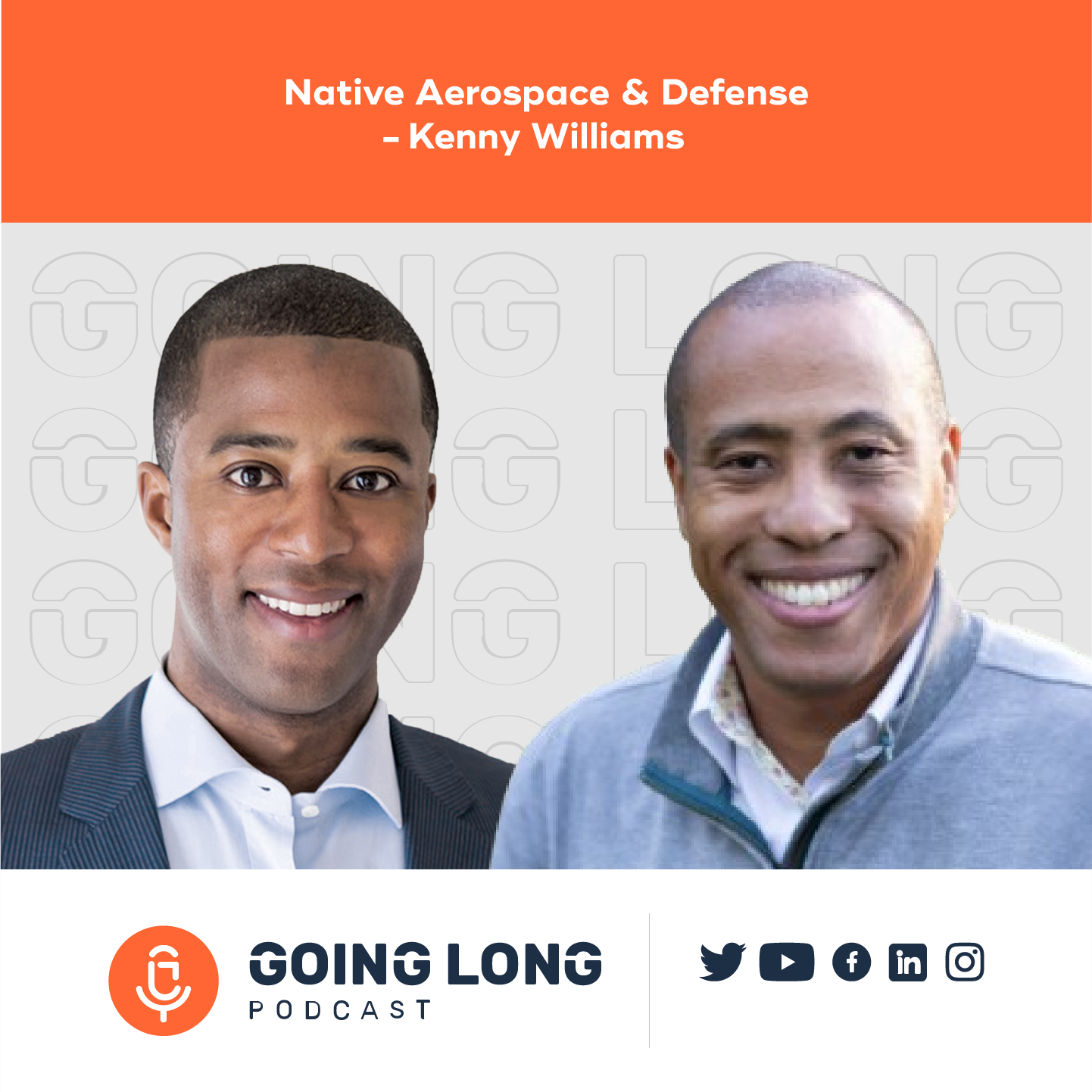
Native Aerospace & Defense - Kenny Williams

Going Long Podcast Episode 610: Native Aerospace & Defense - Kenny Williams
( To see the Video Version of today’s conversation just CLICK HERE. )
In today’s episode of The Going Long Podcast, you’ll learn the following:
- [00:24 - 02:06] Billy welcomes and introduces today’s special guest, Kenny Williams.
- [02:06 - 14:02] Billy asks Kenny to share more about himself in his own words.
- [14:02 - 18:53] Kenny describes the impact that his parents had on his trajectory.
- [18:53 - 25:30] Billy asks Kenny to explain how he was able to take challenges and learning experiences and leverage them into creating and achieving new goals.
- [25:30 - 32:25] Kenny describes the reasoning behind why he chose to move on from a well-paid, secure corporate role to go it alone.
- [32:25 - 40:11] Kenny explains how he was able to identify what unique problems he wanted to solve for clients as a service.
- [40:11 - 44:27] Billy asks Kenny to share the message she would like to hear from herself 3 years from now.
- [44:27 - 48:07] Billy sums up all we’ve learned from Kenny today and asks him to share the best ways we can get in contact and find him online.
- [48:07 - 49:28] Billy wraps up the show
How best to get in touch with and find out more about Kenny Williams:
Website: https://nativeaerodef.com/
LinkedIn: https://www.linkedin.com/in/kennyw2
If you're a corporate executive who wants to make your role optional, then grab your FREE ebook with Billy's proven 3 step process at: www.makeitoptional.com
What you can expect to get out of this ebook:
- Learn how to achieve corporate optionality
- Gain true control over your career
- Turn corporate skills into personal assets
With 26 years of experience in corporate sales leadership, achieved optionality through multiple income streams, Billy has helped dozens of executives build their paths to take control of their time.
This free ebook gives you everything you need to identify, plan, and take control of your career while building financial optionality, leveraging your skills, and start living your IDEAL day - today!
Go to: www.makeitoptional.com
Click the above link or just copy and paste the following directly into your browser to sign up and get your free ebook: https://www.makeitoptional.com/?utm_source=podcast&utm_medium=social&utm_campaign=p2olm
To see the Video Version of today’s conversation just CLICK HERE.
How to leave a review for The Going Long Podcast: https://youtu.be/qfRqLVcf8UI
Be sure to connect with Billy! He’s made it easy for you to do…Just go to any of these sites:
- Website: www.billykeels.com
- Youtube: billykeels
- Facebook: Billy Keels Fan Page
- Instagram: @billykeels
- Twitter: @billykeels
- LinkedIn: Billy Keels
Episode Transcript
Billy Keels 0:00
Today's episode is sponsored by Billy Keels advisory services. If you want to learn more about how to make your 99 optional, just go to make it optional.com. Once again, that's make it optional.com.
Speaker 1 0:14
Helping you build freedom without losing your edge. This is the going long podcast with Billy Keels,
Billy Keels 0:27
I absolutely love hosting this podcast because I get to talk to some of the most amazing industry leaders and people who have been through all kinds of experiences and are continuing to help solve solutions for others today. And today's guest makes you really think about like the fact that big corporate is really a testing ground for some of the brightest minds to find their unique solutions for the world. And like I said, today's guest is a great example of that success, of that success track, because with more than two decades and yeah, if you watch the video version, you'll be like, This guy's actually got more than two that yes, yeah. He's like, he's got it like that. So with more than two decades of hands on experience, he is one of the most sought after voices on topics like reshoring, manufacturing, building resilient defense ecosystems, the future of aerospace innovation and navigating government and industry partnerships. It gives me great pleasure to welcome to today's conversation the CEO of native aerospace and defense, none other than the man himself, Mr. Kenny Williams. Kenny, welcome to the show. Man,
Speaker 2 1:39
wow. Billy, that is a, the best intro I think I ever have had. You are amazing. Height, man, I gotta, I gotta take you around everywhere I go from here on out, for sure.
Billy Keels 1:49
You know, I like being out in Arizona, by the way. Oh, you can
Speaker 2 1:52
come out anytime. And right now is a perfect time. I think we right now we got the Phoenix Open going on, and I think I'm heading out there a little later on
Billy Keels 2:01
today. So sure, sounds good. Sounds good? Well, listen, man, I do my best just to give a little bit of insight into your world, of course, but one of the things I would really love for you to do is share the back your backstory with the going long family, and then with your permission, based on what you say, I've got a couple questions I want to ask you, and then we'll just kind of see where the conversation goes from there. Does that
Billy Keels 2:26
work for
Speaker 2 2:26
you? Perfect. Sorry.
Billy Keels 2:28
Over to you, man.
Speaker 2 2:30
So I am a native of Phoenix, Arizona, which is actually a very rare thing. My family moved out here in 1922 actually from out from Tulsa, Oklahoma. So we are, we are born and bred here, and love it here, out here in Arizona, I've actually, and for people listening, I've traveled to every, every state in the US, except for North Dakota and South Dakota. So I've been, I've been to a lot of places, and a lot of people are like, Isn't it too hot out there? Like, No, it's great. So I love it here. I was born into a family of five. I've got a wonderful older sister younger brother, so I'm the middle child, right? So there's some for all you middle children out there, you can kind of relate to some of the things I've gone through, and I think that's kind of shaped as well. My journey through through the business world and and coming up, I went to Grand Canyon University, played basketball as well, and then got into corporate life almost almost immediately, working out here in Phoenix, I worked for a company called direct Alliance Corporation. They were a offshoot of insight, which was a hardware reseller out in Tempe and started out in a little program called IBM direct, and started out as a sales rep there, which is where I cut my teeth in technology sales. Loved it there, moved up rather quickly, became a manager, won some accolades there as well. And then from there, started up my own company, coming out of direct Alliance. Back then, I was actually selling some insurance. I actually got my insurance license at the age of 18 and for health and life insurance, and decided that I wanted to pursue that again and get back into having my own business, which is something that I think having, and what I didn't say earlier was my both my parents were entrepreneurs, so my mom, she owned a small furniture store for two decades, selling new and used furniture. So she was, she was like arbitrage before arbitrage was arbitrage, right? So, and then my dad was a real estate broker, which paid off really well here in in Arizona, obviously, early on, right? Because we were. A cameo state in 1912 my family moved here in 1922 so he saw a lot of opportunity. And so they were both entrepreneurs, which I think is just in my blood, but I they also wanted me to go to college and get a good job and and make a living not not have to worry about where their next pay, where their son's next paycheck was coming from. But turns out that that wasn't necessarily the case for me, as we're talking now, as I own my own company, native aerospace and defense. But there was a long journey in between that time of working at direct Alliance and now owning my own company. A lot of ups and downs, right? But I loved every minute of it. It's really grown me as a person. It really has made me understand that in order to get what you want to do in life, you've got to go through some hard things. And part of my time of us meeting Billy, was at SAP. And there were some there were some great times at SAP and also Hard Times at SAP. So, you know, that's that's kind of a little bit of my backstory, as far as from a tech standpoint, getting into SAP, doing consulting, doing moving from hardware to software into services as well. So I've sold it all, and I loved every minute of it, but it really gave me a lot of perspective on how to approach certain things, and because all you know, hardware, software and services aren't sold the same way, and they come into play in every part of our lives, and especially in manufacturing, where I'm at now, moving from from tech to consulting and having a consulting company after I left SAP for a number of years, and MSS technologies as well just was an amazing experience. Got to meet a lot of customers, got to meet a lot of people. Got to revamp a lot of businesses that we're struggling with process, that we're struggling with efficiency. And being up close and personal with those companies really gave me a great view into what business owners struggle with. It's not the typical things like most, most people think, oh, you know you're selling, it's it's all about price. It's all about ease and things like that. And if the at the grand scheme of things, business owners don't think about price a lot of times, that's not their main concern when it comes to how things are going to go when they purchase something. The main thing that business owners and think about is, is this going to solve my problem? And that's really the main thing. And, and once I switched from thinking of, how much does this cost, how much are we going to be able to charge from this to, does it solve a problem that they ultimately have that's worth solving, because a lot of problems in business aren't worth solving, they just aren't and, and the faster that you get to the problem that should be solved, the better off you are. So moving into consulting and having my own consulting company was a great move. And became a consultant for a manufacturing company called Kovac. And they manufacture extrusions for buildings, glass as well as metal. And eventually, what they decided to do is, instead of making me consultant, they wanted me to be their CIO, because they had a they had a real need for a new ERP system that they wanted to put in. They were moving from like a QuickBooks type environment in an archaic way to handle their project management and things like that. So they really want an integrated ERP system for construction and manufacturing that gave them view from from the from the time that someone purchased extrusions to the main the shop floor, all the way through delivery and installation. So that was my first C level job. Was a covac. I They're still in business today. They're a great company. They're actually employee owned. Now, got when I was there, they were owned by a private equity firm, and now they're employee owned. And then from there, also from once I left, Kovac went to a company called pixie and help them also to implement their ERP system as their CIO as well. And then my last stop before getting into my manufacturing and aerospace career was another manufacturing, third party manufacturing company called lasify. So was a CIO for three different companies, and enjoyed every minute of it, and learned a lot about the corporate world from a much different level than when we were working at SAP. We were in the trenches and the soldiers and the and the generals, right? But, yeah, once you get into that sea level, it's it's a much different game. I. And but I enjoyed every minute. It really taught me a lot about leadership and what to expect, but it gave me that thirst again, to want to be out on my own after seeing what good leadership looks like, what bad leadership looks like. And I always tell my kids, I you know, I tell them, you don't know what bad leadership looks like until you had a good leader, and because there's a lot of bad leaders out there and very few good leaders. So for some of the folks out in your audience that that might think that they are, that they think that they know what good leadership is, it can be elusive at times, especially with corporate world so but it gave me that, it gave me that itch to get back on my own. I partnered up with a friend of mine and we started Phoenix products back in 2021 we started as a consumer products manufacturing company, really for in milling, lathe work. And we started out to sell in a simple pin on Kickstarter, and from there, we blew it up into a seven figure aerospace company, and just gave me a lot of good insight to manufacturing. I came along at a great time, I believe, because we were reshoring everything the US had just gone through covid, and they realize that, oh, man, we can't just give other countries our products to make for us, because in times of crisis, where do we go? Like, you know, you're going to wait weeks or months and maybe even a year for for things that are vital to the infrastructure of our country. And that really is what set a fire in me to really branch out and start exploring like, what do we need to make America a manufacturing powerhouse once more? And you know, you've got the honeywells, you've got the Boeings, you've got all of these companies Andrew, that are these big prime, you know, slow moving companies, like, like, like, all big companies can be, but the US now needs to have agile, very fast and easily manageable manufacturing companies, and That's what Phoenix really had set out to be, and and we succeeded a lot of different ways. And we started out as a very small company, and like I said, it grew very fast over a period of six years, and thankful for all the lessons learned and made a lot of great contacts there, which made me want to have my own thing. And ultimately, that's where native aerospace and defense comes into play. Focused specifically on aerospace, whereas when we started Phoenix, we were, like I said, a consumer products kind of manufacturing company. And really, native is here to serve the Department of War being part of the defense industrial base, as well as serve some of the largest aerospace manufacturers from an advanced manufacturing standpoint. So when we first started, when I first started out, we were a three axis single lane type company, native is going to be an advanced manufacturing five axis multi spindle, really controlled by a lot of automation, as well as robotics, and bring the manufacturing base really into the new millennium here that we're talking about. So,
Billy Keels 13:38
yeah, man. So there's, there's a lot to, lot to be able to unpack, right? But I think the thing that as we're watching, as those that are watching, and those that are listening and probably running on the treadmill, and you're thinking to yourself, well, you know, Kenny's had so many different experiences, and there's the thing that has come through, and there's two thoughts that go into my mind, and I'd love for you just to validate this, because I had this thought earlier, like success. In achieving success, it's a straight line. All you have to do is go from A to B and and you become successful. Is that how it works? Kenny,
Speaker 2 14:15
totally, totally, you don't you just, it's a straight line. You never have any ups or downs. There's never any road, road blockages or anything like that. Man, no down periods. It's all big, Facebook, LinkedIn, Mirage, it's
Billy Keels 14:34
all easy. No. So Kenny and I, of course, are, it's a tongue in cheek here, but so yeah, you've shared a lot of the different moments, but one of the things that I've recognized in your story is that you started working somewhere, and then you had this desire, this pull for you to learn and do your own thing. You talked about insurance, and then afterwards, you went back to the. The corporate and and you stayed there for a while, and then you decided you were going to do your own thing. I want to know based on what another piece of information that you shared with us, you're very kind to share with us that you talked about your father as an entrepreneur in the real estate space, and your mother as an entrepreneur in and the, I would say, consumer goods in the in the furniture space, right? What influence do you think your parents, seeing what they did one and two, hearing what they were telling you? How did that influence if I don't know if you ever thought about it, but if so, how do you think that that's influenced your professional and personal trajectory to date?
Speaker 2 15:42
Yeah, I think the biggest thing that I took away from my mom and dad in terms of their businesses, was that they were always working at them. And that's not to say that they were workaholics, because they took us on a lot of journeys with them, like, I can't tell you how many homes and real estate properties I went to with my father at a very young age, which actually gave me a very good understanding of Phoenix and the layout I can pretty much navigate my way around the city without even thinking about it. And then also with working at my mom's furniture store, like the necessity and need for systems to be able to track how long certain pieces of furniture on the floor for, how much we paid for them, what the profit margins were, what was moving at a Quicker, quicker pace, things like that. So really getting into the nitty gritty of how a business worked and operated was really something that fascinated me from a very young age. You know, we all, I think all of us, have the story of, hey, we started a lemonade stand as a kid and all those things. And I had that story too, right? Except for me, it was, it was chocolate bars at our school that we had gotten from some like discount store, and we were selling all the kids there were, we sold them for 25 piece, 25 cents a piece, and you got five for $1 right? So, you know, I had a jingle in my pocket from a very young age, thankfully, based on what I what I learned from my mom and dad. So I would think, I would say the biggest thing is just learning from them that their work as entrepreneurs was not 24/7 but every day like they thought about their business, they talked about their business, they tried to improve their business however they could. And that's something I have taken with me to pretty much not just my companies that I've started, but also just for work in general.
Billy Keels 17:45
How
Speaker 2 17:46
do we grow? Or how do I grow? How do I make things better for people that work with me, whether I have my own company, or whether I'm leading them in the corporate world, which you know you, that's where you and I met, was at SAP, where I was leading. I mean, Geez, that was probably over 100 people across Arizona and Philadelphia, PA, going back and forth between those two offices. And just, just thinking about that just brings back some fun memories, for sure.
Billy Keels 18:16
Yeah. So, so, when you think about like, so you're thinking about the fun memories, you're thinking about the you know, what the impression that your parents, what they said, what they did, how that helped you. But I'm gonna assume along the way, because there's nothing that is there's nothing that's perfect. I mean, there were definitely a lot of things that were happening positively during our time we were working at SAP, and after and before, I'm sure, but, but there are also maybe some some challenges that you saw, or challenges or just issues that were happening because of the nature of large multinational companies. And maybe if you have a story of a challenge or an issue that happens, you don't have to name it. But what that did for you in terms of saying, okay, look, there's a great skill set that I can build here, and I'm going to take this and I'm going to use it at a certain point later for myself or to serve others.
Speaker 2 19:10
Yeah. So
Billy Keels 19:11
did that ever happen? Did that
Speaker 2 19:13
ever happen? It'll start in the corporate world and also move to meow, to my own companies.
Billy Keels 19:19
Yeah,
Speaker 2 19:19
one in the corporate world, you typically are getting a job where it's the same old, same old, and it's something that's already done, and you're just kind of managing it right? You're not, you're not necessarily creating something new. You might have some new ideas upon what you're doing, but it's it's been tried before. For me, I really ventured out and for when I was at SAP and wanted to start something new and try something new, and they were just getting into cloud infrastructure at that point, and it was brand new for the whole world in terms of having an actual system. That was a SAS model, and I really gravitated towards being able to go to that and start a in a new department and for North America, right? And it was definitely a step up for me. Like I said, I've been managing two teams on on each of the different sides of the country. And you know, I was, I was well thought out throughout the company. I was top talent, all of those things, and I left all of that to start afresh, something that had never been done at SAP, a brand new paradigm, going from on premise, big data centers, to in businesses and fortune, 100 companies to, hey, we're going to move things to the cloud. And not only are going to move things to the cloud, we're going to focus on small and mid sized businesses, something that SAP had never enough, and it was, it was a great feeling to be able to do that, to start with, right? But with all new things there had, it's had its challenges, and one of the big things was no one knew who we were
Billy Keels 21:11
from
Speaker 2 21:12
a marketing perspective, like at all. So business by design, where I came from, at SAP, was this brand new toy that was going to bring sap into the new the new in the 2000s and be a SAS only model. And they had the mentality of, hey, if we build it, they will come well, of course, that's not how things work. And we turned phones on, we turned the website on for people to sign up and us to have phone calls and coming, but they didn't come.
Billy Keels 21:50
I think
Speaker 2 21:50
they actually manufacture and come up with our own leads and and, you know the, I think the ink 5000 list back then had just started up, and we started to comb that, and started to do a lot of outbound, and that wasn't even in the model. The model for what we were doing was all inbound, which is what it is today for a lot of SaaS companies, is really a lot of inbound. But back then, there was their SaaS was very much new, and people didn't, didn't know really anything about, especially for us as a big company like SAP,
Billy Keels 22:23
yeah, so, you know, and I would if you allow me to just jump in, because there's, there's a pattern that I'm actually seeing that I want the going long family to recognize, because they don't know where we started, right? But if I think about just the beginning story that you you mentioned. So you're you do your college thing, you go to get your direct Alliance. That's something that is, you know, you started there, then you wanted to do your own thing. So you were being called to start your own business. But then, when you joined SAP, you were actually part of a very newly installed part of what they call go to market. So a new distribution channel, which was selling via inside, meaning, not out, yes, with your with your suitcase, face to face, and all that kind of stuff. So that in itself, and then followed by going to another new solution, right? There's a pattern. And what I want the going long family to start to realize is that you can even be in a corporate role, and start to recognize that there's patterns, maybe also to your parents, or one of your parents is an entrepreneur. And so even without you thinking about this, you are exposed to being okay with accepting certain levels of newness. Some would call it risk, depending on where they're coming from. And from and so I'm just wondering if you're noticing this pattern, because then after that, then you went to get into you went from hardware to software, from enterprise software, and then you went into services. So you started to complete that circle.
Billy Keels 23:51
Yeah. And
Billy Keels 23:52
I'm wondering in this is not a pun, but was that by design for you, or was that something that just happened as a matter of continuing to go to the next
Speaker 2 24:02
thing. It definitely happened as a matter of continuing to go to the next
Billy Keels 24:06
thing.
Speaker 2 24:06
I don't think that here's what I'll say. I think a lot of what we do prepares us for the unknown. And the unknown for me was moving from hardware to software to services into from there, moving into owning my own company, from there, moving to going back in the corporate world at a much higher level, as a sea level, from there, starting my own manufacturing company, going into aerospace defense. So I think that all of these things are, are they're not. They definitely weren't mapped out for me. So to your point of is a straight line, and it never has any bumps for me, there was lots of ups and downs for me. There was lots of different experiences that I came across in life through my career that really grew me and made me okay with change.
Billy Keels 25:00
Yeah,
Speaker 2 25:00
and okay with risk. And I don't look at any of those things as risky, really. I just look at them as, oh, I learned how to do this. I've conquered this particular area, and now it's time for me to put that into practice somewhere else.
Billy Keels 25:14
Yeah, okay, in a lot of that is the perspective. So I really appreciate that perspective. There's a lot of things that I share with you, and just in terms of how you evaluate, everybody evaluates risk differently. So, so there's, I'm gonna, it's maybe a little bit of elaborate of a question, but I'll try not to do that. But so you mentioned you had this evolution. You get to this C level, right? And today, I'm working with people or C level, or maybe right below them in large organizations. And a lot of times, people will say, Well, when you're in that type of a role, like, you're making the money, you've got the teams, you have the influence, you have the discounted stock prices, you've got the extra RSUs. Like, like, why would you ever, ever consider doing anything other than getting that one paycheck in those benefits and so, but it happens. It happened to you, Kenny, it happened to me, and it happens for a lot of other people. So can you give us some insight into why in the world? Because a lot of people would even consider that in itself to be risky, but you didn't see it that way. I didn't see it that way. But what was, what was it that made you say, like, I've got this security even at a sea level, and there's still something else calling me that I've got to figure out.
Speaker 2 26:28
What I will say is, is that the misconception of having security at sea level, for people who have not been at sea level, there isn't security there, and that's something really hard for a lot of people to wrap their mind around. My longest stint as a CEO as a CIO was three years or three and a half years somewhere around there. And I think the average, I think, is like one year for most C level executives in their current positions, and that's something that is all. You always have to be innovating at that level. You always have to be delivering at that level. There isn't a down time whatsoever like you can I think, I think when I was a young man, I was able to get it. Get, get be okay with coasting for a little while, right? Like you have a good quarter, you take a couple weeks off, you wake up, whatever it might be. But when you're at that level, you're getting phone calls on the weekend at 989, pm at night, you're taking conferences at four in the morning. It doesn't matter, because I was global. So in my, in my roles for for CIO, so you know, it's it you're always on. And I would look at that and say, there's less security there. Then if I have my own company, I know what my strengths are, I know what my abilities are, and I'm okay with going out and testing that in the market. And that's and that's why I say there's, there's really not a lot of risk, even at a C level C level, C level executive, you're still at the behest of cello or board, or whoever it might be that's calling the shots. Right? It can be a family owned company. It can be a publicly owned company, but you still have to answer to someone. You're not just going out there and doing what you want, necessarily and even even at the standpoint of owning your own company. Guess who you answer to your customers?
Billy Keels 28:43
That's
Speaker 2 28:44
your ultimate boss and you've and sometimes those those folks are, are extremely demanding, right when you have your own company, but I'd much rather be at the behest of my customers than I would a CEO or a board, or, for one of the companies, a private equity firm, which is another interesting
Billy Keels 29:07
that's a whole different kind of a whole different kettle of fish, as they say, so, one of the things that you you mentioned, right? And you get a chance. You have the opportunity as a as a business owner, you can choose your clients as well, right? You You can decide whether you want to serve a, you know, business to consumer market, or a business to business market. And then even within that, you have the the option of of serving those clients and also to there can be a point where you're like, This is not a good relationship. This doesn't work anymore. So, so that's something, that's something to think about. But Kenny, was there a moment when you realized, like, this is like, this is the thing that made you say, I want to start my own thing, like, but on this path that you're on now, because there were already glimpses of that along the way, when you said, you're still a young man, by the way, I. You said when I was a young man, you're still a young man, because I'm a young man.
Billy Keels 30:04
My
Speaker 2 30:04
21 year old son would disagree with you, but that's okay.
Billy Keels 30:07
Well, that's okay. He can disagree. You can agree to disagree now. But was there at that moment that that was like, yeah, now, now I need to this is the time.
Speaker 2 30:21
Yeah, I think, I think definitely, once I got a glimpse of high level leadership as a C level executive, I said to myself, Why am I not doing this on my own?
Billy Keels 30:34
Okay?
Speaker 2 30:35
And really, you know, I had, I had done a services company, a consulting company, and on my own, I've had partnerships and and things like that with in terms of ERP implementations. And what I what I realized was, though, that I definitely needed a partner to handle the more technical aspects of manufacturing, because that's where I didn't have experience. But I would say that that's the being a C level and realizing like, that's where I want to be. I want, I want to be the CEO of my own company. I want to I want to run it. I want to do the marketing. I want to do the financials, I want to do the business development. I want to be the face. And once I realized that, hey, all of these companies that I've worked for, some family owned, some PE owned, some, you know, you know, publicly owned, I was like, Why? Why can't I do that? Right? I had seen the inside. I saw how the sausage was made, and I was like, man, let's just jump into it and do it. And again, I don't look at that as risk. I look at that as areas of my life that were developed over a period of time that I've become very comfortable with, that I needed to go out and do on my own.
Billy Keels 31:58
Okay, yeah, love that. And you know, for that person who's listening, who's watching today, when you have this feeling, when you have these thoughts, when you are saying these things to yourself like you are not alone, there are other people that have and Kenny, I appreciate you sharing that. But can you and as we start to get ready to land the plane, here the proverbial plane,
Speaker 2 32:18
yeah, I figured
Billy Keels 32:19
you'd love
Billy Keels 32:19
that more than even. Anybody else. But how? So one of the things that that happens, right? And when I'm working with clients, they'll come to me and they're like, Well, you know, I'm already, like, I have done my projections five years out, and I'm doing this and I'm doing that, and I'm like, Okay, well, what? Well, what about the like, you're so far ahead, but what's the next step? And they don't even think about it, because they're not thinking, they're not thinking they're thinking so far ahead that they're not not thinking about the practical next step. And one of the steps that's really important and you hit on it earlier, it is, what is the problem that you are best equipped and want to solve for someone or some other entity. Can you take us into how you found out or how you figured out right now, you talked about, you know, being the as you are, the CEO of native aerospace and defense. What was it? How did you figure out what the problem that you wanted to solve and were best equipped to solve
Speaker 2 33:22
Well, in my business, the problems can vary. So typically, there's a few different threads there for problems. One is they might be getting faulty parts from whoever is manufacturing them.
Billy Keels 33:37
The other
Speaker 2 33:37
problem might be, they are getting parts not on time. So screwing up production schedules, every part we make typically goes into another part that goes into an overall system, whether it's a jet engine, whether it's landing gear,
Billy Keels 33:53
you
Speaker 2 33:53
name it, right. So those those production schedules get pushed back if parts are not delivered on time, whether it's a tiny screw that comes off of a lathe or a Swiss machine, all the way up to a anchoring system for a landing gears. So you're talking about obviously time equals money, and when you get pushed back on your production schedule, more money is spent, right? So you've got, you've got that as a threat to very rarely does it come down to price or cost, because we are dealing with such important intricate parts to to a jet engine or a drone or, you know, whatever, whatever it might be, from a aerospace and defense standpoint. So, but those would be the three, three big areas. I would say that that's where people are looking to solve problems. And like I said, usually it's faulty or they're not making it correctly. Or it's just taking way too much time. And they didn't quote correctly, right? So they'll quote, hey, it's gonna be good, and we'll be able to get this to you in five months, when, actuality it took eight months now behind in production. So those were the two areas I think that I concentrate on the most was, if you didn't have big problems like that, where it was you're running behind your production schedules for your parts that you're getting from manufacturers like myself, or they just weren't meeting spec. There's a much bigger problem there that needs to be solved then, then what you're seeing as a as a manufacturer, OEM,
Billy Keels 35:39
okay, okay, so it's basically, and you you know that you like to figure out problems that help people make sure that things need to be where they need to be in time for whatever the next step is. Like you genuinely and you like having things in order. You like making sure that everything that is supposed to be on a line is on a line. And you like solving those types of problems
Speaker 2 36:02
Absolutely. They're multi step. They're not easy. And what I'll tell you is this, the easier the problem is to solve, the cheaper your the cheaper your product or service is going to be. I like to stay where it's the problems are hard. They've gone to multiple people, and guess what? They're gonna they're gonna pay a premium for that, because if, if I can solve it for them, that's a headache that that cost them hundreds of 1000s, sometimes millions of dollars.
Billy Keels 36:32
Yeah. Okay, now that makes sense. So listen, before I get into the last question, I would love for you to share just you know, you've given us some high level but in terms of who you're helping today, as CEO of native aerospace and defense, maybe you can give us an idea there. And then I got one last question
Billy Keels 36:52
for
Speaker 2 36:53
you. Yeah, sure. So I'd say the biggest areas that are people that we are helping, we're going after some of the primes, the honeywells, the bombardiers, the Boeings of the world, they really are needing our help as much as possible to be able to design, manufacture and ship parts out on a reliable basis throughout the year, it's been you've seen some of The headlines for Boeing and some of the challenges that we had, but by offshoring and not having up to spec parts and things like that, like you can't have things falling off airplanes in the middle of in the middle of takeoff and landing or flight, just that's just not acceptable. And then the other thing, obviously, is making sure that we are resilient as a country and being able to support aerospace and defense. We can't rely on the China's, the India's, the Taiwans. We can't rely on those countries. We have to have our own infrastructure to be able to not only design and create, but also to repair and to manage those those those planes and things like that.
Billy Keels 38:11
Yeah,
Billy Keels 38:12
it's interesting. I hear you say that, and I think about how much previous experience can influence us, because you mentioned earlier in the problems that we want to be able to solve. And you talked about the experience that you had in another corporate role during the during the global pandemic, and how that affected you, and being able to get to certain supplies and be able to get them quickly. And so my mind always thinks about, okay, how much, just like I asked you before, from your parents, how much does that help make you much more resilient, or see different opportunities where others may see risks. So I appreciate you sharing that. And Kenny, like, just to kind of wrap things up, there's, there's one thing that, unless there was anything else that you wanted to add, man, that maybe I have not asked you, that you think is important for the going along family
Billy Keels 38:55
to
Speaker 2 38:56
hear, I think that the one of the main things is, is that you take those experiences that you've had throughout your career, and you don't forget them. You you, you continue to kind of cultivate them and apply them to what you're doing today solve those new problems. I think that they're, you know, I think a lot of people think that there's something new under the sun, but I would say it's more of hey, who's thinking outside the box, right? And, and to solve these new problems with a different flavor, because of the time constraints Now, we move so fast. It's insane, how fast we move now compared to even when you and I started out in the corporate world, or, right? Like, you know, I when we started out, there was still fax machines. And now it's, it's, it's, it's all done through, you know, back end API's information. You don't even have to input things into a system anymore for you to get information from your customers or for you to send information out to them. So the. The speed at which we do business now is just mind boggling.
Billy Keels 40:03
Yeah, no, I It's important learn quickly adapt and be prepared. So one of the things that, and I like to wrap up with this, because it's just, it's just life, right? And then for so many years, and there were things, one after the other after the other, that I felt like I was just in this success loop, or at least it felt like everything was going on. Of course, there were things that you learned from because they were just like minor things, but there was a certain point in my life where I was going through very challenging personal and professional issues at the same time,
Billy Keels 40:38
right?
Billy Keels 40:39
And I realized at that moment in time a couple things. One, when things are going really well, we don't tend to pay as much attention because things are going well, and you're like, ah, what? Okay, well, and you just go by so fast and you don't appreciate it. But then when things are not going according to plan, it can be really easy to get caught up in this loop of nothing's working, blah, blah, blah, all the things are going bad, and you have people that love you and people that care for you, and they're sharing their perspective and all these things. But when you're in those low moments, the thing that changes is not the situation. It's not what everybody else is telling you, it's what you actually tell yourself in the action that you take thereafter. And so you're going to continue to be successful. And then sometimes, if you're watching on the video or showing what success looks like, and sometimes it's like this, and sometimes, but it's definitely not like this. So watch the video version if you want to see what that was, because I'm not going to explain it on purpose. But the thing is, is what happened for me was when I basically looked myself in the mirror and I said this, it's time to change like I said, whatever. I'm not going to say what I actually said to myself, but there was a moment that I had to give a message to myself, and that message is a message that I continue to repeat when moments or times are challenging.
Billy Keels 41:55
And
Billy Keels 41:56
so I would love for you to share with me and the going long family, because I want you to think, three years from now, Kenny, you're going to be looking back and you're going to be going, oh my god, Kenny, I'm so glad you told me this, because I've needed this a couple of times. What's that one message that you want to share for yourself that you know you're going to need between now and the next three years so you can look back and go, Hey, I got here.
Speaker 2 42:17
Yeah, it's, it's kind of a cliche, but I love it, and this is something that I I live by. It's do the hard thing first. Don't put off the hardest thing that you can accomplish and actually get the most bang for until last, until the end of the day or the end of the week, or the end of the month, the end of the quarter, tackle that thing first, even if you have to break it up into smaller pieces, do something hard every single day. I'm a I love to lift weights. I'm a big I love being in the gym. It's like, I get up and I get up at like, 430 in the morning to do it, because it helps to set the tone for my day, right? It? I whether it's squats, whether it's deadlift, whether it's inclined, dumbbell, bench press, whatever it is, right? And I go hard and heavy at it, so that when three o'clock rolls around, right, and I should be exhausted, but I'm not, because I did all of the hard things, 4am to basically 11am right? So I got seven hours of hard things done before the day really got started. Because once, once we get into the meat of the day, our day doesn't belong to us anymore, we're going to get pulled in a million different directions. And for those of you that are starting your own businesses and things like that, yeah, yeah, you can schedule all you want, don't get me wrong, and try to keep to that schedule. But once you get your own company, and once you get processes going, once you get your team members going, once you get customers and vendors and all those things, each of those people are going to require part of your time, and they're going to pull at it. They're going to tug at it, and it no longer belongs to you when you get to that 3pm 4pm 5pm threshold. So I would say, tackle the toughest things you possibly can to start your day, and it'll make your life so much easier than if you're putting them off for late in the day or late in the week, or, you know, late in the month.
Billy Keels 44:19
And I love it, man, so do the hard thing first. I appreciate you sharing that with us and Kenny. Man, this, you know, this has been a long time coming, but I can't believe, like the conversation is literally flown by already. I'm thinking, man, he got here. He was telling us like he's actually a native of Phoenix family moved there in 1922 10 years after the state was incorporated, which I think is absolutely phenomenal. Family originally from Oklahoma, and you did say you were the middle child of five, right? And so, like, I'm thinking, oh my gosh, with this university out there, you got to a certain point where, early on, well, yeah, you did your corporate but you also had your own early. Own business experience in the insurance space, you started realizing that there were so many other opportunities you continue to take on. What you saw from your mom, who was the furniture maker owner, and your dad, who is the real estate in the real estate space, and they wanted you to be able to not have to worry about the paycheck, or where the money was going to come and the, you know, all that kind of stuff. So you got that kind of entrepreneurial juice. And then, oh, hang on some some curious, quote, unquote, security from the corporate life. And you continue to do that. You got your experience then in hardware, you got your experience in software, and then you also got your experience in consultancy. And so it really helped you on the services side to really see a full picture. But along the way, you realize like, Hey, you could take these skills. You saw what good leadership looked like. You saw what bad leadership looked like. You didn't have the opportunity to be in the C suite yourself multiple times. And then, even though you rise to the top and were there three times more than most people were in that type of a role, there was still something that was burning inside that said, Hey, listen, Kenny, you want to solve your problems in your way with your clients. And so you took all of that previous experience, the things that worked well, the things that didn't work so well, and you packaged it up to the point now where you are not only leading the vision, establishing the vision, but actually helping and serving your clients. As CEO of native aerospace and defense and my going long family, is like, just ask him the question. Just ask him the question. So let me ask, on behalf of the go along family, what is the best way to find out more about what you've got going on, Kenny, and also to what you've got, also what you have going on at your company?
Speaker 2 46:43
Yeah, sure, the best and easiest way for people to be able to reach out to me, honestly, is LinkedIn. I find that that platform has been invaluable to make new connections, to get the word out about your company. Even more so than and for me, I look at, I look at a business owner as a brand unto themselves. Obviously, I've got native aerospace and defense, but I think that people recognize and want to do business with people they like. And the easiest way for people to get to know someone is on that platform. I think I've gotten numerous leads and met numerous great people on LinkedIn. That be the easiest way. And then they can go to our website, native arrow, def calm as well, and sign up under there for, for you'll get, you'll get just my unfeathered take on, on, on, on the business and and the industry that I'm in, and I'm building it right now. I'm on an acquisition play. So if you know of anybody out there that is looking to either sell their machine shop or their manufacturing company, we are on the hunt for companies like that to acquire so but yeah, I would say LinkedIn would probably be the best place to come to find me.
Billy Keels 47:59
Okay, fantastic. So listen go along family. And as you know, I always whenever I hear LinkedIn, because Kenny, you know, I'm always active over there as well. So going along family, when you when you reach out, not if, but when you reach out to Kenny, just do yourselves a favor. Let him know by sending him a personalized invitation that you have already invested time to get to know more about him and his story. It's going to help you continue the conversation, and just going to give you another point of reference. So that stated, I will also include, Kenny, we're going to include your website in the show notes. So if you're running on the treadmill or doing something else, don't worry. All you're gonna have to do is click. It'll be very simple. We want to keep it simple here. And so with that, Kenny, just on behalf of the entire going along family, I want to say thank you very, very much man, for deciding to invest your time with me, with us, and sharing your insights. So thank you very much, man, I really appreciate
Speaker 2 48:47
it, Billy. I thank you so much for having me on. It was so great to see you and talk to you again, and I'm so excited for you, brother, congratulations on all your success, and thank you for having me
Billy Keels 48:58
on.
Billy Keels 48:58
All right. Thank you very much. Really appreciate it. Go along family. Thanks. Once again. Appreciate you joining Kenny and I today. Go out and make it a great day.