
The Corporate Alchemist - Rae Kyriazis

Subscribe to the podcast


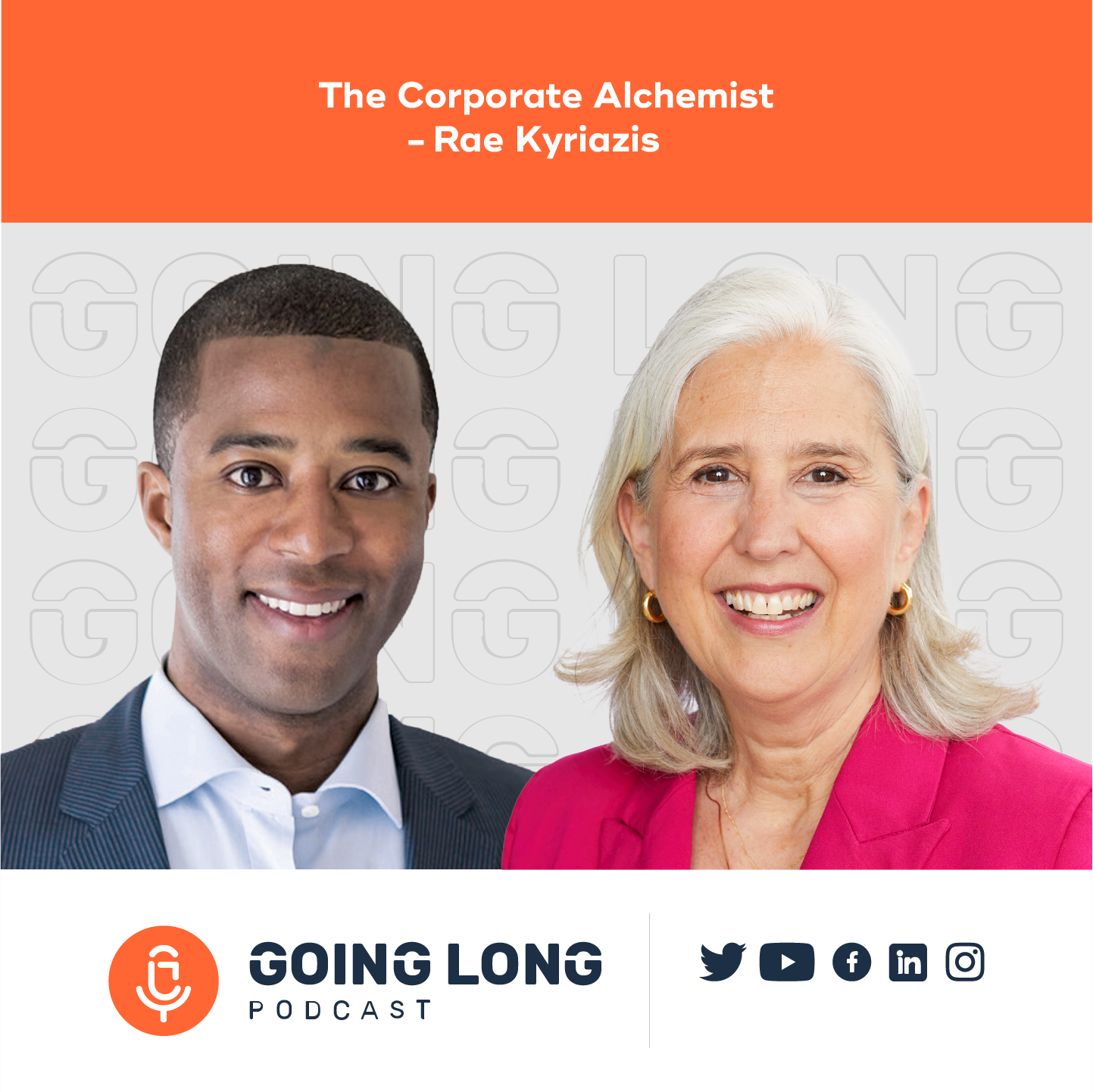
The Corporate Alchemist - Rae Kyriazis

Going Long Podcast Episode 604: The Corporate Alchemist - Rae Kyriazis
( To see the Video Version of today’s conversation just CLICK HERE. )
In today’s episode of The Going Long Podcast, you’ll learn the following:
- [00:24 - 01:59] Billy welcomes and introduces today’s special guest, Rae Kyriazis.
- [01:59 - 08:27] Billy asks Rae to tell us more about herself in her own words.
- [08:27 - 11:40] Rae shares what it was that gave her the fortitude to go against the grain and trailblaze.
- [11:40 - 24:16] Rae shares insights into how personal and family life interacted and influenced her corporate work-life , and details her experience and work in contributing to global corporate transformation.
- [24:16 - 29:23] Rae describes the story and process of how she moved away from corporate.
- [29:23 - 32:00] Billy asks Rae the role mindset plays in self leadership.
- [32:00 - 34:27] Rae describes what commonly holds people back from instantiating self leadership.
- [34:27 - 36:36] Rae shares the message she would like to hear from herself three years from now.
- [36:36 - 39:34] Billy sums up all we’ve learned from Rae today and asks her to share the best ways we can get in contact with her and find her online.
- [39:34 - 40:25] Billy wraps up the show
How best to get in touch with and find out more about Rae Kyriazis:
Email: rae@raekyriazis.com
Website: https://www.raekyriazis.com/
If you're a corporate executive who wants to make your role optional, then grab your FREE ebook with Billy's proven 3 step process at: www.makeitoptional.com
What you can expect to get out of this ebook:
- Learn how to achieve corporate optionality
- Gain true control over your career
- Turn corporate skills into personal assets
With 26 years of experience in corporate sales leadership, achieved optionality through multiple income streams, Billy has helped dozens of executives build their paths to take control of their time.
This free ebook gives you everything you need to identify, plan, and take control of your career while building financial optionality, leveraging your skills, and start living your IDEAL day - today!
Go to: www.makeitoptional.com
Click the above link or just copy and paste the following directly into your browser to sign up and get your free ebook: https://www.makeitoptional.com/?utm_source=youtube&utm_medium=social&utm_campaign=p2olm
To see the Video Version of today’s conversation just CLICK HERE.
How to leave a review for The Going Long Podcast: https://youtu.be/qfRqLVcf8UI
Be sure to connect with Billy! He’s made it easy for you to do…Just go to any of these sites:
- Website: www.billykeels.com
- Youtube: billykeels
- Facebook: Billy Keels Fan Page
- Instagram: @billykeels
- Twitter: @billykeels
- LinkedIn: Billy Keels
Episode Transcript
Billy Keels 0:00
Today's episode is sponsored by Billy Keels advisory services. If you want to learn more about how to make your 99 optional, just go to make it optional.com. Once again, that's make it optional.com.
Speaker 1 0:14
Helping you build freedom without losing your edge. This is the going long podcast with Billy Keels.
Billy Keels 0:27
I absolutely love hosting this podcast, because I get to sit down with some of the most amazing people, global leaders, impact makers, and today is absolutely no different. You know why? Because today's guest has an expertise rooted in human skills, universal principles, global communications and social and neurosciences, to deliver amazing results and make super positive impact, stated by me, and you'll find out why, because you know what, she has done, this across six continents, 123456, continents, in 60 plus countries. It's absolutely amazing. She's a corporate Alchemist, a business accelerator and human Energizer who combines, and you won't even believe this, especially if you're watching the video version, combines four decades of corporate experience in sectors like enterprise software in different disciplines, like sales, sales leadership, human development and global transformation. And you know what? It gives me great pleasure to welcome to today's conversation, none other than Ray. Kiryas. Ray, welcome to the show,
Speaker 2 1:37
Billy. Thank you so much for having me.
Billy Keels 1:40
I'm so excited. I mean, I just can't wait for everyone to learn about the life that you've led, the positive impact that you have literally made around the globe. I am one of those individual recipients of the greatness and the experience that you have shared, and I think it's absolutely fantastic. So yeah, I've said a couple things, hopefully, Ray, you'll keep me honest here. The majority of them were right on key. But if not, what I want to do is invite you to share your backstory in your own words, and if it's okay with you, we'll see kind of well, depending on how you answer, maybe some questions I'll ask you here and there and see where the conversation goes. Does that work for
Speaker 2 2:20
you? Perfect.
Billy Keels 2:21
Over to you.
Speaker 2 2:24
Well, you know, I can begin by saying that from a very young age, I always was wired to pick the non traditional route. So back in the 80s, my dad sat me down and he's like, you're gonna go study engineering. And I was like, Ew, that. What is that? I don't want to do that. So I end up at Purdue University in a totally different discipline, because I have to rebel against him. I get to school, and all of a sudden I'm like, oh, that's intro. Oh, I'm meeting these people. That's really cool. So I end up in this industrial engineering, industrial management program where I literally don't realize that I am one of a very, very small number of women in these class like, I don't see it, I don't feel it, I don't know it. Flash forward. I go to interview for my first job, I end up gravitating, magnetically, gravitating to this small software company. Every single person, my friends, my like, fam, they're like, what software like? That's the paradigm in 1985 so I walk into the office on the first day in this new higher class of four people, two men to women. That was extraordinary. And I announced in the opening introductions that I'm going to sell software and all the middle aged IBM men who had founded this small company look at me like, I have 24 heads and say, There's no way you're going to sell software. So internally, I'm like, well, I'll show you. I do end up meeting what is now my husband of 39 years on that first day of work. So I am super motivated, and I just start walking on a path that had never been really I mean, it was a completely virgin path. So I'm going out, meeting customers, doing all these things after 12 months, become the first the sales salesperson of the year. So I'm 22 years old, sales person. I've sold more than all those, excuse me, senior White men. Then they promote me to be a sales manager like she's. Going to fail at this. I become the Sales Manager of the Year, you know, and it just keeps going. So I loved, I loved enterprise software. I love the challenge, the intellectual curiosity, the, you know, every year was bigger our company then got acquired and acquired again. So now I'm in this large software company, leading, you know, hundreds of people, but my husband and I got married, we had our first child, and then I'm pregnant with our second child, traveling all over the place, seven states, plus Canada, hundreds of people, and I wake up one day and I'm like, I gotta retire. He's looking at me. He's like, okay, so I just knew, and it was very much a visceral feeling in my body. Take a few years. We had three kids in four years, so it was really busy. He traveled all the time. And then our youngest was getting a little bit older, and I woke up another day and said, I'm going to over parent if I don't. I need something to keep my intellectual edge and keep growing and the curiosity that I have in life. So he runs into a former colleague in an airport, says, Ray's thinking about coming back. I get offered a job at a very large software company, and end up being in the most unbelievable incomprehensible situation of my entire life, given a territory that's impossible, a leadership team that does not believe in me, and they put me on a performance plan from hell, I walked around at first. It was supposed to be three months, it got extended to nine, almost 10 months. I felt like I had the scarlet letter, because everybody knew I was on this performance plan, la, la, da. Long story short, I end up achieving it, and I get a phone call pretty shortly after this, we want you to lead this global transformation program. What? Yeah, okay, what is it about? We're going to hire hundreds of 20 somethings in 60 plus countries to diversify our sales force. Because our sales forces, you know, the average is a 48 year old white male, okay, why would I take the job that nobody believes in? That nobody there's no roadmap for this. There's no blueprint. There's nothing and no believers. I mean, 100,000 people in the company, maybe 10 people thought this was a good idea. They're like, yeah, you're the one to do this. So yeah. And today, the program continues. I left the company a couple years ago, but yeah, I take the path less traveled.
Billy Keels 8:19
Yeah. So there's so many different things that we can unpack. Even think about the very first conversation that you're having with dad and but, but there's something that you've mentioned that I think is really interesting from a trailblazing perspective, right? Because this is one of the things that you have mentioned that this is like a part of just maybe your DNA. You didn't say that I'm adding that. But a lot of times when we have the corporate path in front of us, there's already predetermined path. So to be a trailblazer, even inside of a corporate entity like you know, you and I know how that works, I did something very similar, like was part of a team. There were only 12 of us when I first got there, and there and there were 1000s around the globe, because it was a specific sales channel that eventually took off. But what do you think it is about you and your in your makeup that really gives you the fortitude to go against the grain to be that Trailblazer? Because it's not something that everybody is born with. I don't think,
Speaker 2 9:24
I think it's so innate in my soul of doing the thing that is not conventional, not easy. I never, I never sought out the easy path, and and this kind of goes to my principles today, that I help people infuse into their leadership, that the more we feel it, that this felt experience this in. Embodiment of, where am I supposed to? Where do I fit? Where am I passionate? And I've always been fearless in following that path of passion and possibility.
Billy Keels 10:17
Yeah, so, so having this like there's this innate part of you, and then just not you're okay with, with taking action and figuring it out along the along the way. Would that be fair, like you have a true a true north or a North Star, and then you figure out along the way, right? Okay, so it's
Speaker 2 10:33
interesting there, Billy,
Billy Keels 10:34
you can add two, if you'd like brave.
Speaker 2 10:38
I've learned from a very young age to surround myself with amazing, courageous people to hold me so I have often talked about the table of five. I have mentors today that have been with me, supporting me, encouraging me for the better part of 30 years. And so there's this, even when I wobble, of course I wobble, even when I'm scared to death, I activate. I call in these believers and say, Tell me what I need to hear. Give me a swift kick in the rear end to keep me on my focus for my North Star.
Billy Keels 11:32
Yeah, I love that. You know as you as you have that, and you have your table of five, there's there's also something that you mentioned before, and, and I know we've been working with clients that it's something that I start to recognize a pattern. I was watching this video the other day. They're talking about pattern recognition and and things like that. And one of the things you mentioned was, your life was changing. Your family was growing. You were but also you got to a certain point where, like, I need to have like, I'm over. I don't want to over parent. I don't want to do this. Talk to us about like during your corporate experience, like, how did those changes in life actually impact decisions that you were making that affected, like, corporate decisions that were affecting your personal life and vice versa, because I feel like a lot of people, I know I struggled with that a lot during corporate and I didn't want to talk to a lot of people about it. But now, since I have a microphone in front of me, and I can have amazing conversation with people like you, a lot of people can learn from from our experiences.
Speaker 2 12:37
For me, first and foremost was marrying somebody who was equal partner with me, and that remember we met at work, so there was this eye to eye relationship from day one, and we had a deep understanding and belief in each other that no matter where, I mean, there were points, you know, long relationships, long careers, have rhythms, and there's highs and there's lows, and there's all the Things that emerge in life, and having our designed alliance that was supportive, that was absolutely fundamental. So when I was traveling all the time, you know, he was taking care of the carpool and the grocery shopping and the laundry and so and vice versa. So we were very much equals, as I can reflect back now, 40 years into my career, I can say that what parenting brought to work was greater empathy. More more range. Range for all the things, range for people having health issues or family problems or like, just more range and the ability to connect with people on so many different levels, on a personal level, on a mother level, on a we got to close this deal, this quarter level, Like I have range in all of these topics, and I can look at you now 40 years in to say all of that range is probably the greatest gift that I've learned and evolved. In this lifetime?
Billy Keels 15:01
Yeah, I love that in and I was talking to a friend the other day, and we were talking about the difference between empathy and sympathy, right? There was a lot of things that when I was when I had not yet had the experience, I could really sympathize, and I would really say, Yeah, you know, I understand where you're coming from, and blah blah. And actually, I tried, with all my heart, but the reality was I hadn't actually lived the experience. And so it's such a powerful word that you talk about empathy, and then to even extend it beyond that, and talk about the range that you could empathize with, whether it be personal, whether it be professional, there's a lot of depth to that. And also, just, yeah, a lot of depth to the experience of that. So I mentioned also a couple of was there anything else that you wanted to add there? Ray, just want to make sure. Okay, all right, cool. So one of the things that you know I mentioned early on was you having had these different types of experiences, and you're talking to some of that now, but I would really love, as we talked about some of the different disciplines we I talked about you having, you know, development in this, in the sales arena, in the sales leadership arena, in the human development areas. And I maybe like to just go, kind of go down two of them specifically because, well, maybe three, maybe three, but it's not something that everybody has an opportunity to do. I mean, I remember the last company that I was with, you know, I was with SAP for 16 years, and I was there, and I had there a very unique opportunity where I worked at a regional level. So across Europe, Middle East and Africa, I worked at a global level. And then the last seven years, I worked at a local level, so I had to all three experiences. But it's not every single day that you have an opportunity to globally transform an entire organization. It takes a very unique skill set to be able to do that effectively. But we also have global leaders here, or aspiring global leaders here, and maybe you could talk to us a little bit about what were some of the skills that were necessary or that you were utilizing to be able to drive global transformation.
Speaker 2 17:14
Thank you, Billy, that is a really important question. In my experience, I had been socialized for the first 25 plus years as a North American individual contributor, sales leader. And there's a thing, there's a swagger that North Americans have, like the whole world revolves around us, and it's kind of this, we're better than everybody else, and I knew going into that role, that that would never work. So the first thing that I intentionally and purposefully prioritized was humility and curiosity. Curiosity had always been with me from my opening comments, traveling The Road Less Traveled sort of a thing, and the combination of humility and curiosity allowed me created the space to connect with people, and for me to start conversations by, you know, saying to people, teach me what you know, what's most important. What can I learn from you? And that out of that was born, our very first mantra, when we initiated this global transformation, everyone is teacher, everyone is student. And this eye to eye, I talked about it with my husband. You know, it transcended all of my relationships like I know that we all can learn from each other, and whether I was in Africa or China or Singapore or Brazil, I walked in the door knowing that I was equally teacher and student, I can add a couple more.
Billy Keels 19:28
Go
Billy Keels 19:28
ahead. Go ahead. Go ahead.
Speaker 2 19:31
So, so that was the the North Star. I also believed deeply that all there was a lot of noise in the early I mean, everybody, this is the stupidest thing we've ever done. Why are we spending money on this? Young people cancel like I heard it all and I had Colts. Motivated a belief system that my job as the leader and the founder was to find the signal in the noise. And this goes to something you said a minute ago, pattern recognition, intuition that I had had this pretty robust sales career, sales leader, you know, and I was going into a place where there were not there were not a lot of belief systems that were in alignment with what we were doing. So I was committed to find that signal in the noise, using my intuition, using my lived experience and and this is where you personally know. We hired a very small and mighty global team, people that represented every continent, and we activated people like you, multipliers, people who believed they were not influential. Like I think when we first met, you were an individual contributor, if I'm not mistaken,
Billy Keels 21:12
like
Speaker 2 21:13
you weren't in a big job in the org chart. And you had a believership and a file worship, you had a group of people that you were deeply connected to, and you could amplify that. And we found Billys all over the world. So this goes back to finding the Signal and the Noise, and we listened deeply to what all of those voices were saying so that we could scale. Because the intention was not to initiate this program for one year. It was to have it be a lasting impact in the company, sustainable, which it is. You know, 14 years later, it's still going so that integration of signal in the noise, leveraging intuition and humility. The whole thing is predicated on humility and curiosity and knowing Billy when we had to slow down to speed up, because there was a huge amount of pressure on all of us go faster. Hire more more. You know, foot on the gas, foot on the gas. And I can remember a conversation I had with the executive sponsors one day, and I said, this is a moment we must slow down to be able to go faster. And all the looks on their faces like I was, you know, crazy talk that was and slow down. Speed Up continues to be today, one of the great leadership principles that I think, even in the chaos that we're living in today, is more essential and more important than ever.
Billy Keels 23:02
Yeah, it's absolutely critical. And you know just that that philosophy and in in global transformation is something that it's it's a challenge to be able to do, and then to be able to pull it off effectively, consistently over time, right? It's really a testament to being able to have the right people on the bus, as you talked about, before, having those around you that are willing to and open to positively challenge you, challenging you to be able to to think beyond what is the norm, the quote, unquote norm, and then be able to do that consistently. So I think that's um, so those are a couple of things that are well, testament to you, and that's one of the reasons that you're here, sharing and more. Of your experience. One of the things that I it's kind of a right, it's, it's one of these things that I talk about a lot, right, because I have a microphone and I share, and I want to be able to bring people on like yourself, who have these really, I would say positive experiences as it relates to life in corporate and what corporate can provide you. And being high achievers, you usually are providing a lot more back, or you're trying to multiply what you get back, right? And so you've had over four decades of experience. And like I said, if you all check out the video version. I know many of you are running and listening, but like just come check out the video version. You never think like that. Ray was in corporate for 40 years. Get out of here. But even with all of the the the experience that you have with corporate, and the positive momentum that you, that you built, you got to you've come to a point in your life, where you could continue to do corporate for many, many more years. And sometimes people are afraid to talk about like, Okay, well, why am I deciding to, like, take all of those skills, skill set, network, things like that, and be able to do something on my own? Seems kind of. Weird, scary, maybe I'm thinking about it, but none of my friends would actually believe it or understand it, because I've got all this really cool identity and all of this other stuff that I've done for such a long time. Would you be open to sharing some of you know why you've made this decision at this point in your life to kind of not do a corporate thing?
Speaker 2 25:21
Oh, I'm doing a corporate thing. It's just not in the container of the corporate thing.
Billy Keels 25:30
Will you please repeat what you just said? Because I want to make sure no one missed that. Please repeat that
Speaker 2 25:38
I am. Let me just back up and say, remember where I started. I always knew I was supposed to take the road less traveled. And there was a moment two and a half, three years ago where I literally woke up. Thank God I have such a amazing husband that knows when I wake up with a got to do this today. I said I got to leave. I'm going to resign from the company today. And he's like, okay, and it talk about jump, and the nets will appear. And so I did that jump, and I knew in my heart, and I've known for a long time, there was a bigger vessel for me to hold, to discover with leaders, and that the greatest, one of the greatest challenges, that I was experiencing that leaders had, was a lack of psychological safety in their echo chamber, in their board room, in their whatever you name it, where there was so much fear and so much chaos and that there was a way that I could serve leaders in holding that space for them and and supporting them to become the best version of themselves in the face of the fear and the chaos and all the uncertainty. So I don't want to minimize this. It was a really easy when I knew, because, remember, I got a long track record of like I woke up and knew I got to leave, I got to come back, I got to leave, and that I would be able to make a greater impact by holding safe space for people and cultivating something that is very near and dear to me, which is self leadership. And in my experience, the leadership hierarchies, the control the they're just disintegrating. They're obsolete. And self leadership, this belief that everyone is a leader, that leader is not about title. It's not about position in an organization. It's me holding the space for my agency, my authenticity, my accountability, all those things that most companies don't espouse or don't promote for people they're not amplifying that. And when leaders discover that sense of self leadership, that they can amplify their own self leadership and all the people that they're working with every day, that's where real power is in real lasting impact,
Billy Keels 28:43
yeah, so it's, you know, when you think about the lasting impact, it's one of those things. And you mentioned before, as an individual contributor, I didn't have a title. However, you can still lead without a title. It is not about, as you said, it is not about the the title. It's about what you're doing, how you're doing it, and more importantly, are others willing and wanting to follow the lead, or whatever you are wanting to influence. I think that's a really important part of self leadership, and it's I love the I love that, like phrase like self leadership and and I know that there's also something else that's really, really important to you, because I've heard you talk about it many, many times, and a lot of it starts with what's happening between these like, if you're watching, once again, the video version, I have one finger on one side and one finger on the other, and it's what's kind of In between these two fingers. And it's the mindset. And I wouldn't, because I know you're passionate about mindset and just the impact that it can have. Maybe you can talk to us a little bit about mindset and the role that it plays in self leadership that you talked about as well,
Speaker 2 29:58
whether you think you can or. You think you can't You're right, and our mindset is a choice, and we until we inspect carefully, like rigorously, what are our thought patterns? What are our beliefs? What is the mental model that we're going into a situation with that takes intense self awareness and discipline to really explore and understand what that is and be open, be open to the possibility that the mental model, the mindset that we're holding, is not actually the truth, and the more that we can experiment and try on, you know, it's like putting on different hats, The more we can explore and discover different mindsets like so what if we believed this was true? What would that look like? This almost playfulness with mindset and mental model creates a joy and a possibility and a freedom. And I think this goes a lot to what I see all day, every day right now with my clients, is there is so much chaos in the workplace. There's so much uncertainty and this mental model of fear that has a lot of people, you know, really? And I'm not saying the fear is not real. I'm just saying there's other mindsets and other mental models that might be more empowering, that might be more exciting to try on to explore.
Billy Keels 31:59
Yeah,
Billy Keels 32:00
what do you find that is the thing that's holding someone back? Because I, you can, I, you know, I can talk about, like the executives, because that's the people that we serve. Like, what is holding them back? Do you believe from wanting to even explore whether or not this could be possible? For me?
Speaker 2 32:21
I I think it's the identity. I think people get very comfortable with executives, especially with the identity, the title on the business card, the I'm the whatever XYZ in this organization, and I have power. And what you and I know now and you know work to inspire people, there is a huge difference between what you were saying about being an influencer. There's this huge difference between the force of the hierarchy and the power that comes from within those are two very different energies and two very different mental models.
Billy Keels 33:11
Yeah. And so the different energies, the different mental models, and you've talked a bit more about how you are are helping clients. So before I kind of get to my last question I do, I really would like for you to share more about who is the individual and or organizations that you are helping today, just so that you know we've invested some time with you here. So let's, let's understand Who are you helping?
Speaker 2 33:37
I work with people who want to grow, who know that there's more. It can be individual contributors. It can be middle managers, senior leaders. It's really about the motive to expand beyond their current context, to grow beyond their current situation. And I'm working with startups, you know, smaller companies that really want to grow. So it's a big range, and the Common Core thread is people who are really motivated to learn and grow and expand beyond what they know.
Billy Keels 34:18
Well, I know you know a lot about that, not just from the theory, more importantly, from the practice, and being able to see it in those patterns and being able to recognize them. So one of the things ray that my going long family knows pretty well is, for many, many years, I had lots and lots or experienced lots of success, and things continue to go well. And also I had a, let's call it a year and a bit, that life was happening for me. It was happening to me in the moment, but now I recognize so many things happen for me, right? Because I'm taking on the lessons. But during that time, like, because I'm high achiever, usually people came to me with their problems, and I didn't go. To them with with mine, or at least that's what I perceived. But what I really realized, one of the biggest learnings for me, was it wasn't about all of the things that people could tell me. It was ultimately what I told myself and what I believed, and when it came to a certain point, like all of these great things, and you don't think about all the things that happen when things are going really well, but when things are not going not going so well, you want to get out of that space really quickly. And so one of the practices that I really love to ask my guests to share is not necessarily the highs, but if you think about yourself, Ray Now, because you're a very high achiever, you're someone who is consistently making impact in you know, you are going to have lots of highs. You will also have moments that are low, however you define them, and I would love for you to share with us. Let us be a fly on the wall. What's the one message that you want to share to yourself or share with yourself that you know is going to really help you when you're in those low moments, and it's the voice, and it's the thing that only you can tell yourself that's going to help you go from here to start to move along the start to head towards the upscale. What's the one message you want to leave for yourself that's going to help you? When you look back three years from now, go, You know what? Ray, thanks so much for sharing that I needed, that
Speaker 2 36:21
I will find a way I can find a way it's on me to find a way
Billy Keels 36:27
it's on me to find a way I will find a way love that I love that, you know what, and as much as I want to like just keep talking, I just look down and look over. I'm like, Are you serious? Has the time flown by that fast already? I cannot even believe it, because it's like, I just figured we were sitting down. You're you're sharing about, like, this unconventional way that you have tended to trailblaze your life, even to conversations with with your dad early on in deciding that you're going to go study engineering at Purdue. And so that's the thing that you actually started doing. And then eventually you went from there to, I think you said you were one of four people who finished, two two guys, two girls, two men, two women. And eventually you decided to get into this software space, enterprise software space. By the way, you met somebody who's been a life partner when you were in that two of two, and have been with you along the entire path. All of the different moments when you knew it was time to accelerate, to do even more, when it was the moments to say, hey, look, I need to do something else. And you know what? I don't want to like over parent stuff. I need to make another change. And through that communication, you've continued to take on new opportunities, continue to challenge yourself, to do it with humility, do it in a way that allows you to continue to be curious, allows you to continue to serve others, and do it in a way that's authentic to you. Doing it for many, many years inside of corporate, over four decades, also being able to globally transform an organization, the way that they were thinking, the way that they were acting, in the way that they were making positive impact, so much to the point, well, you know what, you've since now gone on to do other things, and the organization continues to make impact within a very large global organization. And I know, I know, I get to talk to you again, but other people are like, Billy, just ask her the question, please. So I'm going to ask you the question, Ray, what is the best way for the going long family to find out more about you, more about how you're helping others. Executives, please let us know so we can get in touch with you.
Speaker 2 38:36
You can reach out to me on my email, Ray, at Ray curiouses.com and my website is Ray. Ray curiouses, k, y, r, I a, z, i s.com, awesome, and
Billy Keels 38:50
we're gonna include that in the show notes. So don't worry, everybody, if you're running on the treadmill or even if you're swimming, I was find out people are swimming like while they're listening to the podcast. I'm like, Oh man, that's pretty cool. That's super awesome. So Oh, and by the way, and I know Ray, you didn't say this, but when you reach out to Ray, because I think she's also active a little bit on LinkedIn, every once in a while, if you'd happen to reach out over there, just do yourselves a favor, not saying that you're there every single day Ray. But it really helps when you reach out there that you let Ray know that you've already invested time here so that you make a connection. But as she said, she's given the email, we're going to include that in the show notes. We want to make it super simple for you to be able to connect with Ray. Ray, I would just like to on behalf of the entire going long family, and also too. And I can say this from the bottom of my heart, I really, really appreciate you deciding to invest your time with me, with us, and sharing just a little bit of your story. So thank you so very much. I really, really appreciate
Billy Keels 39:53
it.
Speaker 2 39:53
Thank you, Billy. It's really a pleasure,
Billy Keels 39:56
awesome. So go along family. Listen. I hope you've enjoyed. One go out and make it a great day. Thank you very, very much.