
Leading into Dealcraft Advisory - Tom Kindermans

Subscribe to the podcast


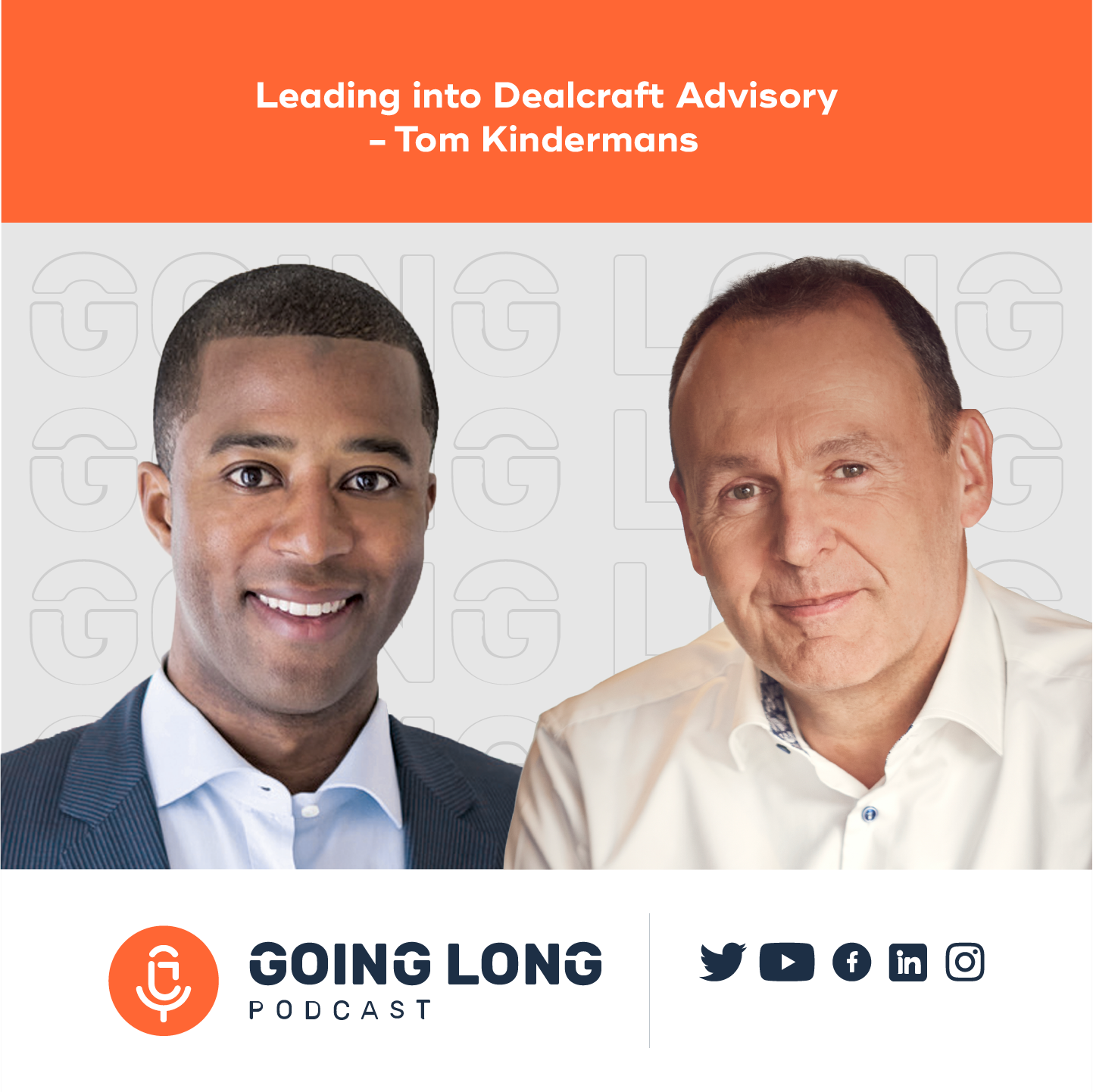
Leading into Dealcraft Advisory - Tom Kindermans

Going Long Podcast Episode 635: Leading into Dealcraft Advisory - Tom Kindermans
( To see the Video Version of today’s conversation just CLICK HERE. )
In today’s episode of The Going Long Podcast, you’ll learn the following:
- [00:24 - 02:27] Billy welcomes and introduces today’s special guest, Tom Kindermans
- [02:27 - 07:09] Billy asks Tom to share insights into how he came to be exploring opportunities for greater optionality in his life and what that looks like presently.
- [07:09 - 09:25] Tom describes how discipline is part of how he got to where he is today.
- [09:25 - 12:30] Billy asks Tom to explain how to navigate the day to day experiential changes of leaving corporate life behind.
- [12:30 - 18:57] Tom explains how he has been able to lead and share his point of view in a way that is widely accepted.
- [18:57 - 21:17] Billy asks Tom to explain the links and differences between ethics and compliance in entrepreneurship.
- [21:17 - 27:30] Tom describes the various impacts that living abroad has had for him.
- [27:30 - 26:28] Tom explains what he has been able to leverage from the wealth of experience he has as a senior corporate leader to help others today.
- [26:28 - 35:44] Billy asks Tom to share some advice for those who are still in corporate who are looking to make their first moves and take their first actions towards moving on.
- [35:44 - 44:10] Tom tells us all about what he does at his company, Dealcraft Advisory, and how they are serving people today.
- [44:10 - 46:47] Tom shares the message that she would like to hear from himself three years from now.
- [46:47 - 48:50] Billy sums up all we’ve learned from Tom today and asks him to share the best ways we can get in contact and find him online.
- [48:50 - 49:37] Billy wraps up the show.
How best to get in touch with and find out more about Tom Kindermans:
LinkedIn: https://www.linkedin.com/in/tom-kindermans/
If you're a corporate executive who wants to make your role optional, then grab your FREE ebook with Billy's proven 3 step process at: www.makeitoptional.com
What you can expect to get out of this ebook:
- Learn how to achieve corporate optionality
- Gain true control over your career
- Turn corporate skills into personal assets
With 26 years of experience in corporate sales leadership, achieved optionality through multiple income streams, Billy has helped dozens of executives build their paths to take control of their time.
This free ebook gives you everything you need to identify, plan, and take control of your career while building financial optionality, leveraging your skills, and start living your IDEAL day - today!
Go to: www.makeitoptional.com
Click the above link or just copy and paste the following directly into your browser to sign up and get your free ebook: https://www.makeitoptional.com/?utm_source=podcast&utm_medium=social&utm_campaign=p2olm
To see the Video Version of today’s conversation just CLICK HERE.
How to leave a review for The Going Long Podcast: https://youtu.be/qfRqLVcf8UI
Be sure to connect with Billy! He’s made it easy for you to do…Just go to any of these sites:
- Website: www.billykeels.com
- Youtube: billykeels
- Facebook: Billy Keels Fan Page
- Instagram: @billykeels
- Twitter: @billykeels
- LinkedIn: Billy Keels
Episode Transcript
Billy Keels 0:00
Today's episode is sponsored by Billy Keels Advisory Services. If you want to learn more about how to make your 99 optional, just go to make it optional.com Once again, that's make it optional.com
Speaker 1 0:14
helping you build freedom without losing your edge. This is the Going Long Podcast with Billy Caels.
Billy Keels 0:27
I know I say every single time I love what I do in this podcast, and you know what, I absolutely love it, because I get to speak to some of the most amazing people ever, like anyone who is like a former corporate senior leader who's created optionality during their corporate lives, that's also even special, even more special. And today's guest, he's done this not once, but he's done it twice, and he's recently transitioning from corporate into entrepreneurship, I like to call it business ownership. He's most recently he was the managing director of SAP Central and Eastern Europe, where he oversaw 26 countries, man, that is just unbelievable. But this guy's travel schedule is also unbelievable. I know he's going to tell us more about that. He previously held roles as a global vice president of channel sales, as well as senior vice president across application solutions, as well as channels, and he's also even had senior leadership roles at other companies, like Siemens Communications at Canon, as well as Ansys. I'll let him tell the detail around that, and he's also proud husband and father, and he is the founder of Deal Craft Advisory, who is a consultancy that focuses on go-to-market deal crafting and negotiations. It gives me great pleasure to welcome to today's conversation mr. Tom Kindermans. Tom, welcome to the show.
Speaker 2 1:46
Thank you. Thanks, Billy. Happy to be here.
Billy Keels 1:48
Yeah, man, I'm.. I'm.. I don't think you're as happy as I am, because I am so excited for the Going Long family to know more about you, your story. I know I led with some of the, some of the things in the beginning, but just seeing, and as I talk about optionality, and just knowing that you embody that, I really want to have the go-around family find out about more about your story, and so I have to just start kind of like even almost at the end point, not at the beginning, but at the end point, because I mentioned before, not only have you been able to create optionality in your life, not once, but twice. But it brings us to the point of, you know, every corporate relationship at some point ends, right? It's whether you decide, or whether the corporation decides, or the entity decides. And so, maybe you could give us a little bit of insight into your most recent decision to explore options and live this portion of your part of your optionality. Yeah,
Speaker 2 2:45
well, the first sentence you, you mentioned here in the, in the podcast, Billy was, you love what you're doing, and it's, it's about loving what you're doing, and I dare to say, when I look back at my career, I loved every single phase of it, and this doesn't mean that every day is just fun, but it means overall when you look at what you're doing, you have a feeling of, hey, it's satisfying, I really, really like and enjoy what I'm doing. Now, there is also a moment that the well, everyone has bad days, you're not, not every day in a year is successful, is fun. Everyone has bad days, and that's good. There are bad days, because then you can appreciate the good days. When everything is constant, it gets boring, and that's not what we want to. But it's always good to stand still, and to look back on what you're doing, and to say, look, or the fun, the very good days, or they're dominating the few bad days that I have, and once this balance is somehow skipping in the direction that you have the feeling that it's, it's, it's less fun than it used to be. I think that's the moment you need to consider to end that phase in your career, and that can be a corporation, it can be a company, it can be anything, it can be a sabbatical, and that's actually where optionality, you call it, is so extremely important. It's actually once you come to this conclusion, what are the options, what is next, and that's the point where I came to a beginning of the year, where after nearly seven very successful years in my previous role at SAP, where I said, well, I have some optionality. It's, it's probably the right time to change something.
Billy Keels 4:25
In, you know, as it relates to that, there's a certain amount that I would say many times you could move towards optionality, but it also takes a bit of courage to recognize and say, okay, listen, maybe it's not exactly where I want, and you get to a point where you have to make a decision. It's not always easy to make a decision, especially, and there are a lot of people that are, that are watching and listening, that have been in the, you know, say enterprise software space, or they are in telco, or in, or in pharma. These are very similar. Bubbles, and it can be difficult, even though you know that you can make that choice to actually make that choice, because there's so many other priorities, let's say, that are vying for your, for your attention. How do you, how do you push through what could many could potentially see as fear or the security?
Speaker 2 5:21
Yeah, yeah, well, um you mentioned the name Courage, and I think it requires some courage to take these decisions. Mainly, you always know what you leave behind, you never know where you're getting into, so it requires some, some courage also, because when you're a longer time in the same corporation, in the same role, it's a bit of a comfy situation, you, you know the environment, you know what to do to be successful, you have a good network, and that's that's also the danger that you get into this comfort zone and that you're not alert anymore, and I think that's actually also the right time where you need to ask your question, Am I still the right person for the role, maybe there is somebody who can do it better. I was successful in the past, but it does not give you the guarantee that you will be successful in the future. And I tell you, the courage and the fear is less when you have the optionality, when you know that there are several options in front of you in your future, then taking this decision is less a jump into the unknown than when this optionality is not there, so I had the luck when I took this decision that the optionality was there. Secondly, having a career which spans over, let's say, more than 30 years, it also gives me a certain financial independence, so I don't have any mortgages or I don't have an expensive lifestyle, and I'm not really needing a job in order to survive in my life, me, my family, my friends, and people around me, which gives it also, I think, a bit of easiness to take this kind of decisions,
Billy Keels 6:59
and I appreciate where you're coming from on that, Tom. I am going to, because I know you will appreciate this slightly push back on one of the things that you said, because I think, based on the way that you've just said it, there could be a an idea that what you did is really easy to do, but I'm going to guess that in order to be in the position that you're in, you have also had that discipline must have played some type of role in allowing you to get to the point where, where you are right now, and if that's the case, can you maybe give us some insight into to what that that discipline looks like?
Speaker 2 7:40
Yeah, well, the discipline is also to be honest with yourself, and if you come to the conclusion that some people in the market might be more suitable to do the role, then you need to be honest for yourself, and then it's actually a logical step, I would say, but the logical step is never easy, so in that sense you're absolutely right, it's never easy, and I was also fearing that I was going to miss it big time, because I really, really enjoyed my corporate life, and it was, it was really good fun. I often repeated I'm in a corporate role for fun and success, and I found this actually throughout my career, and and always really enjoyed it. So, when I, when I left the corporate world, which was on the on the 19th of January, my biggest fear is that I was going to miss it. Now we are exactly today, four months later, I didn't miss it at all, and I'm looking back with a lot of satisfaction. I'm still having a lot of friends in the in the company. It was, it was a very smooth exit with a with a fantastic goodbye party, so I'm actually leaving the corporate world with a very good feeling. Does it make it easier? Yeah, maybe it does, but it was, it was not easy anyway. So, if I leave here the impression that this was a walk in the park, and and a decision, which was taken impulsively, not at all. It was a conscious decision, but it was not an easy decision. And now, after four months, I dare to say it was the right decision.
Billy Keels 9:10
Yeah. And now, and when you can look back with some perspective on that, it's, it's very helpful as you pass that that experience forward to others. Now, I guess, for me, it's been.. it's been a while, right? It's.. I can't even believe it's almost been four and a half years now for that person that's going through the fun, as you talked about the fun and success. That was something that always.. that I was excited about when I was going into my corporate role. There's also two.. I don't know if this has happened to you yet, but there's that moment, like once the maybe for you it was january 20, right, the day after you no longer have your login and stuff like that, but where the phone maybe doesn't ring quite as much as it used to ring, or the emails don't come in quite as much as they used to come in, and there's not this that you have to get something around. Have you gone through that, and if so, how have you navigated? That that day after, because it's a, it's a shocker, at least I found it to be a shocker.
Speaker 2 10:04
Yeah, well, I had a bit of a three months leeway, because officially my last day was 19th of March, so I had actually three months to climateize. I'm not sure if this is an English word, so I still got my login, I still few things, so in that sense, it was more a soft landing than a sudden landing, and the fact that I prepared this decision already for a few months means that I was also mentally prepared to fill my days with other things, because that's probably also one of the fears you talked about. Fears, it's a the next day, what will you do? But I had the idea to create this company, Deal Craft Advisory, which I did in the meantime. Commercial activities will start from September onwards, because it requires a lot of very active preparation. I'm in a few advisory boards of companies. I announced one additional one today, which is an Armenian company. Very proud of that. My son has a very successful scale-up company, where I'm not an investor and have absolutely no official role, but I'm always available if I can help him. So life is good, and it's not a corporate role anymore, but I have the impression that every day is a very useful day, and I can make myself useful based on my experience, based on my now, how, based on my network, and yeah, really enjoying it.
Billy Keels 11:31
Yeah, and so I love that, and this is one of the things that, that you, as you've talked to us about, you know, where you are right now, even though that you know, and I love the way the fact that you were able to prepare that soft landing versus that the day after, and it's like, oh, hang on a second, but also one of the things that I know about you, and I know that there are lots of viewers and listeners, more listeners right now, but when we're in our corporate roles, there is this tendency, we're doing our role, we may have this desire to do some things to create this optionality that we're talking about, but we don't really want to talk about the thing that we really want to do, right? So we're in our day job, we're over performing in our role, and at the same time we have this desire to create something on our own to create that optionality, that's sort of the idea, but more than that, it's being coherent with who we are as individual, as an individual, as a person, and one of the things that I've known about you as a leader in a very highly visible type of role is that you have continued to excel in the roles that you have been in at the highest leadership levels, and at the same time you've been able to also be very true to who you are as a person and feel that it's okay to share your point of view on things that may not be related to the specific leadership, and the reason I talked to you about this is because it's always one of those things that, like, I had a job when I was working at SAP, but I was also building this business on the side, but I didn't want anybody to know that I was building a business on the side, because I thought that they wouldn't think I was, I was committed, but I was going to Hawaii, I was seeing people all the time, but there was this thing that I didn't really want to share, now that was the example, but also from a leadership perspective, across 26 countries, in your most recent role, you've continued to help lead people from many different backgrounds, many different ideas, and at the same time, you continue to be true to who you were and be able to share your opinion, which sometimes people feel that they can't when they're in a corporate. Can you talk to us about that specific part of your what I'll say is coherency and being able to lead and share your point of view and do that in a way that is that was widely accepted.
Speaker 2 13:52
Yeah, well, I wouldn't say it was widely accepted, but definitely it was staying faithful to myself, and this was always a conscious choice, so this was not something where I wake up and impulsively I will do some posting on social media, not at all, which I later regret, not at all. It's a conscious choice to stand up for, for who I am, for my conviction politically, but also to do to do right for the world. I think I'm a very ethical person, and I dare to say at any moment in time I can look in the mirror and said I tried at least to do the right things for humanity and the world, and for those who follow me on the on social media, where I'm, by the way, very active, I'm very outspoken about my, my opinion about, for instance, the Russian war, and I will continue to do so and support Ukraine unconditionally in what they're doing there. I'm very outspoken with some other political opinions, which I have, where I believe. If it's standing up for what is right, I have zero tolerance for bad behavior, for corruption, for any of these zero, and I dare to say I made good money in my life, but every single penny I made, it was made in a very, very almost official way, and I would not even consider to let one hour of sleep because I made money into, in a shady type of way, so, so, in that sense, I stand up for that, and I will never change this, and I dare to say it was sometimes a nightmare for my communication team, because they are not used that executives are so explicitly coming up for, for their opinions, political and others, and it was not always easy. So, as I said in the company, I had some pushback. Outside of the company, I had several times the remark, "Hey, Tom, is it clever what you do now? Why are you doing this? What is the upside for you? Should you refrain from doing that? My opinion is no, because I mean, when you stay silent when bad things will happen, you're part of the problem, and the evil people only get successful because the non-evil people shut up, and that's actually the type of group I want to be part of. Yeah,
Billy Keels 16:13
and Tom, is that something where you feel like that, that it was, you know, because it is, it's it's a different thing, and it's the same, right? In that you have this thing that you want to talk about, but you don't talk about it because you're afraid of the backlash. Is that something that you learned at home? Is that something that you've learned to grow into and feel much more comfortable and confident with?
Speaker 2 16:35
Yeah, well, yeah, it probably 20 years ago I might not have acted this way, because somehow there was always a fear of backlash, so that that somebody will will punish you because you do that, that somebody will take kind of revenge, that and I have some of these bots, which are also now on social media with all kind of threats coming to me, I just delete them, I never react to them. I'm actually quite cool in these things, but, but you're right. It is, it is like a side of my personality, which was growing, I would say, the last 15 to 20 years, where I say, look, I see it as a, as a role of every human being to stand up for what is right, and, and, and again, I continue to do so, and the only thing I regret is that I didn't do it earlier, so, and I believe I would encourage everybody to do the same, and to stand up for what is right, and also openly communicate for what is right, of what you believe is right, and the backlash, it, you, you will, you will make enemies, that's clear, but we are not here on planet Earth to only make friends.
Billy Keels 17:44
Yeah, no. And I love what you said, like for you to stand up for what you believe is right, which, which is a, which is also an important piece, right? It to be able to have also healthy debate, to be able to talk about things, and most importantly, to be able to share your opinion. What role, and I would not, this wouldn't be the optionality. We wouldn't be talking about optionality if I didn't ask this question, but what role do you believe also feeling that you have this well, not feeling, but having the optionality to be able to say, well, okay, well, if this goes the wrong way, then it's okay, but I have achieved a level of optionality, or achieved a level of of confidence to be able to to speak my mind that play a role, would you say, or is that something that's,
Speaker 2 18:29
yeah, indirect unconsciously I think it does, because you come in on a certain, a certain moment in your life career where first of all you're more self-confident to express your opinions, and secondly, you care less what negative potential negative consequences, although I don't think there are a lot potentially negative consequences could be, or might be.
Billy Keels 18:54
Okay, yeah, appreciate that insight. Now you said something that's really interesting, and I want to dive into it, if it's okay with you, because you mentioned, and I know probably a lot of people don't even think about this, especially when you're in a, let's say, you're in a corporate role, but as you go from the constraints of corporate into this new world of business ownership, or entrepreneurship, however you want to call it, there's a really fine line of something that you were talking about before, like being very ethical and being very compliant. I think people use these words interchangeably, but I have a feeling that you know a lot more about it, and you more than likely have a feeling or a strong opinion about that.
Speaker 2 19:38
Oh yeah, I think ethical is doing the right things compliance or compliant, you can be very compliant, but doing the wrong things and being very unethical. One does not guarantee or exclude the other, and I believe ethics is still a much higher level than compliance. Compliance is, is actually respect. A set of rules, which are defined by people, but no, nothing says if these rules are the right ones or not. And ethics is at the higher level, because there it's really at humanity level to be ethical. And for me, the rules of ethics are universal. The rules of compliance are company-related. And you, I mean, let's give you a stupid example. You can have a drugs business, for instance, and define a set of rules, and you're very compliant with your, with your own set of rules. So, you think, hey, everyone who works in my drugs business is very compliant, yeah, but you're not doing an ethical business. The same can be said of many other businesses, so for me it's the for me the highest, let's say values to comply to, or the ethical values, and much more than internal compliance of company, which, which is, does not give you any guarantee of ethical behavior.
Billy Keels 20:59
Okay, yeah, and I love that example. It's a really good example. So, thanks for sharing that. What role I didn't really mention this at the beginning, but you know anyone that goes through, and there I would suggest you go check out Tom's profile, especially on LinkedIn. He's going to tell you other ways where you can get in touch with him, but I usually see a pattern, and it's a pattern that you possess in that, as you were European-born, you have lived in Asia, and it's on your, on your profile. You've managed businesses across Central and Eastern Europe, and if they check out your LinkedIn side, you'll even see that some of your family members are living on other continents. What role do you believe not just traveling abroad, but actually living abroad has helped you as it relates to leadership and also the ability to do things that are different, meaning Tom, there's lots of companies that would love to have you in a senior leadership position today, but you're choosing to follow your own path. What role does living abroad do you believe play in, in, in that?
Speaker 2 22:11
Yeah, I mean, I would recommend everyone who is, who is ambitious, who wants to make a professional career, but not only professionally, even even develop as a human being to spend some years in another country, and I had the blessing, the luck to already to leave my country, for it's in the meantime 27 years. So I left Belgium, which is my home country, to Germany, where I lived for seven years, then moved from Germany to Singapore, six years, four years, Hong Kong. Now I live since eight years in Prague, in Czech Republic. So I'm a bit a digital nomad, to call it this way.
Speaker 3 22:48
And I think
Speaker 2 22:49
every single experience to live abroad, to build up your network abroad, to meet different cultures, is an extremely enriching environment. And I think the most interesting one was still Asia, and when you take Asia, Asia is not homogeneous, it is, it is a mixture of actually hundreds of cultures, but the way you do business, the way you communicate, the way you motivate, the way you interact with an with an Indian, with the Chinese, with a Japanese, with a Korean, it's with a tie with the Filipino, it's so different, and understanding what, what are the triggers is such an interesting part of life that I believe my 10 years in Asia were from far the most interesting ones, and that's also why I'm still partially in love with with the Asian continent, and I spend there also now that I have more flexibility, quite some time, still have a house there, and it's still, it's, I think, one of the most interesting parts of the world, because it is not homogeneous, and it's so different.
Billy Keels 23:53
Yeah, and so, having lived on, you know, myself, on a couple different continents, four different countries, over the last 25 years, but not as, as diverse, let's say, as the countries that you've just named. How much, and even if you had a home base, you were traveling to those, those different countries. How challenging was it initially to be able to adapt as you're living abroad, and you're going from, you know, I'm just thinking out loud, from, you know, South Korea to the Philippines to Japan to China. Initially,
Speaker 2 24:24
yeah, yeah. Well, first of all, you need to arrive in these countries with an open mind, and definitely not that from your reference framework. You come into these countries and you, you believe now you will teach them how they need to do business, how they need to interact. I think that's the biggest mistake you can make, and I saw it happening many, many times. I mean, I will not mention any countries here, but clearly, the bigger the country, and the least the country is exposed to international, to other countries, to other cultures, the bigger the danger. Is there that you walk into a country and you think that that's how they need to act? Probably I was the luck to come from a small country, Belgium, with only 10 million inhabitants, and even within Belgium with a with a big diversity that I was always listening, observing. I was also preparing my visits, I was I was reading that I do not make mistakes, and I also made several mistakes in the cultural mistakes, which is unavoidable. But anyway, I tried actually each time I was visiting a country, and even today I'm doing this, that I understand a bit of political landscape, that I understand what's going on in the country, and even when you do that, and you show to your, the people you meet in this country, for business or private that you're interested in the country and that you're, you're prepared and that you know something about their country is already opening the door and the acceptance to a big percentage. So that's what I did in the past, that's still what I'm doing today. Even today I understand these cultures better, but I'm always, always preparing myself to visit these countries. Last week I was in the Philippines, I was in Thailand, I was in Turkey, and I'm going there in a certain way, prepared,
Billy Keels 26:10
and here
Speaker 2 26:12
we talked about courage when you leave the corporate world, optional, Billy, etc. There is also quite some courage when you change countries, and when you move internationally for your job, or even privately, it's quite a courageous decision, which you need to take, and I think it requires even more courage than changing corporations. And what do I mean with that? I mean, it's always good to go into these discussions and to say, hey, I want to go abroad and I want to move and I want to develop my career, but the day you need to pack your suitcases and leave your friends and your family behind and tell your kids well, your friends in school, say bye bye to them and build up a life at the other side of the world, it requires a lot of courage, and not only for yourself, but also for the people in your immediate orbit.
Billy Keels 27:06
No, absolutely, absolutely, it's.. it makes so much, it makes so much sense. I'm glad that you also talk about that, because it's not just an individual move, is it affects those that are that are closest to you. So, I think it's not one of the things that we haven't really touched on, but I would like for you to bring some, shed some light on on that, and just help us to understand this. After a very successful corporate career, and there's also you mentioned there's some things that you've done in the past that you continue to do, and I believe that there's a lot of times where we have lots of skills that are being developed and we don't even recognize it, and then when you decide that you're in a corporate role and you move from corporate and you decide to build your own business in parallel or you make a jump, there's a lot of transferable skills that we tend to not even think about that we are very fortunate when we're working in large multinationals that we are developing constantly. Number one is that something that you can recognize, and if so, Tom, what are some of the skills that you developed as a senior leader in a very large multinational that are serving you as you build out your company, your network, your ecosystem today.
Speaker 2 28:24
Yeah, so you know that for the moment I'm working with some startups with some scale-ups, which is very interesting. I really like it. Usually young people full of energy, full of great ideas, who are coming up with some solutions, which where I'm extremely positively surprised, what they, what they pulled together, and with a lot of creativity and energy. Though there is one area where I said I learned this throughout my career in corporations, where they are nearly all lacking experience or lacking now, how? And it's how to make money with these solutions, and that sounds very simple, but that's that's what it's about. Bottom line, when you build a business, so, and the number of times that I'm mentoring some of these startups, scale-ups, and there's the full focus is on their solution, and they said, how wonderful they are, extremely proud, and rightfully so, on what they built. And then you ask the question, yes. Explain me your business model. What's your margin? How will you make money? What is your go-to market strategy? How will you penetrate the market? Define your accessible market, and these are all questions. When you worked at the senior level in a corporation, these are basics. I mean, without that, nobody, nothing moves, but that's something where the whole startup and scale up phase still has a lot of space to improvement of improvement and I think that's also where the complementarity with with people like me is is very important because that's basically what I what I teach them where I help them
Billy Keels 29:56
yeah I love that so not only is it so we. Talk about the things that you're doing as a senior leader, you're understanding the go-to market, understanding the basics. It's the simple monetization and the profitability of a company. Therefore, you can stay in business. Do you find that that happens more from the founders that are self-funded or versus those that have received funding from the outside that they're still fine?
Speaker 2 30:21
I mean, at least 90% of the companies I'm in touch with in the startup scale up phase or non-self funding. I need to do funding rounds, and, and this also, how to prepare for these funding rounds. What are the arguments? How can you convince your investors that you will get into the black numbers, when you will get into the black numbers, because let's face it, even in technology these days are over, that you can do an exit without when you're still pre revenue, even when you're pre profit, it is getting more and more difficult, that there have been different times, but I dare to say now valuation of your company is driven by top line growth and writing black numbers, and that's actually the phase they need to get into, and if you want to have external funding, that's actually the plan you need to be able to present to your future investors.
Billy Keels 31:15
Okay, I appreciate you digging into that. There's one other question that I really want you to get us to tell us more about Deal Craft Advisory, because that's like, I know that's your, the thing you're really focused on today, but what would you say to that person who is, and I always am in the premise of number one, I really enjoy my corporate role, like I said, and I can't say this enough, I was consistently overachieving, you know, what we call the Catalyst program, or was traveling to a winner's circle, all these kinds of things, right? Not every year, but pretty frequently. But at the same time, like, there was this thing that was pulling me to have me build on the side while I was performing, not like not saying not performing, this is I'm talking to you, you're performing, and Tom, the person maybe has something else that they want to be able to do with the excess time or the excess energy that they have. They don't want to go to the gym, they want to do something else. What would you say to that person, like, as they're deciding where to make their quote unquote bet? Like, what are the things that they should be listening to if it's the potentially the right thing for them to even be able to follow, because sometimes it can just be like everybody around you is like, don't do anything else except that,
Speaker 2 32:28
yeah. Well, I mean, during the last seven years, I had several times this, this, these ideas in the style, if I had time now, that's what I would do, yeah. And, but of course, when you're, when you're caught into your very demanding corporate role, you don't have time for that. And I really, I didn't build anything on the side, because I was so busy 24 hours a day, seven days on seven. I was always on, always ready to take a call, to take, to answer emails, etc. There was simply no space to develop whatsoever, but during the last seven years, at least 10 times, I had the idea, assume I had more time now, that and that, and that I would do so. To come back on your option optionality, it was not with New Craft Advisory, and I can explain a bit what, what, what I am doing there now, but New Craft Advisory was one of the, I would say, many options, and assume that I have now more time, I probably would develop a second or a third option, but I also need to keep the focus, so you cannot do, you know, when you do too many things in parallel, you do a bit of everything, you're scratching the surface, but you don't do anything to the end, and that's also why I don't do that, New Craft Advisory is the initiative I want to make it work, and I can, I can tell a bit about this. Yeah,
Billy Keels 33:47
and definitely I want us to dive into that. So, Tom, just really quickly, what's the one thing that you are enjoying, because, like, what it's what I call the corporate busyness, like it's in, and because you know we make choices, and the higher you are up on the org chart, the more challenging it can become, right? Because you're, you got 26 different countries in your example, and maybe you're doing other things as well. But when you, when you think about now, not Deal Craft Advisor, because we're going to talk about that now, but like, what is the one thing that you are enjoying the most about not having the corporate busyness at this phase in your life.
Speaker 2 34:26
Yeah, but what always drove me is fun and success, and this didn't change. And success is something I mean, it's a kind of a drug. Let's face it, you, it's like an adrenaline shot you get, and I need to work in an environment where I can feel that I achieved some successes, celebrate these successes, etc. and and I'm pretty confident I will reach this point with Deal Craft Advisory as well, although I'm still having some months of work, but again, I'm going commercial first of September, it's not yet on my LinkedIn profile, it's still. It's not a secret project, everyone. All my friends and family knows about it, but it definitely is not
Billy Keels 35:05
going to be a secret anymore, because once
Speaker 2 35:07
it shouldn't. But let's say it's not yet ready for prime time.
Billy Keels 35:12
Gotcha. Okay, okay, yeah. So, but at the fundamental basis, it's, you know, being able to enjoy the moment, have fun, and celebrate success. Okay, that makes sense. So, and we've talked around it a little bit, we've talked around it, but now I want you to let's, let's really dig into it. So, you had this moment, it was one of the many different options that, when you said when you had time, you wanted to really pour into it. We know that you're doing advisory and things like that, and now you're going to focus on this one area. The thing that you said earlier, before that, I just want to add here is when you have a diluted focus, you get diluted results, like when you were talking about that earlier. That's the thing that you made me think of. And so now in this season, you're very much focused on Deal Craft Advisory. Talk to us, Tom. What's the genesis of it? Where was it born? Who, who, what individuals, what companies are you going to be helping with Deal Craft Advisory?
Speaker 2 36:08
Yeah, well, let me go back a bit in history. I always had a passion about negotiation, and negotiation is actually how to get to a win-win, and negotiation, not only from the sales side, also from the purchasing site, or let's say, in every environment that that you come to a deal, and I was fascinated how the human factor is making a difference there. And in times of AI, I know that every every human activity is now questions, can AI take this over? But there is one area, which is negotiation, which I still believe the human factor is extremely, extremely important, and it's already for the last six seven years that I felt like my experience, the techniques I'm using, the structure I'm bringing into a negotiation. One day I want to do something with this, I want to write a book, or I want to give a training about it, etc. So now that I had the time, I said, "Hey, that's what I'm gonna do now. And in the last four months, I developed, you can call it the training course, it's called Negotiation Excellence in a Corporate Environment. I plan also maybe to write the kind of an ebook about it, which supports the training, and I'm giving the first try out of the training on the sixth of June, so the program is quite finalized, so I will give the first tryout training to a diverse group of people, maximum 10, who joined the training, and I will collect feedback. Does it resonate? Is it good? Is it well set up, etc. And I give a second one, which is in-house training in a corporation on the third of July. I do this clearly for free. It's a tryout, and I want to actually collect a feedback to optimize this one day training program. And the first of September, I want to go commercial in two ways, one is in house in companies who want to improve their negotiation skills, purchasing site, selling site, every site you can imagine. Secondly, I will offer it in open seminars, and I have I have the right space for that, which is a nice villa on a golf course, which will be a training center with a pool where they can combine it, where companies can combine it, participants can combine it with some fun, with some barbecue, with a round of calls, with some good food, etc. And consider the training also as a kind of a motivational factor for the company. So it's a very simple idea, and this idea will be linked to some of the consultancy, which I'm doing, and they're actually, I'm still working, how the two can be, can be linked with each other, maybe with a kind of a combined program training plus consultancy, but that's still in a very immature phase of implementation.
Billy Keels 38:57
Okay, so what I want just to stop the going along. Family is, I want you to hear what Tom is saying right now. Like, he is very much, you know, a senior executive from a very large company, and at the same time he's in his phase of optionality, and he is genuinely and very intentionally taking an idea that he's got in his mind, and he is openly testing it, and he is testing that because he has the idea, but he needs to understand if the.. and I don't want to take words out of your mouth, but what I want everybody to understand is you have to test your idea, if it's a genuinely an idea, and it's okay, it doesn't have to be perfect, and I'm kind of talking to my past self, Tom, because there's this idea that if you're going to go out and you're going to do something, that you have to have the idea perfectly. Everything has to be ready from day one. There's a framework, there's a structure, and then you've got to test the structure, because maybe what Tom is thinking to himself, that's not what the market wants. Mm. So I mean, I'm just, I'm sharing with the Go Long Family, because I want to just, really, I love what you're sharing with us here, Tom, and it's about breaking this belief that everything that we do has to be like the perfect thing from the very first time. Is there anything you want to add to that or build on that, Tom?
Speaker 2 40:15
I mean, that's also why I do tryouts, exactly because it is not perfect, and it will not be perfect from the beginning, but I want that it's a, that it's that's like a minimum viable project in software, you in the implementation you use the term minimum minimum viable project, and that it must be, and then once you can, once the train is rolling, you can optimize it, and once the train is rolling, so the first module is now negotiation excellence in a corporate environment, is the title, but I have at least five other ideas of other modules, which can be added to, let's say, other wagons, which can be added to the train. What, for instance, is forecasting in a corporate environment? How you do forecasting, financial forecasting, based sales forecasting, how you improve your forecasting process, that's another training I have in mind. I didn't start yet, it's still the page is still completely blank, but that's another idea, that's another wagon, which I want to hang on the train, and then there are some other thoughts of other wagons as well, but the first and utmost important thing is that the train rolls,
Billy Keels 41:19
yeah, no, and I, yeah, there's so much great, you know, great ideas, and just the fact that things don't always have to be perfect, and it's just great to hear the, the idea, when you have an idea, the idea must be tested, which is very different than the services or consultancy that Tom has, which is that's based on pure experience and expertise that doesn't need to be tested, that's already been tested for three plus decades. So it's really helping us to understand what is truly an idea that needs to be tested versus what is already intellectual property that you have gained over 30 plus years, which you should never give away for free ever, because that you've spent a lot of time, that's just me putting my own opinion out there, and because that is something that you have worked a really long time to be able to identify. Tom, there's one thing that you did not mention, but I'm also wondering, how much of when you think about negotiation that you have is also pattern recognition, because you've been in 1000s of negotiations, you didn't mention that specifically, but I always think about, like, okay, well, you see what's happening now, you've already seen this so many other times, so you're able to recognize certain patterns in negotiation, is that a fair statement as well?
Speaker 2 42:36
Yeah, well, look, negotiation is a craft. Nobody is born as a negotiator. It is something you can, you can learn. There is, there were tools, there were techniques. I wouldn't call them tricks, because tricks are getting into the more less ethical environment, but it's definitely a skill to be learned, like you learn how to play tennis, or to play golf, or to learn a language, and I think that's actually where, where the combination of, of knowing the toolbox, knowing the framework of a negotiation with examples out of my personal career, this mixture I think is what, what will make my training quite unique, and and that's actually where I'm, I'm focusing on
Billy Keels 43:20
fantastic, well, is there is there anything else time that you wanted to add on? I think
Speaker 2 43:25
from first of September, you're all welcome to join. Of course, I will. I will make some announcements on the social media during the next, the next months, and I would be delighted if some of the audience of your podcast, Billy, is showing some interest, because I'm, I'm convinced that it will show immediate value for every participant of in the training negotiation excellence in a corporate environment.
Billy Keels 43:50
All right, fantastic. We're going along, going along. Family, you've just heard it. You've heard from the man himself. You have, you have an invitation, so no. So that's excellent. Listen, Tom, I am well, you know, I was going to ask you another question, but I guess it's.. I can't believe that this time goes by like it literally flies by. You've experienced lots of life, right? You have experienced a lot of, a lot of highs in life, and you've also experienced lots and lots of opportunities that that tell you in life, well, hang on a second, things are not necessarily going to go according to plan. So the thing that happens is when things are going really, really well, we tend to not think about it because they're going really, really well, but when things are in the kind of like the low moment, the things that we think are going to never, it feels like those moments are never ever ever going to end, because they're just less positive now. You and I both know you are in a new phase of life, in this new optionality outside of the corporate life, and you are openly sharing with us that you are having new ideas. Is imagining new things, and you want to test new ideas. Well, of course, I'm sure a number of those are going to go work really, really well. And you know, between the ideas you have, and maybe these things in life don't go according to plan. I want you to think, Tom, I want you to really project three years from now, three years ahead from now, and I want you to look back, and I want you to look at those moments that were the down moments, and you and I both know at those moments you're really going to need to tell yourself something to get you out of the rut, not all the other people that care about you and are there to support you, but you yourself are going to have to look into the mirror, and you're going to have to tell yourself something. What is that one thing that you know you need to tell yourself, Tom, so that when you're looking back three years from now, you're going to go, Tom, you know what, I'm so glad you shared that with me, because I absolutely needed it to get out of that rep. What is that one thing you know, that one sentence you need to share with us?
Speaker 2 45:53
Turn the page, and what do I mean with the turn the page? It's absolutely justified, you feel you feel bad, you feel down, you suffer. Life works against you. This happens to all of us. So, do not ignore it. Suffer when the moment is there to suffer, but once you climb out of that, and everyone climbs out of that, there is a certain moment you need to turn the page, and you need to say, well, now life is rosy again, and now I'm with full energy, with with a positive spirit. I'm tackling life again. Turn the pages by one word, and to come back on the moments where, where life is serving you very well, and your unhappiness, etc. I think that's the moment you have to be grateful.
Billy Keels 46:42
Love it. Turn the page, turn the page, Tom. I like, look, man, I feel like we just started this conversation a second ago, and we did, like, time just flies by. I feel like we just started the conversation. You're saying that you really wanted to focus on, you know, love exactly what it is, what you're doing, not just have fun. You want to have fun and success, and you got to multiple moments where you had the courage to be able to not just enjoy a comfortable situation, but also be able to move on from a comfortable situation, asking yourself those questions, like, is this the right moment to do what it is that you wanted to be able to do. Now, fortunately, you had the discipline that you put in and instilled in your life to be able to say, hey, listen, I'm at a point where I don't have a mortgage, I don't have these types of things, I am living in a state of optionality, and right now, at this phase, or this moment of your life, it's really about being able to take those three plus decades of experience living on multiple continents, leading organizations across multiple countries and different cultures and different languages, and being able to say, you know, what I want to take a lot of those transferable skills, and today, aside from helping startups and advise them in certain capacities, I want to be able to put my own role together, my own dream, my own imagination, and doing that through Deal Craft Advisory, and so I know that I know I get to stay in touch with you anyway, but I know so much of so many of the Go Long family really want to understand, how can we get in touch with you, Tom? How can we find out more about the services that you offer, as well as what what you have going on at Deal Craft Advisory?
Speaker 2 48:14
Yeah, yeah, well, I mean, I'm very active on social media, mainly LinkedIn, so all the listeners, they can all connect to me on LinkedIn, and I think that's that's the best way to get in touch with me. I mean, the email at Deal Craft Advisory is a bit more complicated, because a lot of domain names were already taken, so well, I will not try to express this here now verbally, but I think LinkedIn is the best media to get to get in touch with me.
Billy Keels 48:39
All right, fantastic. So everyone, Tom Kindermans will include his link in there in the show notes. Tom, I think we'll also include the show notes, the email address, if somebody wants to write to you directly. And what I just like to say, man, is thank you so very much for deciding to invest your time with me, with the entire Going Long family. Really appreciate you investing your time today. Thanks, Tom. It's an honor to be part of it. Thanks a lot, Billyy. All the best. All right, perfect. Thank you so much. And go along, family. Thank you very much for investing your time with us. We'll be here, I'll be creating and preparing for the next episode. So, until then, go ahead and make it a great day. And thank you very, very much.