
Leverage Your Corporate Ecosystem with Integrity - Sana Asher

Subscribe to the podcast


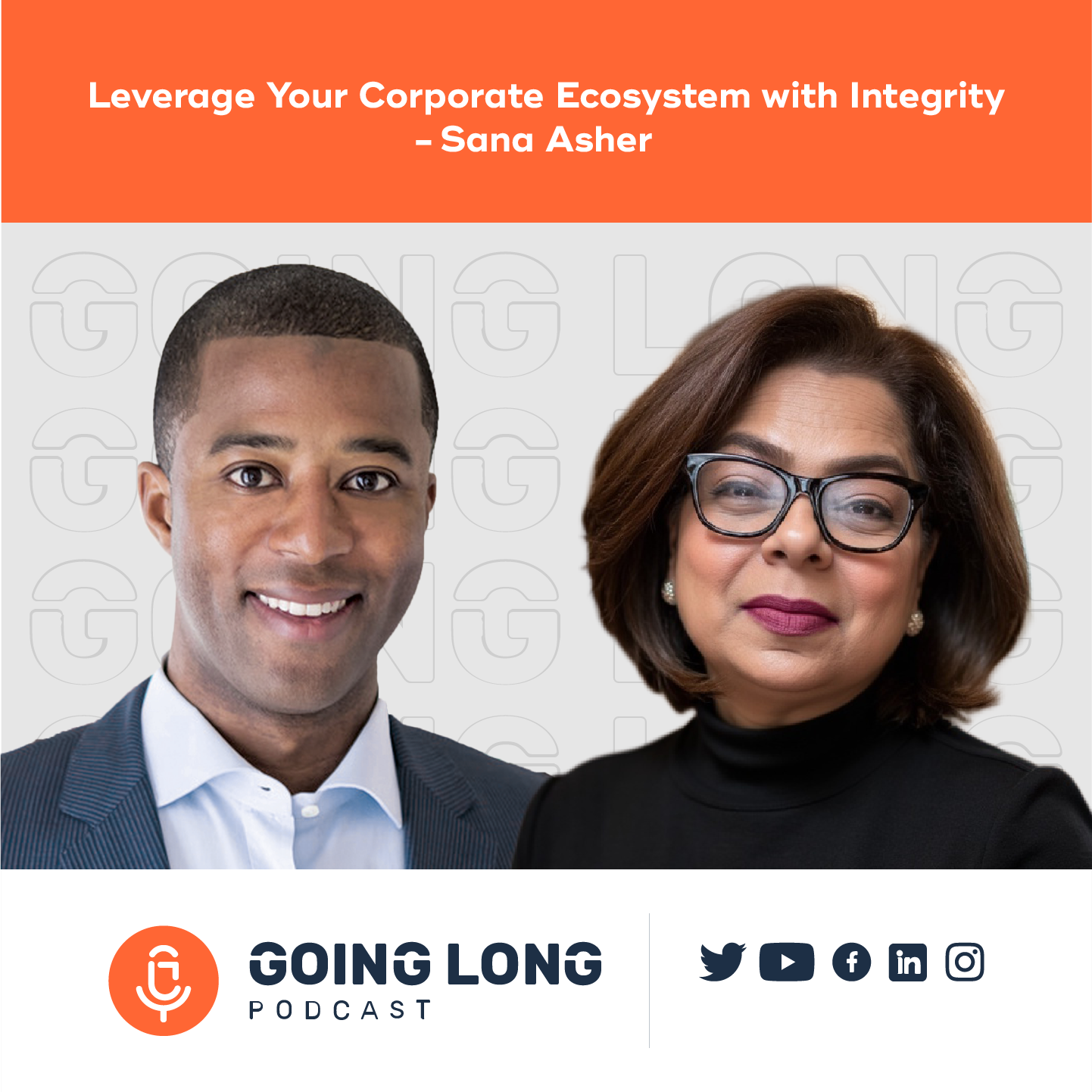
Leverage Your Corporate Ecosystem with Integrity - Sana Asher

Going Long Podcast Episode 616: Leverage Your Corporate Ecosystem with Integrity - Sana Asher
( To see the Video Version of today’s conversation just CLICK HERE. )
In today’s episode of The Going Long Podcast, you’ll learn the following:
- [00:24 - 02:43] Billy welcomes and introduces today’s special guest, Sana Asher.
- [02:43 - 12:05] Billy asks Sana to share more about herself and her backstory in her own words.
- [12:05 - 17:00] Sana shares why she was looking to go somewhere else and move into entrepreneurship when she was already in a comfortable and successful position, and how that move played out.
- [17:00 - 23:00] Billy asks Sana to describe the reasons for wanting to pursue a career overseas and the benefits that it brings.
- [23:00 - 26:00] Sana shares what the crux issue was that drove her to take action.
- [26:00 - 34:28] Billy asks Sana to explain all about her SAP masterclass and related books that she authored.
- [34:28 - 36:08] Billy asks Sana to share the message that she would like to hear from herself three years from now.
- [36:08 - 38:23] Billy sums up all we’ve learned from Sana today and asks her to share the best ways we can get in contact and find her online.
- [38:23 - 39:212] Billy wraps up the show
How best to get in touch with and find out more about Sana Asher:
Website: https://masterclasswithsap.com/
LinkedIn: https://www.linkedin.com/in/sana-asher/
If you're a corporate executive who wants to make your role optional, then grab your FREE ebook with Billy's proven 3 step process at: www.makeitoptional.com
What you can expect to get out of this ebook:
- Learn how to achieve corporate optionality
- Gain true control over your career
- Turn corporate skills into personal assets
With 26 years of experience in corporate sales leadership, achieved optionality through multiple income streams, Billy has helped dozens of executives build their paths to take control of their time.
This free ebook gives you everything you need to identify, plan, and take control of your career while building financial optionality, leveraging your skills, and start living your IDEAL day - today!
Go to: www.makeitoptional.com
Click the above link or just copy and paste the following directly into your browser to sign up and get your free ebook: https://www.makeitoptional.com/?utm_source=podcast&utm_medium=social&utm_campaign=p2olm
To see the Video Version of today’s conversation just CLICK HERE.
How to leave a review for The Going Long Podcast: https://youtu.be/qfRqLVcf8UI
Be sure to connect with Billy! He’s made it easy for you to do…Just go to any of these sites:
- Website: www.billykeels.com
- Youtube: billykeels
- Facebook: Billy Keels Fan Page
- Instagram: @billykeels
- Twitter: @billykeels
- LinkedIn: Billy Keels
Episode Transcript
Billy Keels 0:00
Today's episode is sponsored by Billy Keels advisory services. If you want to learn more about how to make your 99 optional, just go to make it optional.com. Once again, that's make it optional.com.
Speaker 1 0:14
Helping you build freedom without losing your edge. This is the going long podcast with Billy Keels,
Billy Keels 0:27
hosting this podcast is one of the greatest joys of my life, because I get to meet some of the most amazing individuals who have been in the corporate ecosystem, outside the corporate ecosystem, and they're continuing to make impact, and today is absolutely going to be continued par for the course, as we like to say, because one of the things that I've started to realize is that when you can understand your corporate ecosystem today, it will allow you to create business opportunities for yourself tomorrow. You just have to be paying attention. And Today's guest has actually done this absolutely perfectly. And so she has been at a point in her career where she was around many different markets, especially the enterprise software market, and she's worked from within the ecosystem of one of the largest and I know she's going to talk about it, this one that I know very well, where today, she's taken all of that experience from the past, and she's now enabling organizations to modernize, innovate and grow to the adoption of not just business process improvement. Author, also through enterprise software. And it gives me great pleasure to welcome to today's conversation the VP, Vice President of integrity, resource management, none other than Sana Asher. Sana, welcome to the show,
Speaker 2 1:42
Billy, thank you. Thank you so very much. I am. I just I'm so excited by your enthusiasm and the way you present it, and you know, that's kind of what got me. So thank you. I appreciate you having me here.
Billy Keels 1:54
Yeah, you know what? And just from the very beginning, so much of you know, we talk about how we're investing our time and how we are leveraging the past. And you know, you and I have met recently because of what you have been doing, how active you've been, especially on the LinkedIn platform, I've been watching a lot of the things that you have been doing, and had a chance to, you know, meet you and speak to you. And it really felt like this is the opportunity I really want to help more people understand about how you can recognize what's happening in the corporate environment, having the experiences that you have, and, you know, making decisions to say, Hey, I'm going to take all of this experience and I'm going to be able to do something very similar in a way that makes the most sense for you at the point of your life. And so I just, I really am so excited for everybody to understand more about your story. So let me just go ahead and be quiet, I want to turn it over to you, actually, Sana, because I really love for you to tell us more about your story, your backstory, tell it in your own words, and then we'll see kind of where you and I take the conversation from there. Does that seem fair?
Speaker 2 2:54
That sounds fair, all right. So let's, let's do a rewind, right? Let's do a rewind, you know, like three decades ago. So I am originally from Bombay, born and brought up in Bombay, and did some schooling in London. And in 1993 had just finished my masters and decided to come to the United States with my husband. That's kind of where I started my career. Just before that, I had worked also with Xerox, and believe it or not, my father wanted me to go to a home science school. And so I'm not afraid to say, Billy, I'm 56 years old, and when I was growing up home, science was a thing about you go and you learn about how to cook and how to present the dishes and and how to make your table look amazing. And you know, all the good stuff, right? All the what the good girls would do. And I actually, truly was a rebel. And I said to my dad, I'm like, Nope, I'm not doing a home Science School. I'm going to go to a bachelor's in science, and then I'm going to go do a marketing, you know, like a MBA. And he's like, who even does an MBA? You were never going to do a business, I mean. And he himself was running a business at that time. But of course, as you know, the ceiling always was, women can't do it. And I'm like, No, I'm going to go do it. And that's exactly what I did, right? So that was, like, the number one thing that I was like, No, I'm not going to listen to what you're saying. I'm going to kind of chart my own life. Was it easy? I you know, no, of course not, right? It was very different from what he wanted me to do to then what I thought I wanted to become. So that started that journey of, you know, trying something different than what I wanted to be or what the world was telling me to be. That was step one, right? Step two was, so, you know, I did my math, you know, did my bachelor's? Did my master's got a position with Xerox where I was working with them. It was an on campus recruitment, and we worked with them. And I, you know, Billy never sold to anyone. I would just talk to everybody, right? And I'll give you an instance, you know, in Bombay. So I. Yeah, there is a very dense business district, which is in southern Bombay, and that was my territory, in with Xerox. And at that on that territory, I probably had 1000s of offices, you know, 1000s of, you know, like hundreds of people who were doing, if you remember the word Xerox, which was called photocopying, right? And they would have photocopy machines, and that that was a business that was a living. They were making like a storefront, right? And they would take copies, they would make passport pictures and things like that. And whether it was that person I was talking to, who was a shop owner, or whether it was a corporate CFO, I would just talk to everybody, and believe it or not, I was the only woman in the Xerox team, and I was the number one sales person for entire Asia for 1991 92 and I'm going, Wait, I didn't even do anything. And everyone kept asking me, saying, What are you doing? And I'm like, I'm just talking to everybody. They're like, What do you mean? You talking to me? Talk to them. I'm like, talk to them. I'm like, No, I'm just talking to everybody. So that made me understand that people want to be seen, they want to be heard, they want to be felt like people. And that's what I would do. I would just go, I would talk to them. I'm like, Okay, what's, what's your story? Like, what's going on? You know? What do you need? And that's how I was, I was doing it right? And then fast forward, I came to the United States. I started my career with PeopleSoft, which then became Oracle, and I was with people so for a couple of years. And when it became Oracle, I was like, okay, you know, maybe time to look at something different. And it's so interesting how I came into the SAP ecosystem. A friend of mine said, you're going to look, you know, leave people soft, and people soft, obviously, is very, very big. Then I'm talking 9596 at that time, right? And she's like, Have you heard of a sap? I'm like, No, I have no idea what is SAP, right? And I did the exact same thing that I hit people on their hands today. I said, SAP. She goes, it's not sad, it's SAP. I'm like, Okay, I remember that. So that's how it started. And she's like, You know what, you should, you should go talk to them, or you should see if you can work within, you know, the SAP ecosystem. I'm like, Okay, then let's, let's go do that. And I actually reached out to a couple of people that I knew within, you know, within my network, but didn't know too many people. I was very, very new in the United States, but through somebody else, God referred into a position where they were looking for a, you know, a territory manager or a sales person for their SAP clients. Okay, and I had no idea what SAP did. I had no idea what SAP was. I had no clue nothing. I was just like, walking in, okay, fine, it's another software. We'll figure it out. That was, that was the notion, right? So I go in there. And the, you know, incidentally, this is, this is funny. This is how life, like, becomes full circle. The client they have is Xerox, lo and behold, out of Rochester, right? And these guys are a regulator. And they're like, Okay, you know what? We don't have a salesperson on the account. We have a number of, you know, people, a lot of projects going on. I'm like, Oh yeah, Xerox, I know at the back of my hand, I've worked at Xerox, they're like, really, I can handle it. But I had no idea, Billy, what the hell I was getting into, because everything was like, Greek and Latin, right? Did not know it, so got into the company, went and worked with Xerox, and used my past experience of Xerox, of just talking to people, we grew that account, Billy I honestly from maybe 15 consultants to over 350, consultants in about two years.
Speaker 3 8:44
Yeah,
Speaker 2 8:46
and that growth was not growth about going and selling an S, O, W or selling, you know, people. It was all about what is the problem you were trying to solve. Again, talking to people, right? And mind you, I had no idea of what SAP was, right, no clue, but I found a number of really good consultants who kind of guided me to tell me, what is SAP? Fi, CEO, what is SD? What is mm? And SAP was just getting its momentum. This is early 2000 white Okay. Was happening, and that's how I actually learned. I learned from people who were in the job, and I would make notes of what they would do, and then I as one of the
Billy Keels 9:29
things that you're just saying right now is and it's so it happens a lot of times, right? And it's already cut you off, but it's because you're talking about something that's real you. You're talking about learning by doing. There are execs that I talked to today that there's like in this theoretical world, and I was in my own theoretical world for such a long time, like building a business on the side. And it's so important to hear you say, and so I just wanted to reiterate that it's Thank you. You know you talk about learning by actually doing. Yes, there's a place. Theory. And actually, at the time you go from the theory to actually, how do I apply what I'm now learning so that I can really get the experiential learning? So sorry, sorry, but I just, I really wanted
Speaker 2 10:10
to spot on with that. And Billy, I did it the other way, right? I actually learned it, which was interesting. So that was the beginning of my SAP career. And you know, ever since then, I didn't look back. I, you know, was able to understand business outcomes with SAP being that vehicle, right? So that, that is what clicked for me. And as I mentioned before, right? It's all about people. It's always about people. It's not about software, it's not about technology, it's always about people. And, you know, I started growing in my career. Went from, you know, one opportunity to the next 2008 I had my first taste of being an entrepreneur. So there was entrepreneur journey, first entrepreneur, and I was like, You know what? Let me, let me try this. You know, I've never done it. Let's, let's give it a shot. So I took an SAP product, used it to create an additional extension, and worked on it for about three years. And it was, that was a time when the market had just crashed the mortgage.
Billy Keels 11:24
I know, were you? Were you in your role? Were you in your role at the time when
Speaker 2 11:28
you had this idea? I was actually, I had just started my company. It was September. It was August, one, 2008 and September is when this happened, if you remember?
Billy Keels 11:40
Okay, yeah, so it was in September, but were you still working within the ecosystem, and you
Billy Keels 11:44
were doing your thing on the side? Okay, perfect, perfect. Because
Speaker 3 11:47
I think this
Billy Keels 11:48
is really important, because a lot of times we get where when we're in our corporate roles, yeah, there is a tendency to say, Hey, listen, I'm in a corporate role, especially when you're in sales, and you talk about enterprise sales, and whether you're on the sales of actually the software or the sales of the service, it's still the same pressure of sales and sales leadership, right? And so a lot of times people would say, well, Sana, hang on a second. You're doing this thing and you're in we know that you're driving growth, and you've given outcomes all the time. And so why in the world would you actually even think about trying to do something on your own when you've got this amazing thing? Because everybody from the outside is like, Sana, what? Don't wait a minute. Hang on. A second. You've got this amazing thing. Why are you doing something else? Can you dive into that? Because it's like, sort of the premise of a lot of what we do
Speaker 2 12:28
here is, yes, absolutely. And you're asking the same exact question my husband asked. He goes, You're completely crazy. So one of the things I Billy, that I have seen, you know, growing up, you know, in India, in Bombay, being around so many women,
Speaker 3 12:43
one
Speaker 2 12:43
of the things that I realized very, very early on, you know these fairy tales, and I'm sure you've heard it too. Oh, you know what, you are, this amazing Princess, you are in this in this tower, and a prince is going to come and save you. I'm so sorry. Wake the heck up. No one's coming to save you. Okay, this bullshit about everyone giving the narrative to, you know, to woman especially, right? Oh, you need a male mentor. You need a male counterpart. You need someone to show you the way. No, you absolutely don't. Women are creators of the universe. It's only through women you have life. So if we are the creators, why the hell are we stopping ourselves by not creating? And that stuck with me, and I was like, You know what? I'm going to change that rhythm. I'm going to not let anyone tell me what to do. And I also saw Billy on the on the same note how women were being treated. So I'll give you a real life example, right? I was a salesperson. I was driving growth. I had become an account manager, director of sales. I had done, you know, I'd gotten to that at all. And when I still had this delivery leader, this pre sales leader, who would be with me, right? Oh, you don't know how to solution this. Oh, you don't know how to do this. And one day I said to him, I said, I just want you to know if I didn't sell, there's nothing to deliver. So please remember that
Billy Keels 14:19
that's the that is the classic line. So everybody, when you think about the corporate P and L, is that if there is no sale, nothing else happens, right? So in the in the good and the bad in that, right? Because it's one of those things
Speaker 2 14:31
that nobody
Billy Keels 14:32
wants to talk about the sales team. However, if the sales team is not doing their job and doing it in an in the right way, then nobody else has the opportunity to even go to work
Speaker 2 14:42
exactly right? And you know what? Supporting another woman is a different story. That's that's different. This is not about supporting this is always making her feel, Oh, you're not good enough. Oh, who the hell gave you that you know, right to say, I am not good enough that? No, so that is kind of what we're. Going on in through my head. And I said, I have to give it a shot. So I did it come 2008 became an entrepreneur, took the SAP product, ran it for a couple of years, and then got acquired by a company called Virtua. I'm sure you've heard of them. They're about a billion dollars plus. And, you know, they're an SAP practice, so worked with them for a little bit, you know, transitioned everything, worked with them. And at that point I was like, Okay, I did the entrepreneur journey was amazing. I there was days I did not have money to meet payroll, but these are people that I knew who would trust me, and they're like, We trust you. I we know you're not going away with our money. So when people give you this LinkedIn post about, oh my god, success is amazing. Oh my god, I woke up and I have 10,000 followers, please shut up. That is not true. You have to work at it every single day, and not just on one channel, which is LinkedIn. You have to work at it through, you know, with your friendships, with your relationships, with your colleagues, with people who work for you, people who work with you, with your clients. And it's a continuous cycle. It's not waking up one single day and saying, Oh yeah, I look at me, I just woke up and I'm so successful. Yeah, no. It's
Billy Keels 16:18
one of those things that it definitely and if someone tells you that they did it overnight, you probably want to run the other way, because it's just, you know, it takes work. If it was, if it was simple, or if it was easy, sorry, if it was easy, everyone would be doing it. It can be simple, right? And I'm a big believer that things can be simplified. But if you don't show up every day, if you're not consistent about the work that you do, then it's, then it's just, it's just not there, or it's not something that's going to be real. You mentioned something in the very beginning, and this is something that I can relate to a lot. And you know, as I work with more and more senior leaders, there's this concept of, and this is more about the just working in your role, yeah,
Speaker 3 17:00
that
Billy Keels 17:00
there is a desire to have an overseas experience, right? You talked about your early days being born in India, then you took that experience to the UK. You took it from the UK to the US. I'm from the US. I've lived in Europe for the last 25 going on 26 years, and I remember in the beginning, I didn't have family and all that kind of stuff. I just traveling by myself. But there is this moment where most of the people that you're surrounded with, if you grew up in a certain town, they kind of think that you're like, wild and out there, like, Why in the world would you ever leave? Oh, yeah, and a lot of corporate senior leaders that I talked to today, there's this desire, like, I want to do this overseas thing, but I'm not really sure yet. And like, can you talk to that? Because I've talked about it before, and it's a scary moment. And at the same time, when you make it, there's so much greatness on the other side of it, at least, that's my perception. And I would love to know what your your perception is of that overseas, that immigration experience and living abroad and learning language and culture and all that kind
Speaker 2 18:01
of stuff. Yeah, absolutely. I think everyone should do it at least once in their life. Absolutely. And I tell you what it'll do for you. It'll bring you out of the comfort zone and make you realize who you really are. Look in the grand scheme of things, Billy, we're all just specs in the dust, right? Think about it. We're nothing more than that, but our egos are inflated, every single one of us, right? It's a huge it's a great exercise in your ego. Check, seriously, it truly shows you place here or nothing.
Billy Keels 18:35
Just on that point, I was talking to a really good friend of mine yesterday, and we talked about the fact that four generations, just in your own family, four generations from now, unless you are like, they probably won't even know your name. They won't remember your name. And so when you think about that, and you take the to your point, when you take the ego out of the equation,
Speaker 2 18:55
correct,
Billy Keels 18:55
you start to realize like, Oh, wow. You know what the impact that I can make is like for right here and right now. So sorry. So it was just because I was literally talking to a friend
Speaker 2 19:04
about this yesterday. Spot on. You were spot on. So for anybody who is contemplating doing a career or a opportunity overseas, my advice always is, do it. And you know the motto of my life, Billy has always been, you know, the three words that Nike has for years and years and years, just do it, right? I never think about something, because I believe, when you think about something over and over and over again, you start doubting why you are going to do it. And you start looking at different excuses. If you just do it, you get into it, you do it done, and then, like, Oh, shoot. How did I get that done? Like, what did I do? Your mindset, your entire focus, your zen moment, is just doing it. You're so focused on the doing nothing else matters and and that's the focus. You know you want to go you want to go with. So, yeah, continuing from my story. So. Sold to vatsa, you know, went back into corporate America. I don't know what I was thinking, Billy, but I did do that. I was like, Okay, let's go back. And something weird happened. And I shared this with you when you when I first spoke, everything was going well, no problem. But in 2023, August, I actually, literally had a panic attack. Billy and a lot of people, and I've heard this over the years, so I'm one of those people who's as guilty as other people. When you listen to someone saying they've had a panic attack, I used to just foo for it. I'm like, seriously, how can you have a panic attack? I mean, it's
Billy Keels 20:40
not a thing. That's not a thing
Speaker 2 20:41
exactly. It's not a thing exactly, right? That's exactly how I used to feel until it happened to me. And it's so weird, right? Like, I've heard different people talk about panic attacks. I've heard how things happen, but what happened to me was, really, it was bizarre. So I was having a conversation with my husband. We were, it was, I think, six, seven o'clock in the evening. We were talking, you know, we were on our backyard, we were having a drink, and I just felt this feeling of someone just kind of choking me completely, just choking me, right? And I had like, no air. I was talking mid sentence. I had no words coming out. My husband's like, what's going on? I completely paled, went completely white, and I was motionless, like, just like dead, if you want to say the word, right? I mean, I was breathing, but I was just dead. I think it probably lasted maybe 2030, seconds, but obviously it felt longer in that moment for sure, I did not even know what's going on. So, you know, you know, he got me back, got me water. He's like, let's, let's just go to the ER. So we went to the ER, and, you know, they started monitoring my heart rate, blood brain, and they're like, Oh, you were having a panic attack. And I'm going, oh shit. All these times I've been fooling everybody else. And I was in the hospital for about a day and went, but I was there Billy, that's, that's when something just shifted for me and and what shifted was all these years of being in the corporate ecosystem of, you know, doing the right thing by the employer you're working with, right because that's what you're supposed to do. That's the loyalty. But looking at the greed, looking at only the discussion of revenue or margin, or, you know, how, how does this person not be in bench. I think it just, it just got to me. It just came all crashing down in those 30 seconds, right? And I had not cheated anybody. I had not done anything wrong, but I had this innate sense of burden, if you want to call it that, right, that, Oh, my God. What am I doing, was there
Billy Keels 23:00
something at that point in your life that had changed? Like, have you taken a step back to see like, because what I find is that there's usually something that is happening that's usually not related to money, but it's happening in related to life that puts us in these moments where we are now thinking about the greater like, the what is the higher purpose? Like for me? And I've talked about it a lot, like I missed my son's third birthday party, and that really put me into a motion of like, I'm out of alignment with my own personal values, and there was something that I could do about it, and and I started questioning things about the decisions I was making in in the criteria that I used to make certain decisions, but it was just an increased height, increased awareness of, yeah, there was happening. So I don't was something like that happening for you as well.
Speaker 2 23:51
So funny, no, it wasn't actually, really. There was nothing going on,
Billy Keels 23:55
okay? Yeah,
Speaker 2 23:56
my entire life, I raised both my kids on technology. So I have two children. My son is 28 my daughter is 23 I was traveling Monday to Thursday, you know the drill. I raised so much technology. I'm not kidding, Skype, then Blackberry, then, of course, iPhone, when iPhones came out, and I would be in any part of the world, but they would always listen to my story. So I never, for a moment, thought, Oh, I'm missing out on my children. I never thought that
Billy Keels 24:22
okay.
Speaker 4 24:22
I never, didn't even cross my mind,
Speaker 3 24:24
yeah, but
Speaker 2 24:25
that moment it was, I was, you know, 53 years old, and I don't know what shifted Billy. I still question it, chemical imbalance. And, you know, yeah, it
Billy Keels 24:39
could be anything, yeah, could
Speaker 2 24:41
be any, any of those things, right? I, at that moment, Billy, I decided that I did not want to work for anyone. I didn't want to be a part of those Hunger Games, if you want to call it, I just didn't want to do it. So that was the turn a big. Turning point in my career at that point,
Billy Keels 25:01
yeah, and so I think this is a well, I don't think I know for sure that this is one of those, another one of those moments of of just understanding for our our viewers, our listeners, is everyone's story is different and the same thing, like Sana and I are both talking about, how do we leverage our previous experience. I had a very concrete moment in time that said, Hey, this is has to change, and sauna is telling you that she had a moment where it wasn't a moment like there was nothing concrete that happened, but what it has allowed us both to do is all of the experience that we had from our corporate we're now using that to be able to go help others in something that you said earlier, which I absolutely love. So I have to get into another part of the of the of the show is, is you're you're using that experience to help others solve their problems, right? And so I know we talked about it, and if you're not watching the video version, you need to check out the video version, because sauna has this really cool like background, and it's got the, I'm not even gonna tell you what it is, because you've got to go check it out. I'm not even gonna go check it out. I'm not even going to tell you, so go look at it. Go check out the YouTube video. But you've taken this and so today, one of the things that I did not mention, but you are an author, there is a specific focus that you're using, and what's also for a company that I invested a lot of my years of my life in. And so maybe you can tell us a little bit. Us a little bit more about the s for HANA playbook that you have, and really, what was the genesis behind that? Because you're using all that previous experience to help someone or some organizations to solve a very specific challenge. Maybe tell us a little bit
Speaker 2 26:36
about that. Sure. Thank you, Billy. So I took that experience and like I said, I took some time off, and I decided I'm like, Okay, what am I going to do with my life? What do I want to do? Do I want to retire? Do I want to just, you know, hang up the head? I was like, No, I'm not ready. So I came up with this, with this thought of helping clients with, you know, a phase zero kind of an initiative. So I've seen multiple, multiple, multiple, multiple, multiple. I can't even tell you the number of clients who start a project, start a transformation, zero planning. Zero planning, right? They got the budget, we got the approval. Let's go right. I'm like, Oh my God. And then when they do do the planning it's like not even valid, because you're getting an SI into a planning phase where you need an independent person to tell you what's right, what's wrong, what you can do. The SI was coming in is coming in with the mindset that I'm going to get the downstream revenue from this specific planning, and I was like, no, no, you need to have independent lenses. So I put together a phase zero advisory, just for some
Billy Keels 27:50
context, because I also want people to understand so when, when Sana talks about the SI, it's the the systems integrator, which is the actual team that takes software and helps them to actually be able to use the software. And sana's experience, would say, after having please fact check me on this, after having worked at six or seven different systems integrators, you're in a very good place to be able to speak to the different approaches and what works, what doesn't work, and things like that. So I just want to give everybody some context, so it's just like you've got lots of experience from different systems integrators. So you know what you're talking about
Speaker 2 28:24
exactly. Yeah, thank you. And so, you know, I said, You know what? No, let's, let's do something for a client which is independent advisory of phase zero. So I put that piece together. I did a couple of you know, opportunities. We went and sold it to a few of our clients, and it worked beautifully. And we're still working on a number of phase zero opportunities. And the big thing I realized there is a deadline that SAP is facing, which is in 2027 that the current ECC, which is enterprise core component software, is going to be end of life. And why is it going to be end of life? Because it's been around for 20 plus years. They've done everything on it, they've maximized it, they've customized it. Everything's happened. So now for the new world, there is cloud, there is a new platform called S for Mona, and I realized that the clients know about it, but there's not enough adoption. And I started looking into the why, the why, the why. Started talking to people, and the why was very simple. It was too expensive to move. I did not know what I was moving to, and why do I need it? And that's when I got this idea of putting together a masterclass. So most SAP journeys, or most SAP theoretical classes, as we talked about Billy in the beginning, was about going to a class for two weeks and understanding it, I'm like, No, let's do a class which tells people what do you get in a specific software for example, if I want to go and implement business technology platform, I don't need to spend two weeks. I don't need to buy the licenses and then do it. Let me come to sana's class spend eight hours. And totally understand what that's doing. So I created that opportunity for even folks who are on ECC, but want to make the move to s4 which is the professionals, the consultants, to understand that, right? And help them make that transition.
Billy Keels 30:17
Yeah. And so the beauty of this, right? So, and if you're in the SAP world, of course, you understand all the things that son is talking about. If you're not what the important part of what son is talking about is that she from her previous experience. Took all I'm just doing a little translation. That's what I like to do here, right? Is, is saying she has this previous experience, depth of experience, you know, decades of experience in the ecosystem, and recognizes that she wants to continue to contribute, and because you want to continue to contribute, when you say retire, I always think, Sana. We barely know each other, but you're never going to retire because you are going to continue to help, help people solve problems. But that's just all. That's a whole different conversation, but recognizing that there was a gap, a problem in the marketplace, with lack of clarity from clients, and whether they be individuals or organizations. And so now the idea that you are continuing to do, because it's something you've done in the past, is create a solution based on your experience, your network, the relationships, the professional relationships that you have to be able to now offer a solution to help to resolve or solve that problem. And so, you know, if you strip all the other the technicisms back, I mean, really, that's what you know, what you're what you're doing right now, how much of being able to have a flexible mindset comes into play with you being able to come up with the right solution at the right time,
Speaker 2 31:41
100% How about that being completely open, right? And that kind of, you know, pivots into the book Billy. So everyone, every time we did the phase zeros, every time we, you know, we did the master classes, everyone would be like, Oh my God, I've done this before. What do I do? And I said, You know what? I need to put everything that I have gone through true stories about transformations and transformations will change you. Look a transformation changed you. You woke up and thought about something. A transformation changed me. So transformation is not necessarily just about a software implementation, a transformation correct is what happens to us humans as we go through life. And I took all my experiences Billy and wrote this book that talks about leaders who make it through a transformation. Talked about leaders who don't make it through a transformation, but how it changes them and experiences on what to do and what not to do, so which is why I called it a playbook. And yeah, that took me about a year and a half to write, and I just launched it in February of this of this year. Yeah,
Billy Keels 32:52
fantastic, fantastic. So I appreciate you sharing that. And of course, we're gonna include links in the show notes. So you know you want to take a look and be able to learn more about the this for HANA playbook, but you also was there a masterclass that you'd mentioned once or twice, and so you want to talk a little bit about that before we get ready to wrap things up.
Speaker 2 33:10
Yeah, sure, absolutely. Thank you, Billy. So yes, I we do offer master classes as well, and it's for individuals, professionals, SAP professionals, who've spent 15 plus years in the SAP ecosystem, and help them transition to the cloud as well as clients who are currently implementing s for HANA, but don't know who to go to. You know how to get a specific topic and control. We help clients as well. And my goal, Billy in general, is to lift everyone together, because I think there's tremendous opportunity for all of us to help each other.
Billy Keels 33:45
Yeah, well, I, I appreciate you. You sharing that there's, there's one last question that I do need to that I want to ask you, basically, is, you know, I learned right at the realm the same time you were having your moment, like in 2023 that there are, you know, everything doesn't always go perfectly. There are moments in life where things don't go according to plan, and when things are going really, really well, we tend to not pay much attention because they're going so well. But when things are not going according to plan, two things happen. One, there is a tendency, if it's not happened before, that you can get you can stay stuck in that moment, because it's just like something you're very unfamiliar with, and as a result, it feels like it takes forever, right? Yes, but, but time is always the same, right? And, but it's how we perceive it that's different. And so you've been through the highs and you've been through the lows, but I want you to project Sana three years from now, right? And you know, you're going to go through some highs, but you're going to go through the lows as well. You and I have both been through challenging situations, and so I would love for you to share with us. Like, what is the one thing? Because, like, I had a lot of people that were trying to help me while I was in those low moments, but I didn't. It wasn't until I actually had a conversation with myself and said, Look, Billy, now is the moment. And I said certain things to myself, and that took me out of that moment. What is the thing that you know that like, what is the one sentence that you know you need to tell yourself? That's going to help you move from that low moment and get you back to the high moment, and so that three years from now, you can look back and go, Sanna, I'm so glad that you said that to me.
Speaker 2 35:08
Absolutely. Billy, remember what I said earlier? No one's coming to save you. That's the truth.
Speaker 3 35:15
Yeah,
Speaker 2 35:15
for a moment especially, we tend to nurture relationships, right? We tend to create relationships. We tend to create life. So our natural rhythm is always leaning on someone else. And my my advice, you know, to everyone who's tuning in a man or woman, but believe in who you are, and no one's coming to save you. You have to save yourself. And you know, what? Is it worth it? It absolutely is worth it. Because maybe you maybe I don't succeed, right? Maybe I become a huge, horrible mess three years down the road, no problem. But guess what? I had the courage to try.
Speaker 3 35:55
Yeah, and
Speaker 2 35:56
that's what matters.
Billy Keels 35:57
It's so much better to or, you know, to live with the fact that you tried something, versus living with the regret of it, that I can assure you. So thank you very much. No one's coming to save you. And I, you know, these conversations literally fly by, Sana, and I'm thinking about you talking about your you and your your father having the conversations. And you're in Bombay, and you know, he's talking about home science, and you're like, well, home science, I'm not doing that. That doesn't work with me. And so you go from from Bombay to the UK, and from the UK, and eventually 1993 you get to the US, and you think, okay, hey, look, I'm going to do these different things. I'm going to go to new areas, and you're going to try new things because you want to try something different, as you said, I would say you didn't try something different. You did something different as you were in sales, and whether it was moving from Xerox to PeopleSoft, PeopleSoft eventually getting into this little known company and called SAP, or SAP no SAP. So you get into that, and you develop great relationships, professional relationships, within that ecosystem. You've had multiple opportunities with different SI systems integrators, and you also recognize having built a business on the side, sold that business, and then getting back into corporate, which you thought, I don't know if this is the thing for me or not, but eventually it was for you, up until a certain moment, right? And what I really, really love about your story is you can even be in your fifth decade of life and decide, hey, listen, you know what? I want to continue to contribute. I want to continue to build my dream, help others solve their problems and their challenges. And everybody's going, Yeah, Billy, will we get all of that? But please just ask Sana the question. So let me just ask you, on behalf of the entire going long family, Sana, what is the best way to find out more about you? What you have going on, how you're helping individuals and organizations, whether that's through the s for HANA playbook or through your master class. How can we find out more about
Speaker 2 37:42
you? You could absolutely find me on LinkedIn. Of course, Sana Asher, I'm on LinkedIn. You could, you know, get reached out to me through my website, masterclass with SAP and advisory with SAP. So there you go. And, of course, contact Billy. Billy will be able to get you in touch with me.
Billy Keels 37:58
Yeah, there you go. Fantastic. And also, to listen everyone, because son has just mentioned it here. And, you know, and you know, you all know that I also like to invest time over on LinkedIn when you reach out to Sana, do yourselves a favor. Just let Sana know you've already invested time listening, learning more about her story, and so you're, you're taking her invitation to reach out, reach out to her directly on LinkedIn. Just say, hey, look, I've listened to the podcast with you and Billy, and it's going to help the two of you continue the conversation in the way that makes the most sense for the two of you. So with that sauna, I want to say thank you. Thank you. Thank you very much for deciding to invest your time with me and the entire going long family today. Thanks so much. Really appreciate
Speaker 3 38:31
it,
Speaker 2 38:31
Billy. Thank you for your time, and I truly appreciate the opportunity for telling my story. You're very kind. Thank you.
Billy Keels 38:37
All right, fantastic. So thanks so much sauna and listen. Go along family. Thank you very much for investing your time with me, with Sana. And guess what I'm going to be doing? I'm going to be here preparing for our next guest conversation. So until then, go out and make it a great day. And thank you